


Once hailed as the land of Rabindranath Tagore and Subhas Chandra Bose, West Bengal today seems to be fighting a battle against itself—its culture, its conscience, and increasingly, its Constitution. Under the rule of Mamata Banerjee and her Trinamool Congress (TMC), what was once an intellectual powerhouse of India is now plagued by violence, fear, and lawlessness. From the disturbing Sandeshkhali incident to the recent communal riots in Murshidabad, and the ever-repeating saga of election-related bloodshed, West Bengal appears to be spiraling into a vortex of political decay.
The Murshidabad Riots: A Communal Tinderbox Ignited
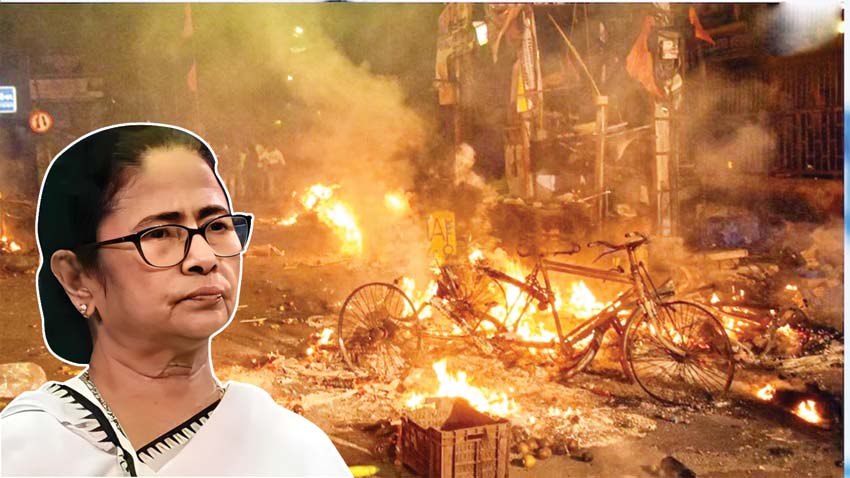
Murshidabad, a district with a long and complex history of communal harmony and tension, recently witnessed horrific communal violence that shook the state to its core. Triggered by an allegedly minor religious dispute during a local festival, the situation quickly escalated into full-blown riots. Mobs attacked homes, torched shops, and clashed with police forces. Several were killed, dozens injured, and hundreds displaced. Videos circulated online showed helpless families fleeing as their homes burned in the background—scenes chillingly reminiscent of Bengal’s partition-era scars.
What’s most disturbing is the alleged complicity of local TMC leaders in either fomenting or ignoring the violence. Multiple eyewitness accounts have pointed fingers at the police for arriving late or standing by as the riots unfolded. Critics argue that the Mamata Banerjee government’s selective silence on the issue stems from political calculations—it fears alienating its minority vote bank by taking firm action. However, inaction in the face of communal violence is not neutrality; it is negligence. The fallout is not just social disintegration but a dangerous erosion of public trust in law enforcement and justice.
The Sandeshkhali Episode: A Tale of State-Sanctioned Exploitation?
If Murshidabad is a story of communal conflagration, Sandeshkhali is a tale of systemic oppression and state-enabled impunity. The remote island region of Sandeshkhali in North 24 Parganas hit national headlines earlier last year after allegations of widespread sexual abuse and land grab by local TMC strongman Shahjahan Sheikh and his aides surfaced. Women from the area courageously stepped forward to accuse Shahjahan and his henchmen for years of brutal exploitation—sexual, financial, and territorial.
The initial response from the state government was shockingly indifferent. While the women of Sandeshkhali protested, pleaded, and marched in the streets, Mamata Banerjee’s government tried to downplay the incident as a politically motivated attack by the BJP. It was only after nationwide outrage and media pressure that action was initiated, leading to Shahjahan's arrest—weeks later.
What does this say about governance in West Bengal? That political loyalty to the ruling party can override law, morality, and basic human decency. The Sandeshkhali episode has exposed a deeply entrenched nexus of local goons, corrupt officials, and TMC politicians who function above the law. And in shielding such elements for years, the Mamata government has not just failed—it has facilitated criminality.
A State Trapped in Cycles of Electoral Violence
Perhaps the most consistent symptom of West Bengal’s descent under Mamata Banerjee is the culture of election violence. Panchayat elections, assembly polls, even student union elections have become battlegrounds soaked in blood. The 2023 Panchayat elections were among the deadliest in recent memory—over 50 people lost their lives in political clashes that turned rural Bengal into war zones.
The irony is sharp: a party that once came to power riding the wave of ‘Ma, Mati, Manush’ now clings to control through ‘Muscle, Murder, Manipulation’. Opposition candidates are routinely assaulted or prevented from filing nominations. Ballot boxes are looted in broad daylight. Voters are intimidated. And police officers, often accused of acting as agents of the ruling party, look away. In many cases, even journalists have been attacked while covering the violence.
Murshidabad Riots: A Deep Dive into the Alleged Nexus of Extremism, Political Complicity, and Illegal Migration
In a disturbing turn of events, the recent riots in Murshidabad, West Bengal, have raised serious concerns about the growing nexus between radical Islamist groups, illegal migration, and local political patronage. What initially appeared to be a protest against the Centre’s Waqf Amendment Bill has now taken on the shape of a coordinated act of violence, allegedly orchestrated by elements within Jamiat Ulema-e-Hind, the Bangladeshi extremist outfit Hizb-ut-Tahrir, and with the tacit support of West Bengal’s ruling Trinamool Congress (TMC).
According to sources close to central intelligence agencies, over 40 sleeper cells of Hizb-ut-Tahrir had been active in Murshidabad for several days leading up to the violence. Murshidabad, which shares a porous border with Bangladesh, has long been vulnerable to illegal immigration and cross-border infiltration. It is alleged that these sleeper cells did not enter overnight; instead, they slipped into the region under the radar of the state government, possibly disguised as migrants—a development critics say points to administrative apathy or collusion.
The political backdrop of the riots is equally unsettling. Shortly after the Centre passed the Waqf Amendment Bill, West Bengal Chief Minister Mamata Banerjee publicly opposed the legislation, vowing not to implement it in her state. According to a statement made by Siddiqullah Choudhury, TMC minister and state president of Jamiat Ulema-e-Hind, Mamata Banerjee even expressed happiness at the massive mobilization of protestors, indicating potential encouragement from the highest levels of the state government. Choudhury quoted a message from the Chief Minister’s Office that allegedly said she was “very happy to see such a gathering.”
The riot itself unfolded in a methodically planned sequence. After Friday prayers, a large unauthorized procession led by members of Jamiat Ulema-e-Hind and other groups marched through Murshidabad in protest of the Waqf Bill. As the procession neared a Hindu temple, it reportedly descended into violence, with mob members vandalizing idols and damaging the temple premises. This moment marked the escalation from protest to riot, with alleged participation of Hizb-ut-Tahrir sleeper cell members, who were said to have infiltrated the protest under the guise of ordinary demonstrators.
The pattern of violence, observers note, mirrors tactics used by the same group in Bangladesh, including targeted attacks on Hindu shops and religious structures. The situation quickly spiraled out of control, with multiple vehicles torched, police vans vandalized, and at least ten police personnel injured. Alarmingly, the riotous crowd even turned on the Border Security Force (BSF)—a heavily armed paramilitary force—raising serious doubts about whether such an attack could have been carried out by unarmed civilians alone. The involvement of trained elements cannot be ruled out.
As chaos reigned, the state police reportedly became mute spectators, unable—or unwilling—to respond effectively. This has fueled suspicions of deliberate state inaction. Further adding to the controversy, Siddiqullah Choudhury recently claimed portions of South Kolkata as Waqf land, doubling down on his opposition to the amendment and stoking communal tensions.
In another alarming statement, a local religious leader was caught on video declaring, “Our fight will continue till Qayamat (Day of Judgement),” linking the current protests to broader ideological grievances like the Triple Talaq Bill and alleged persecution of Muslims and Sikhs under the Modi government. Some analysts interpret this rhetoric as a sign of growing convergence between radical Islamists and Khalistani sympathizers, pointing to a dangerous pan-ideological coalition.
The political fallout from this event has reignited the long-standing debate over the Centre’s hesitation to impose President’s Rule in West Bengal. Many BJP leaders and Hindu organizations are questioning why, despite repeated outbreaks of violence—including the 2021 post-poll violence, the Sandeshkhali sexual exploitation scandal, and now the Murshidabad riots—no central intervention has been initiated under Article 356 of the Constitution. They argue that demographic shifts caused by unchecked illegal migration, coupled with vote-bank politics and religious appeasement, have created a dangerous powder keg in districts like Malda, Murshidabad, Nadia, Dinajpur, Birbhum, and Howrah.
Reports from Murshidabad indicate that more than 400 Hindus from Dhulian area have been rendered homeless, some even forced to take refuge on the streets. Their appeals to the central government for help have grown increasingly desperate. Many fear that if such incidents are allowed to continue unchecked, West Bengal could become an “Islamic enclave” within India, altering the state’s secular fabric and posing a long-term threat to national integrity.
The Centre now faces a critical juncture. If the allegations of involvement by terrorist groups like Hizb-ut-Tahrir, political shielding by the TMC, and radical mobilization by organizations like Jamiat Ulema-e-Hind are indeed proven, then swift and decisive action is imperative—not just to restore law and order, but to prevent future communal and ideological unrest from destabilizing the region further.
This is not democracy. This is terror with a ballot box.
The Erosion of Institutions
One of the most troubling aspects of Mamata Banerjee’s tenure has been the systematic weakening of institutions that are supposed to act as checks on executive power. The state police have been repeatedly accused of functioning as an extended wing of the TMC. The State Election Commission, rather than acting as an impartial guardian of democracy, has often appeared reluctant to challenge the ruling dispensation’s strong-arm tactics. Even the judiciary has faced public backlash over perceived delays or muted responses in politically sensitive cases.
Furthermore, dissent—once a celebrated virtue of Bengal’s intellectual heritage—is now met with repression. Opposition leaders are routinely harassed with legal cases. Students and civil society voices critical of the government face threats. Media outlets that question TMC are either blacklisted or pressured. In this climate, governance has become a game of perception management, while the real issues—unemployment, rural distress, migration, and lawlessness—fester unaddressed.
The Political Calculus Behind the Chaos
OWhat explains this descent into near-anarchy? The answer lies in Mamata Banerjee’s political strategy—a populist model dependent on identity politics, welfare schemes, and patron-client networks. To maintain her dominance, she has created parallel power structures in districts, empowering local satraps whose loyalty lies not to the Constitution but to the party leadership. These local strongmen control everything from real estate to rations, and often through coercive means. Sandeshkhali is not an anomaly—it is a blueprint.
Moreover, Mamata’s reliance on appeasement politics has created dangerous fault lines. In a state where the Muslim population is around 30%, the TMC has often been accused of pandering to religious leaders and overlooking issues of radicalization or communal flare-ups. This balancing act, intended to consolidate minority votes, is now backfiring as communal tensions rise and public outrage spreads across communities.
Public Sentiment and the Road Ahead
What’s striking in the current scenario is the growing disenchantment among the people who once celebrated Mamata Banerjee as the harbinger of change. From the Bengali middle class to rural women, the sentiment is shifting. The promise of 'Paribartan' (change) has given way to disillusionment. Instead of ushering in a new era of transparency and governance, TMC has become what it once opposed—a party synonymous with muscle power and corruption.
This growing public discontent is being capitalized upon by the opposition, especially the Bharatiya Janata Party (BJP), which has made deep inroads into Bengal’s political landscape. While BJP’s rise has its own challenges and baggage, it is undeniably offering an alternative to a regime many now view as autocratic and decadent.
However, the road to political correction in Bengal is not easy. The state’s deep-rooted culture of violence, patronage politics, and identity-based mobilization cannot be undone overnight. What is urgently needed is not just regime change but structural reform: police modernization, institutional independence, judicial accountability, and civic empowerment.
Conclusion: Bengal’s Identity Crisis
West Bengal is at a crossroads—torn between its glorious past and its grim present. The land that once led India’s intellectual, cultural, and political awakening is now mired in violence, repression, and chaos. Mamata Banerjee, once seen as the people’s chief minister, now appears increasingly isolated from ground realities. Her governance model, built on populism and political loyalty, is cracking under the weight of lawlessness and public anger.
If Bengal is to reclaim its rightful place as a beacon of progressive politics and cultural renaissance, it must confront the rot that has set in. That means accountability for Sandeshkhali. Justice in Murshidabad. Free and fair elections. Strong institutions. And above all, a leadership that serves—not suppresses—the people.
The fire in Bengal is real. And unless doused with the waters of justice, reform, and democratic renewal, it threatens to consume the very soul of this historic state.

By NILABH KRISHNA
(The content of this article reflects the views of writers and contributors, not necessarily those of the publisher and editor. All disputes are subject to the exclusive jurisdiction of competent courts and forums in Delhi/New Delhi only)




















Leave Your Comment