


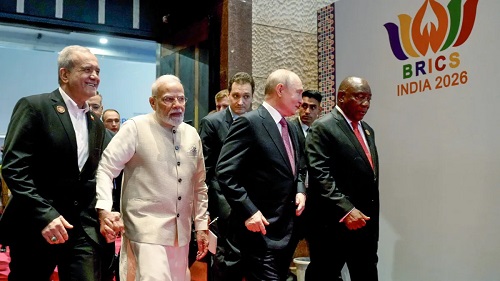
At a time when geopolitical fault lines are widening across West Asia, Europe and the global maritime domain, Prime Minister Narendra Modi used the BRICS platform in New Delhi to project a powerful image of engagement rather than isolation. Walking alongside Russian President Vladimir Putin, Iranian President Masoud Pezeshkian and South African President Cyril Ramaphosa at the BRICS Business Forum, Modi’s public interaction captured the complex diplomatic landscape India is navigating—deepening partnerships while keeping communication open across opposing geopolitical camps.
The optics of the moment were significant. Modi was seen walking with several BRICS leaders along the red carpet, including Putin and Pezeshkian, as the grouping’s 2026 summit got underway in New Delhi. The scene offered more than ceremonial symbolism. It reflected India’s attempt to use its BRICS chairship to bring together countries whose interests often overlap economically but diverge sharply on security and strategic issues.
BRICS has expanded considerably in recent years and now includes 11 members—Brazil, China, Egypt, Ethiopia, India, Indonesia, Iran, Russia, Saudi Arabia, South Africa and the United Arab Emirates. Collectively, the grouping represents nearly half of the global population, around 40 per cent of global GDP and roughly a quarter of global trade.
For India, however, the challenge goes beyond showcasing the bloc’s economic weight. The geopolitical environment surrounding the summit is exceptionally complicated.
Iran remains deeply affected by conflict and instability in West Asia, with repercussions for energy supplies and maritime commerce. Russia continues to confront extensive Western sanctions linked to the Ukraine war. Yet India has deliberately preserved working relationships with both Moscow and Tehran while simultaneously expanding its strategic, economic and technological cooperation with the United States and other Western partners.
This diplomatic flexibility was evident in Modi’s address to the BRICS Business Forum, where he placed economic cooperation alongside the need for a safer global trading environment.
The Prime Minister underlined that the expansion of international commerce depends heavily on the security of maritime routes. Freedom of navigation, uninterrupted supply chains and the protection of seafarers, he argued, cannot be treated as secondary concerns when global trade is increasingly vulnerable to geopolitical shocks.
India’s emphasis on maritime security is particularly relevant as disruptions in key waterways have demonstrated how quickly regional conflicts can spill over into the global economy. For a country that is heavily dependent on international trade and energy imports, secure sea lanes are a strategic necessity as much as an economic requirement.
Modi also sought to give BRICS a more practical economic agenda. He proposed identifying and resolving the grouping’s ten largest trade barriers, encouraging the entry of 100 BRICS startups into member markets each year and creating 1,000 new business partnerships annually.
The proposals indicate an effort to move BRICS beyond political declarations and towards measurable commercial outcomes. India’s approach appears to be that the grouping’s growing economic influence must translate into easier market access, greater investment and stronger private-sector connections.
The Prime Minister’s separate meeting with Putin added another important dimension to the summit. According to the Ministry of External Affairs, the two leaders reviewed bilateral engagement as well as cooperation within BRICS under India’s 2026 chairship.
Their discussions also touched upon conflicts in the Middle East and the Black Sea region, both of which have implications for maritime trade and the safety of Indian seafarers.
Modi reiterated India’s long-standing diplomatic position that dialogue and diplomacy are indispensable for resolving conflicts. He also conveyed India’s willingness to contribute to peace efforts wherever it can play a constructive role.
The message was carefully calibrated. India is neither seeking to become part of competing geopolitical camps nor willing to remain a passive observer as conflicts threaten global economic stability. Instead, New Delhi is attempting to position itself as a bridge—capable of speaking to Moscow, Tehran, Beijing, Washington and other major centres of power.
The BRICS summit therefore presents India with an opportunity to demonstrate that its growing global influence is not limited to economic numbers or diplomatic symbolism. By combining economic initiatives with calls for maritime security and peaceful conflict resolution, Modi is seeking to make India’s BRICS chairship relevant to the real challenges confronting the international system.
The red-carpet image may have lasted only moments, but the larger message was unmistakable: in an increasingly divided world, India wants dialogue to remain open—even with countries standing on opposite sides of the geopolitical divide.




















Leave Your Comment