


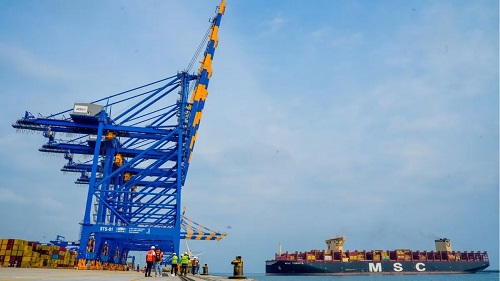
Prime Minister Narendra Modi marked a historic moment on Friday with the inauguration of the Vizhinjam International Seaport in Kerala, signaling a significant stride in India’s maritime capabilities. Situated in Thiruvananthapuram, this deep-sea port stands as India’s maiden dedicated container transshipment hub, catapulting the southern state onto the global naval map.
Constructed at a cost of approximately Rs 8,867 crore, through a collaborative effort between Adani Ports and Special Economic Zone Ltd (APSEZ) and the government under a public-private partnership model, Vizhinjam Port is poised to bolster India’s presence in global shipping and trade routes.
Key Features and Significance
Even ahead of its formal commissioning, Vizhinjam Port has already made waves, handling 285 ships and processing 5.93 lakh TEUs (Twenty-Foot Equivalent Units), surpassing initial performance projections.
Boost to Trade and Economic Efficiency:
By enticing large container vessels directly and diminishing reliance on foreign transshipment hubs such as Colombo and Singapore, the port promises to reduce logistics costs, enhance turnaround times, and augment the efficacy of India’s import-export trade.
Exceptional Transshipment Capability:
Outperforming established global ports in terms of efficiency, Vizhinjam has attracted major shipping lines like MSC, which previously bypassed prominent hubs like Dubai and Colombo.
Large Capacity:
Designed to handle 30 lakh TEUs annually, the port is exhibiting potential to scale up to 45 lakh TEUs per year based on current operational trends.
Strategic Advantage:
Strategically located near vital international east-west shipping lanes and boasting a deep natural draft, Vizhinjam Port offers an ideal setting for transshipment operations.
Early Operational Success:
The port’s significant operational efficiency and international allure prior to its formal inauguration underscore its potential as a pivotal global maritime hub.
Understanding Transshipment:
A transshipment hub serves as a crucial port where cargo containers are transferred from one ship to another en route to their ultimate destination. At deepwater ports like Vizhinjam, large vessels offload containers, which are then transferred to smaller feeder ships for delivery to regional ports incapable of handling larger vessels.
The inauguration of Vizhinjam International Seaport not only marks a monumental achievement in India’s maritime infrastructure but also positions Kerala as a formidable player in global trade dynamics. As India charts its course towards becoming a maritime powerhouse, Vizhinjam stands as a beacon of progress, poised to redefine the nation’s role in international shipping and trade.




















Leave Your Comment