



Prof. Kapil Kumar
In 1770, British soldiers of the East India Company shot dead a hundred Sanyasis in Bengal. This brutal act triggered a prolonged struggle against the Firangis, led by Sanyasis from present-day eastern Uttar Pradesh, Bihar, Assam and Bengal. The uprising, which lasted nearly 42 years, came to be known as the Sanyasi Uprising. Led by Mohan Giri, it received support not only from peasants such as Dheeraj Narayan and Devi Chaudharani, but also from Fakirs such as Majnu Shah. The rallying cry and war cry of this great struggle was "Vande Mataram". From that time onwards, the slogan continued to inspire revolutionaries and freedom fighters in their struggle to liberate the motherland.
Vande Mataram was originally a Stuti of Goddess Kali, which Bankim Chandra Chatterjee is said to have discovered among the records maintained by the Pujari of a temple at Lalkot. The local Zamindar of Lalkot had supported the Sanyasis, whose struggle the British described as a rebellion. Bankim, who was posted there as a British official, recognised the significance of this devotional invocation as a war cry against British rule. He subsequently gave it a wider national and political expression through his celebrated novels Anandamath and Devi Chaudharani. At a time when the British were teaching a distorted version of India's history, Bankim used the medium of literature to bring suppressed historical narratives before the people and awaken them to continue the struggle for freedom. Following the publication of Anandamath in 1882, Vande Mataram became an immensely popular slogan, particularly in Bengal.
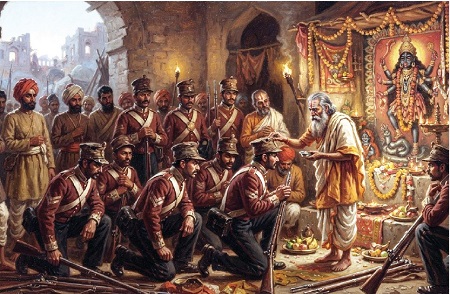
We do not find references to Vande Mataram during the First War of Independence in 1857. Nevertheless, it is important to recognise the significant role played by Sanyasis and Sadhus in planning the resistance, creating awareness, carrying secret messages and actively fighting the British. The worship of Goddess Kali was also prevalent in several cantonments of the East India Company, where Indian soldiers sought her blessings before raising the banner of freedom. We also find an account of a priest addressing Indian soldiers shortly before the assault on Kashmiri Gate in Delhi in September 1857. The speech is worth reproducing here: “No white-face can move out, Therefore advance your batteries without fear. The camp shall be destroyed like Lunka by fire; Increase the number of your guns. By the grace of Bulbhudder and Ramchunder The camp shall be annihilated. Fight without intermission day and night; Protect from injury our mother the cow. Offer sacrificial food to Joala Maee and Bhovanee, And distribute it among the Brahmins. Present daily an offering of fourteen cows. I have serutinized the leaves of the book, Nirput Jee Jurria, and ascertain that Suneechur (the god of vengeance) Has descended upon the heads of the English. Offer sacrifices to Sunneechur; See what a moment will bring forth.”
Throughout the freedom struggle, religion and religious texts remained powerful sources of motivation in the fight against the British and their local collaborators, including the Brown Sahibs.
In 1896, Rabindranath Tagore composed the music for Vande Mataram and sang it at the Calcutta Session of the Indian National Congress. This was a significant event, particularly considering that the Congress had traditionally hoisted the Union Jack at its sessions and sung the British National Anthem, "God Save the King". It is equally important to remember that, by the mid-1890s, the Moderates within the Congress were increasingly being challenged by leaders such as Bal Gangadhar Tilak, Bipin Chandra Pal and Lala Lajpat Rai.
When Lord Curzon partitioned Bengal in 1905, Vande Mataram once again emerged at the forefront of the movement to awaken and mobilise the people. Singing Vande Mataram to draw strength from the Motherland and inspire resistance against British rule became a regular feature of public rallies and demonstrations. Bipin Chandra Pal and Lala Lajpat Rai transformed the song into a powerful rallying point for the freedom movement, with Lala Lajpat Rai also popularising it in Punjab.
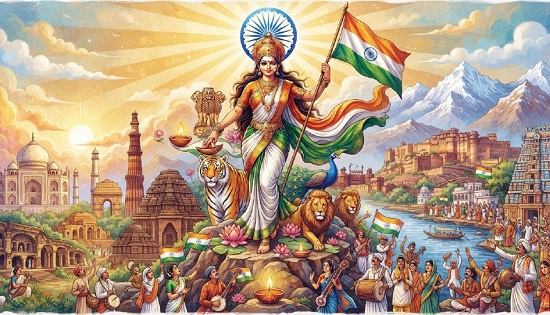
Although the concept of Matribhumi and the idea of the motherland have deep roots in Indian tradition, the worship and popularisation of Bharat Mata as a powerful national symbol received a major impetus from Vande Mataram. The song is not merely a prayer extolling the virtues of the mighty Mother; it is also an appeal to her to protect and liberate her millions of children. It invokes the blessings of the Mother for those who have taken up arms in her defence, while celebrating her strength, compassion and magnificence.
The revolutionaries did not merely draw inspiration from Vande Mataram; they translated its spirit into action. Aurobindo Ghose translated the song into English, describing it as a powerful political and spiritual inspiration. He also presented it as an expression of the vision of a free motherland, a vision that continued to inspire the struggle for independence.
The influence of Vande Mataram extended beyond India's borders, reaching those revolutionaries who were working in foreign lands to mobilise international support for the liberation of the motherland. Bhikaji Cama, one of India's foremost revolutionary women, unfurled the flag of Indian independence at the International Socialist Conference in Germany. The words "Vande Mataram", written prominently in Sanskrit, featured on that flag.
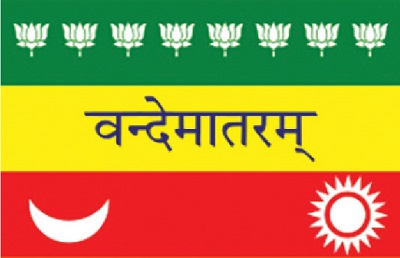
The Ghadar Party, too, prominently depicted Bharat Mata in chains in its pamphlets and literature, accompanied by the slogan Vande Mataram. Bhikaji Cama's flag was adopted in 1914 by the Berlin Committee, which subsequently became the Indian Independence Committee.
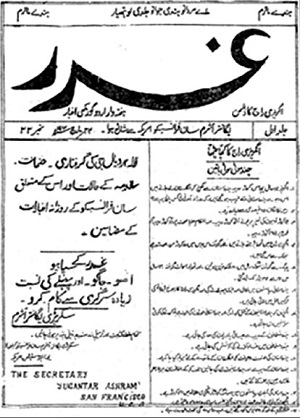
(At the top left and right it’s written: “Bande Mataram”)
There were numerous revolutionaries who walked to the gallows with Vande Mataram on their lips. Among them were Khudiram Bose and Surya Sen, the latter of whom was tortured for singing the song. Vande Mataram was also on the lips of Matangini Hazra when she was shot while holding the Indian flag during the Quit India Movement in 1942. In 1943, the British hanged four brave members of the Azad Hind Fauj, namely Vakkom Abdul Khader, Satyen Bardhan, Anandan and Fauja Singh, at Madras Central Jail on charges of espionage. All four walked to the gallows raising the slogan Vande Mataram.
It would be interesting for many to know that, until 1937, Jinnah had not opposed the singing of Vande Mataram. Indeed, he had himself been present on the dais on several occasions during Congress sessions, fully aware of the song's meaning and significance. However, as he increasingly embraced an uncompromising communal political agenda, Vande Mataram became a target of opposition from him, the Muslim League and its followers.
Following the Muslim League's electoral defeat in 1937, Jinnah raised objections to the singing of Vande Mataram in the Legislative Councils by the newly elected Congress legislators. Jawaharlal Nehru, then a prominent Congress leader, took serious note of this opposition and sought the views of Rabindranath Tagore and Subhas Chandra Bose. It is worth recalling what Subhas Chandra Bose wrote to Nehru on 17 October 1937, while emphasising the importance of Hindu-Muslim unity: “Communal Muslims are in the habit of raising bogeys from time to time – sometimes it is music before mosques, sometimes inadequate jobs for Muslims and at present it is ‘Bande Mataram’. ‘Bande Mataram’ has suddenly sprung into importance probably because it was sung in Legislature thereby demonstrating Congress victory. While I would gladly try to meet all doubts and difficulties raised by nationalist Muslims, I do not feel inclined to attach much importance to what the communalists say. If you give them the fullest satisfaction on the question of ‘Bande Mataram’ today, they will not be long in bringing up other questions tomorrow, simply in order to pander to communal feeling and embarrass the Congress.”
Ultimately, Nehru, as Congress President, decided that only the first two stanzas of Vande Mataram would be sung. This subsequently became the accepted practice within the Congress. In doing so, Nehru chose to accommodate the objections raised by communal elements, despite the caution expressed by Subhas Chandra Bose. Within three years, the demand for Pakistan was formally raised. The relevance of Bose's observations is something readers can judge for themselves, particularly in the contemporary context, when objections to Vande Mataram continue to be raised by radical Islamist elements.
There is also evidence of Maulana Abul Kalam Azad's admiration for Vande Mataram. After listening to the renowned singer Krishna Kumar perform it in Delhi on 1 January 1952, Azad reportedly described the song as graceful and inspiring, recalling the many great leaders and freedom fighters who had sung it. Several other prominent personalities, including Rafi Ahmed Kidwai and Aruna Asaf Ali, also sang Vande Mataram with enthusiasm. Its echoes were heard during the Quit India Movement of 1942, the Naval Uprising of 1946 and the widespread protests against the trials of Azad Hind Fauj officers and soldiers in 1945-46.
Yet, even today, we find sections of the so-called secular establishment, Lutyens' circles, several Congressmen and opposition leaders, along with radical Islamists and Communists, raising objections to the singing of Vande Mataram.
I recall a personal experience from a live BBC broadcast a few years ago. During the programme, Prof. Irfan Habib supported the opposition being raised by radical elements against Vande Mataram. When the anchor indicated that his views had been heard and invited me to present my perspective, Prof. Habib became visibly agitated. On hearing the anchor address me, he exclaimed, "Kapil Kumar!" and declared that he had nothing further to do with the programme before walking out of the broadcast. I could not help but find the episode amusing. When confronted with historical facts and evidence, some self-proclaimed custodians of secularism seem more inclined to disrupt a discussion or walk out than engage with the arguments.
It is important to distinguish between such political posturing and the position of nationalist Muslims, who do not subscribe to this opposition. Equally revealing is the contradiction in the position of certain Communists who, for electoral and vote-bank considerations, readily invoke the worship of Goddess Kali as a means of political mobilisation, yet vehemently oppose Vande Mataram, a song rooted in the same devotional tradition.
Whatever the political opportunists may say or attempt, one fact remains undeniable: for millions of ordinary Indians, Vande Mataram is not merely a prayer to Maa Kali; it is an enduring expression of love for the motherland, a call to defend it, a commitment to fight for it and an inspiration to work for its progress.
The brave men and women of our Armed Forces, who stand guard over India's territorial integrity, democracy and Constitution, often serving for months away from their loved ones, continue to draw inspiration from this spirit of patriotism. For them, too, Vande Mataram is an expression of devotion to the nation and its people.
There is something profoundly stirring about listening to this great patriotic song, or even hearing the simple words Vande Mataram. It awakens an overwhelming sense of national pride. Before my eyes appear the scenes from the film Anandamath, in which Devi Chaudharani leads her forces against the British while singing Vande Mataram. It is a powerful reminder that this song is far more than a composition or a slogan. It represents a legacy of resistance, sacrifice, devotion and an undying commitment to the motherland.
(The writer is Former Professor, Chair, Centre For Freedom Struggle & Diaspora Studies, IGNOU; Former Sr. Fellow, Nehru Memorial Museum & Library, N. Delhi; Chief Historian, 7 Museums in India; Principal Trustee of O.U.S.R.H.H.; Former Director, Centre for Freedom Struggle & Diaspora Studies, & Chairperson, History Faculty, IGNOU; Former Director, School of Tourism & Hospitality Services Management, IGNOU, New Delhi)
(The content of this article reflects the views of writer and contributor, not necessarily those of the publisher and editor. All disputes are subject to the exclusive jurisdiction of competent courts and forums in Delhi/New Delhi only)






















Leave Your Comment