


R Hari
I am Vande Mataram. I have no human body. I am a sculpture fashioned out of poetry—a lyrical sculpture. I have my own form, melody, language, emotion, rhythm and pulse. I have a body, a connection and a life of my own. Just as Lord Shiva blessed the sage Markandeya with eternal youth, I, too, have been blessed with timelessness. I have witnessed one hundred and twenty-five Vishukkani, yet I remain ageless. Like a young woman at Kanyakumari, observing a sacred vow at the feet of the Mother Goddess, I remain forever youthful.
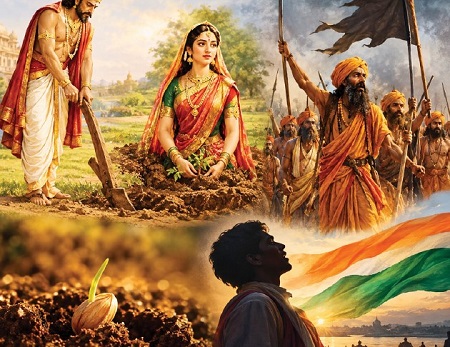
I have said that I was introduced in Anandamath. I chose those words deliberately. Contrary to what many people believe, I was not born in Anandamath. I came into existence several years before the novel appeared. When Maharishi Manu cupped water in his joined palms to offer an oblation to the Sun God for the welfare of humankind, I, too, appeared like a fish emerging from the water held in his hands.
When King Janaka ploughed the earth, Mother Earth presented him with Sita, who would become an instrument of righteousness and transformation. My emergence followed a similar course. I was born in the atmosphere of the Sanyasi Rebellion, in the language of the Sanyasis. At that time, I was merely a seed—a simple invocation: Vande Mataram.
For a while, I wandered through the atmosphere as a formless presence. Then I took refuge in the womb of Mother Earth. Years passed. But does a seed ever truly perish when it lies buried in the soil? When the time came to liberate the mother, my father ploughed the earth. Like Sita, I emerged from the soil. Yet the spirit of the Mother had already bestowed upon me the essence of my being. From that tiny seed, I gradually acquired the form in which the world recognises me today.
People rightly say that Bankim Babu is the father of Vande Mataram. Yes, Bankim Babu is my father. My mother is Dharani, the Earth herself, also known as Vasundhara. Like Sita, I cannot be separated from my mother. Without Dharani, I have no independent existence.
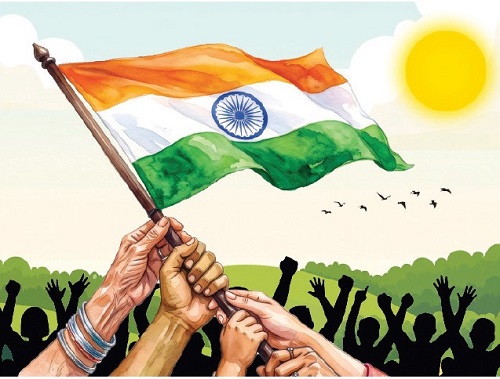
When uncertainty, hardship and danger surround people, they seek strength in the values that sustain their society. The Rajputs, riding into battle to defend their land and honour, cried out, "Bhagwan Ekling Ki Jai!" The Marathas, setting out to defend their country and faith, raised the cry, "Har Har Mahadev!" Bengal revered Durga as its Mother Goddess and Bhagavati as its divine protector. The Sanyasis, too, invoked their mother—the land itself—and proclaimed, "Vande Mataram!" For them, the goddess and Mother Earth were inseparable.
I have already mentioned the patriotic song Matar Namami, composed by the poet Bhudev, which enjoyed popularity in Bengal during that period. Bhudev was not alone in giving voice to patriotic sentiment. Ranglal Bandopadhyay, in his Padmini Upakhyan, asked a question that captured the yearning for freedom: who would willingly live in humiliation, and could anyone truly wish to remain shackled?
Another distinguished poet of my father's time was Hemchandra Bandyopadhyay. Through his Bharat Sangeet, he called upon the nation to awaken from its slumber and rediscover its strength. His poetry, too, contributed to the growing spirit of national consciousness.
Satyendranath Tagore, the elder brother of Rabindranath Tagore, added his voice to this celebration of the Motherland. His patriotic song called upon the children of Bharat Mata to sing together in unison and celebrate the country's glory. The song was performed at the beginning of the Hindu Mela, organised by Nabagopal Mitra. Its verses resonated through the gathering, carried by the voices of men and women alike. Many regarded it as an early expression of India's national song tradition. My father, too, appreciated this growing literary and cultural movement.
Moreover, when my father composed the soliloquy of Kamalakanta, he eventually gave voice to his emotions through these words:
Jaya Jaya Jaya Jaya Dhātri
Namami Sirasa Devim
Bandhanat Suvimocitām
It was a glorious moment, when the creative spirit of nationalism soared.
My father, a passionate lover of literature, was not satisfied with merely having Kamalakanta repeat the words Bandhanat Suvimocitām—liberation from bondage. He understood that freedom could not be reduced to the simple act of releasing a captive. A parrot freed from its cage might learn to fly, but that alone does not capture the full meaning of freedom. True freedom is the ability to soar across the boundless sky.
My father understood that a nation needed more than release from oppression. It needed strength, confidence and the capacity to triumph. The Vedic prayer was not merely Ripum Jahi—destroy the enemy—but also Balam Dehi—grant us strength. And beyond strength lay the aspiration expressed in Jayam Dehi—grant us victory. Similarly, the divine mission expressed through Vinashaya Dushkritam, the destruction of evil, becomes complete only when accompanied by Paritranaya Sadhunam, the protection of the righteous.
My father recognised that these ideas belonged together. Liberation, strength, victory and the protection of righteousness formed parts of a larger vision. He sought to overcome the limitations of the earlier expression and give the idea a more complete form.
He embraced the mantra of the Sanyasis. Because it was a mantra, he did not simply translate it into another language. Instead, he absorbed its spirit and allowed it to become part of his creative imagination. Slowly, as a tree grows from a bud, threads combine to form a garment and letters unite to create a verse, I emerged from the seed of that invocation. Thus, the mantra Vande Mataram gradually became the complete expression that the world knows today.
All this happened before my father began writing Anandamath. He proudly introduced me to his friends, many of whom were distinguished personalities of their time. Among them was Yadunath Bhattacharya, a scholar of classical music. He recognised that I could be sung and gave me a musical form. He set me to Raga Malhar, with a Qawwali rhythm, enabling me to reach the audience as a complete musical experience.
Bharat is a union of hearts connected by a shared spiritual and cultural consciousness. It brings together scattered energies and transforms them into a collective national spirit. I often wonder whether Swami Vivekananda's reflections on national unity in India echoed ideas that my father had already expressed.
I remember Sister Nivedita, the close disciple of Swami Vivekananda, who succinctly expressed the relationship between country, people and dharma. Together, these three help shape the identity of a nation. Dharma, in this understanding, is not merely a ritual identity imposed in the name of religion; it represents a broader moral and cultural foundation. My father had recognised the importance of this idea even before these great figures articulated it in their own ways.
My father firmly believed that although India was under British rule, the nation itself had existed long before the arrival of the English. Rajnarayan Bose and Nabagopal Mitra were among those who helped cultivate this consciousness. My father instilled the same conviction in me: the country comes first, its people come next, and dharma provides the moral and cultural foundation that sustains them.
The land is the body of the nation. It is sujalam, suphalam, malayaja-shitalam—richly watered, abundantly fruitful and cooled by fragrant southern breezes. It blossoms with trees and plants and radiates beauty. My father portrayed the Mother as graceful in appearance and melodious in expression, giving poetic form to the beauty of the land.
But he went further. Bharat was not merely a stretch of territory somewhere on the world map. It was a sacred home that shaped the lives, identities and aspirations of millions of people. The nation was not simply its soil; it was also the people who belonged to it and the shared consciousness that connected them.
My mother speaks through the voices of seven crore children and holds a sword in millions of hands. Can such a mother be considered weak? She is powerful, courageous and protective. She embodies the strength of the people and the spirit that enables them to defend their collective identity.
Having described the land and its people, my father turned to the many dimensions of dharma. Through his poetic imagination, he explored the deeper consciousness of the country, drawing upon the rich traditions of India's literary and spiritual heritage. Like waves arising within the sea, these traditions came together to express the larger unity of the nation. Ultimately, my father gathered these elements into me, giving poetic voice to the idea of Bharat. How fortunate I am to embody such a vision!
I am one from beginning to end. I am complete and indivisible. To call me by any name and reduce me to a few stanzas is to overlook the larger meaning I carry within me. Can a nation, constituted by its land, its people and its cultural and spiritual inheritance, be adequately represented by only one of these elements?
There are two things my countrymen should remember. First, my father was a senior official in the British administration. He understood the importance of choosing his words carefully and knew what could be expressed openly and what had to remain implicit. When I made my appearance, my father made certain things clear while leaving others unsaid.
What he did not specify were the geographical boundaries of the land. He did not define the territory in the precise terms found in the Vishnu Purana or in the writings associated with Chanakya. The geographical picture in his mind remained suggestive rather than explicit. Yet his listeners could understand the larger meaning. Sometimes, silence communicates more effectively than words. Like the eloquent silence of Dakshinamurthy, which resolves the doubts of disciples, my father's restraint conveyed an idea without spelling out every detail.
My father also demonstrated the subtlety of a skilled writer. Through carefully chosen references, he conveyed a powerful idea while maintaining the outward appearance of a literary narrative. When he referred to seven crore children of the Mother, he invoked the people within the setting of Anandamath. His words expressed a national sentiment without openly declaring a call for the entire country to revolt against British rule.
The Sanyasis in Anandamath belonged to a particular historical and geographical setting, and the reference to seven crore people reflected that context. Over time, however, the idea of the Mother's children expanded in the national imagination, growing from a specific number into the familiar expression of countless sons and daughters of Bharat Mata.
Even my father's friends fully appreciated the implications of his literary craftsmanship only after his death. When a group of writers undertook the task of preparing his biography, they examined his official records. During this process, they came across a note written by a British official concerning Anandamath. The discovery revealed the unease the novel had caused within the colonial administration. Other British observers and the pro-government newspaper Indian Mirror had also commented on the work in different ways.
My father was a storyteller who drew upon historical events to create a literary vision. His narrative was rooted in the circumstances of its time, yet it carried meanings that extended beyond the immediate story. Those who interpreted every such expression as sedition failed to appreciate the distinction between literary imagination and a direct political declaration. They were like people who mistake a rope for a snake, seeing a threat where a more careful examination might reveal something else.
Let me clarify once again when I first appeared. It was on Shukla Paksha Navami in the month of Kartika, a day associated in Bengal with Akshaya Navami and the worship of Jagaddhatri. The date was November 7, 1875. Perhaps because I first appeared on this auspicious day, my entire existence has become an enduring celebration of the Mother.
Anandamath appeared in 1882. My father's friends were delighted to see me enter its pages. One of them remarked that Bankim Chandra Babu had fashioned a diamond ring using a diamond he already possessed.
(The article is excerpted from the book The Story of Vande Mataram, published for Prajna Pravah Pratishtan by Indus Scroll Press)
(The content of this article reflects the views of writer and contributor, not necessarily those of the publisher and editor. All disputes are subject to the exclusive jurisdiction of competent courts and forums in Delhi/New Delhi only)















Leave Your Comment