


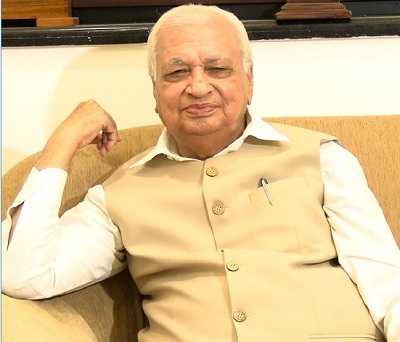
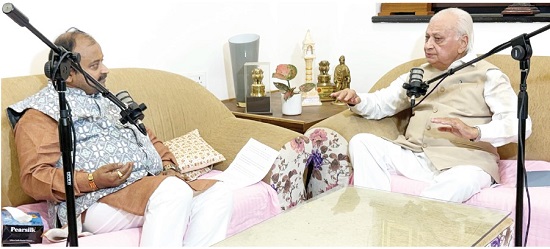
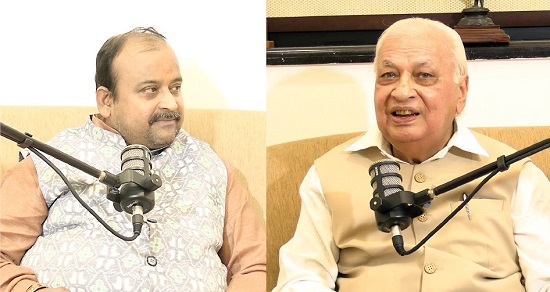
As India commemorates the 151-year journey of Vande Mataram and reflects on its enduring place in the country's national consciousness, the historical, cultural and spiritual significance of the national song has once again come into focus. To understand its historical significance, the role of different political forces, the importance of respecting national symbols and the deeper philosophical foundations of Indian civilisation, Deepak Kumar Rath spoke to Arif Mohammed Khan, former Union Minister and former Governor of Kerala and Bihar. A widely respected public intellectual with a deep understanding of Indian scriptures, the Bhagavad Gita, the Vedas and the Upanishads, Mr Khan offers a thoughtful perspective on Vande Mataram, national identity, religious diversity and Sanatan Dharma. In this wide-ranging conversation, he emphasises that patriotism must rise above political considerations, that national heritage deserves respect and that the true essence of Indian philosophy lies in recognising the same divine presence in every living being. Excerpts:
Vande Mataram played a remarkable role in bringing people together during India's freedom struggle. How would you explain its historical significance and its relevance in contemporary India, particularly as the country marks its 151-year journey?
Vande Mataram was not merely a literary composition; it gradually became the emotional expression of India's freedom movement. Its significance cannot be understood only from the perspective of literature. It became deeply connected with the sentiments of those who participated in the struggle for independence.
There were countless instances when people were subjected to physical persecution, beaten by the police and punished for raising their voices against British rule. Yet, in response to every blow, Satyagrahis continued to proclaim Vande Mataram. Many people even sacrificed their lives while raising this slogan. It became an expression of courage, sacrifice and an unshakeable commitment to the motherland.
Therefore, Vande Mataram became much more than a song. It represented the emotions and aspirations of an entire national movement. Its historical importance lies in the fact that it brought people together through a shared feeling of devotion to the country.
Even today, its relevance remains undiminished. We must remember that the freedom struggle was fought for liberty, and one of the most important aspects of liberty is the freedom to express one's opinion. People may have different views, and I do not believe in criticising anyone merely for holding a different opinion. However, when something has touched the deepest emotions of millions of people and has become part of our national heritage, it deserves respect and regard.
Our Constituent Assembly also made it clear that the national anthem, Jana Gana Mana, and the national song, Vande Mataram, would receive equal respect and honour. The Constitution's fundamental duties also emphasise the responsibility of citizens to respect national symbols and constitutional values.
India is a democracy where everyone has the right to express an independent opinion. How should society respond to those who have historically opposed or expressed reservations about Vande Mataram?
If we examine the issue historically, I find the argument made by Rafi Ahmed Kidwai particularly powerful. He had pointed out that Muhammad Ali Jinnah opposed Vande Mataram for political reasons. Otherwise, there were occasions when people stood together without any such objection, before the politics of partition became dominant.
The important principle here is that the nation must always come before political parties, families and personal interests. Our first commitment should be to the country. Political parties and individual interests come afterwards. If political considerations are allowed to take precedence over national interests, it creates unnecessary divisions. We must understand that national heritage belongs to the entire country and cannot be reduced to the interests of any particular political organisation.
At the same time, I do not advocate forcing people to express a particular opinion. The freedom of expression was one of the principal objectives of our freedom struggle. However, freedom of expression should coexist with mutual respect and an understanding of the historical emotions associated with national symbols.
You have spoken about your effort to translate Vande Mataram into simple Hindustani. What prompted you to undertake this exercise, and what response did you receive?
I undertook this exercise at a time when a controversy had arisen over a government circular, probably around 2007, suggesting that schools should organise collective singing of Vande Mataram on its anniversary. There were objections, and religious pronouncements were issued advising parents not to send their children to school on that day. I felt that before opposing something, people should at least understand what it actually says. Therefore, I sat down and translated Vande Mataram into a simple language. Some people described it as Urdu, but I prefer to call it simple Hindustani, a language that is neither heavily Sanskritised Hindi nor heavily Persianised Urdu.
Initially, I intended it to be only a translation. However, as I worked on it, the words gradually took the shape of a song. I wanted people who had reservations about Vande Mataram to read it and decide for themselves whether there was anything objectionable in its meaning. I sent copies through someone to an institution and specifically requested that my name should not be disclosed. I wanted them to examine the translation independently. If they found anything objectionable, they were free to say so. But if they found nothing objectionable, they should simply be told that it was a translation of Vande Mataram.
I remember that a person from that institution later contacted me and questioned how I could claim that it was a translation. On the same day, however, a professor who headed the Sanskrit department at Delhi University spoke at another programme. He said that when he read my translation, tears came to his eyes because it had successfully captured the spirit of the original composition.
That response was particularly meaningful to me. A person who knew Sanskrit appreciated the spirit of the translation, while some others who did not understand the original language questioned its authenticity without identifying anything objectionable in its meaning.
You also presented your Hindustani translation in a musical form. What was the thought behind expressing the national song in a language accessible to a wider audience?
I did not originally set out to compose a song. My intention was simply to translate Vande Mataram so that people could understand its meaning. But as I worked on it, the translation naturally acquired a lyrical form. I used the expression Tasleemat, which is the plural form of salaam, to convey repeated salutations and emphasise the depth of reverence for the motherland.
The translation describes the beauty, richness and affection of the motherland. It speaks of her moonlit nights, greenery, beautiful smile, sweet language and the sense of security and happiness that one experiences in her embrace. It also expresses the idea that the motherland is the source of one's deepest comfort and fulfilment.The concluding expression, Tasleemat, Maa Tasleemat, Mataram Vande Mataram, conveys repeated salutations to the mother. I believe the original composition contains immense sweetness, love for the country and devotion to the motherland. I merely attempted to communicate that spirit in a language that could be understood by a wider section of society.
My purpose was simple: if people are opposing Vande Mataram, they should at least know what it contains before forming an opinion about it. Understanding should precede opposition.
The Congress often refers to its contribution to India's freedom struggle. What, in your assessment, was its historical association with Vande Mataram?
I am not entirely sure which particular part you are referring to. However, as far as I know, before Independence, the sessions of the Indian National Congress traditionally began with Vande Mataram.
There was also an important musical contribution associated with the song. I do not remember the exact year, whether it was 1935 or 1937, but Gurudev Rabindranath Tagore composed its music, and his niece sang it on that occasion. If I deny my own historical inheritance, what right do I have to question others about theirs? Vande Mataram is part of our national heritage. It should not be viewed through the narrow lens of contemporary political competition. Its place in India's history is much larger than the identity or interests of any political party.
I do not wish to turn this discussion into a political controversy. My point is that national heritage should be acknowledged and respected by everyone. Political differences should never become a reason for distancing ourselves from the country's shared historical inheritance.
You have emphasised that respect for parents and elders is an essential social value. Yet, we see increasing instances of family breakdown and the growing number of old-age homes. What, in your view, is the way to address this problem?
Respecting one's parents is important legally, morally and ethically. However, the question is whether every individual actually follows this principle. There are people who do not respect their parents. What can we do about them? Should we take a stick and force them to behave properly? That is not the solution.
I believe every individual acts according to his or her inherent nature. The Bhagavad Gita explains this beautifully in Chapter 3, Verse 33:
सदृशं चेष्टते स्वस्याः प्रकृतेर्ज्ञानवानपि।
प्रकृतिं यान्ति भूतानि निग्रहः किं करिष्यति॥
Meaning: Even a person endowed with knowledge acts according to his/her own nature. All living beings follow their inherent disposition; what can restraint accomplish?
This is a universal truth. My responsibility is not to reform everyone else. My responsibility is to present an ideal through my own behaviour. I cannot improve someone by criticising or abusing them. I can influence others by demonstrating better conduct.
India has witnessed many attempts throughout history to weaken its cultural and civilisational unity. What, in your view, has enabled Indian civilisation to survive these challenges?
History offers numerous examples of attempts to weaken India's cultural identity, civilisational continuity and social cohesion. Yet, something inherent in this soil has always helped preserve its essential character To understand this, we must first understand the true spirit of Sanatan Dharma. It is not merely about performing rituals, offering prayers or following certain external practices. The tradition we are discussing is fundamentally a tradition of knowledge. It is knowledge that transforms the way a person looks at the world and understands the relationship between oneself and others. The Bhagavad Gita gives us a profound explanation of this knowledge. Lord Krishna tells Arjuna in Chapter 4, Verse 35:
यज्ज्ञात्वा न पुनर्मोहमेवं यास्यसि पाण्डव।
येन भूतान्यशेषेण द्रक्ष्यस्यात्मन्यथो मयि॥
Meaning: Having attained this knowledge, you will never again fall into delusion. Through this knowledge, you will see all beings, without exception, within yourself and also in Me.
The most important expression here is Asheshena, meaning without exception. Once a person acquires this knowledge, he begins to recognise every living being as an extension of himself and as part of the same universal consciousness. Consider a simple example. Your child is an extension of you. Even if the child makes mistakes, you would not willingly inflict suffering upon him. Why? Because you recognise the child as part of yourself.
The same principle must be extended to every human being. This is the essence of Sanatan Dharma. It is not meant for one particular community, class or section of society. It teaches us to recognise the interconnectedness of all existence.
You have often said that Sanatan Dharma should be understood as a way of life rather than merely a religious identity. How do you explain the distinction between Dharma and religion?
One of the greatest injustices done to the understanding of the Bhagavad Gita is that it has been presented merely as a religious book. I believe it is fundamentally a way of life.
Dharma and religion are not necessarily the same thing. Dharma, in its deeper sense, is connected with duty and a code of conduct. For example, if I am someone's son, I have certain duties towards my parents. If I am a father, I have responsibilities towards my children. If I participate in public life, I have a different set of responsibilities towards society. Every relationship brings with it certain duties. Dharma is therefore not simply an identity; it is a set of responsibilities governing how we conduct ourselves. Our behaviour also changes according to circumstances. If a person is alone at home, his behaviour may be different. If several people are present, his conduct may change. If women or children are present, he may conduct himself differently again. This is why our tradition speaks of different dimensions of Dharma, including Sanatan Dharma, Yuga Dharma, Kala Dharma and Swadharma. Dharma cannot be confined to one narrow definition.
Unfortunately, we have sometimes interpreted it in a very restricted manner, which does not reflect the broader spirit of Sanatan philosophy. The true spirit of Sanatan Dharma requires us to recognise not only human beings but also animals, trees and plants as part of the same interconnected existence. In this philosophy, the concept of an entirely separate 'other' becomes difficult to sustain.
The one who truly understands this philosophy begins to recognise the same universal presence in different forms of life.
You have explained that Sanatan philosophy does not accept a rigid division between different forms of existence. How does this understanding influence our perception of the Creator and creation?
The central idea of Sanatan philosophy is that the Creator and creation cannot be understood as completely separate entities. In many philosophical theories, the Creator is seen as someone who creates something separate from himself, much like a person manufactures a product. The creator and the creation are considered distinct, without any inherent connection between them.
Sanatan philosophy presents a different understanding. It recognises an intrinsic relationship between the source of creation and everything that has emerged from it. The Upanishadic tradition expresses this through the idea of the ultimate reality manifesting itself in multiple forms. The Taittiriya Upanishad describes the primordial desire of the Supreme Reality in the words:
सोऽकामयत। बहु स्यां प्रजायेयेति।
Meaning: The Supreme Reality desired, "May I become many; may I manifest myself in multiple forms."
This expresses the idea that the entire creation is an expression of the same ultimate reality. You are one manifestation of that reality, I am another, and every other living being is also part of the same existence. Therefore, when we look at another person, we should recognise the same divine presence within that person. This is not merely an abstract philosophical proposition; it has direct implications for how we treat others. If we genuinely understand this principle, discrimination and hostility become difficult to justify because we begin to recognise the fundamental unity underlying all existence.
What is the ultimate message of India's spiritual tradition, particularly in the context of national unity, cultural diversity and the responsibilities of citizens?
The essential message is that we must learn to recognise unity behind diversity. Everyone may have a different appearance, language, social background or way of life, but the underlying reality is one. This idea is beautifully expressed in the Upanishadic invocation:
ॐ पूर्णमदः पूर्णमिदं पूर्णात् पूर्णमुदच्यते।
पूर्णस्य पूर्णमादाय पूर्णमेवावशिष्यते॥
Meaning: That is complete, this is complete. From the complete, the complete emerges. Even when the complete is taken from the complete, the complete remains.
This is a profound expression of the idea of wholeness. The same universal reality exists within all forms of creation. What appears different externally is fundamentally connected at a deeper level.
Sanatan Dharma is not simply a collection of rituals and customs. It is a philosophy that asks us to recognise the divine presence in every living being and to conduct our lives accordingly. When we speak of national unity, cultural identity and social harmony, we must remember this fundamental principle. India's civilisational strength has always rested on its ability to accommodate different traditions and expressions within a broader understanding of existence.
The responsibility of every individual is to live these values through personal conduct. We should not attempt to reform society through abuse, condemnation or coercion. We must first become examples of the values we wish others to follow. Our spiritual inheritance teaches us that there is no justification for treating another living being as completely separate from ourselves. Once this understanding becomes part of our everyday behaviour, respect, compassion and social harmony will naturally follow.






















Leave Your Comment