


India’s widespread and good quality road infrastructure is facilitating operation of combat aircrafts during contingencies.
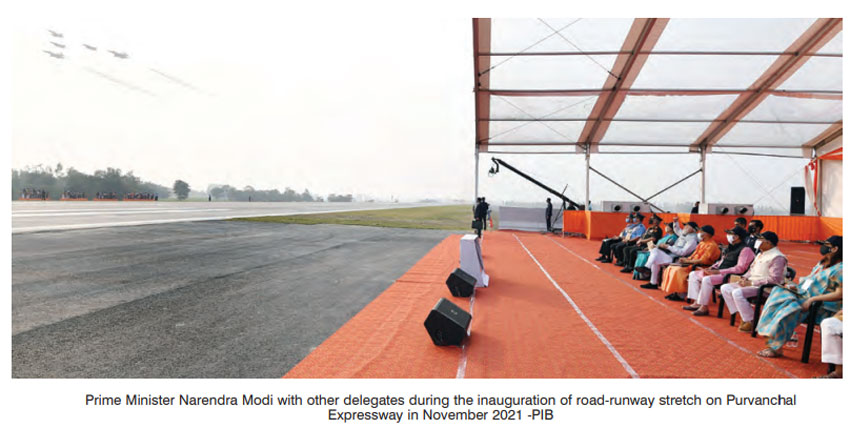
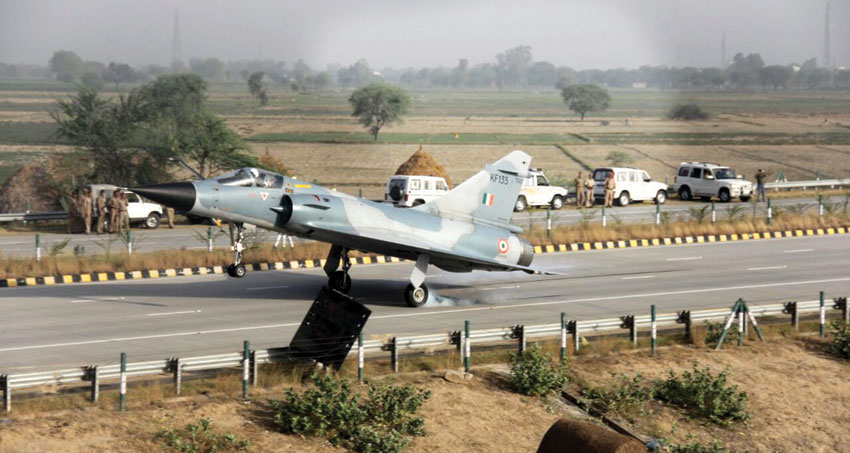
On June 24, 2023, the Indian Air Force had conducted a tactical trial of the emergency landing facility specially constructed on an expressway in Uttar Pradesh. The emergency landing facility (or ELF) is made on the Purvanchal Expressway located at Kurebhar in Uttar Pradesh. Around ten aircrafts of the Indian Air Force (IAF) participated in the exercise. Mirage-2000 and Jaguar fighter jets, and an An-32 military transport plane were part of the trial run. These combat planes performed ‘touch and go’ operations on the 3.5 km-long emergency facility. The drill was part of the stringent process that would help the officials to ascertain the readiness of the emergency landing facility. Constructed at Arwal Kiri Karwat, the drill saw the warplanes circuiting, approaching and landing on the ELF. As all the criteria have been met for an operational ELF, the airstrip on the expressway is fully functional.
On September 15, 2021 the Taiwan Air Force had also started a similar exercise when its F-16 fighter aircrafts took off from rural roads and highways in the country, which also saw the participation of AWACS aircrafts. A war between China and Taiwan is not imminent, but as China has grown increasingly assertive in both the East China and South China Seas, Taiwan has stepped up its defences. China, which claims Taiwan as part of its territory, flies fighter bombers toward Taiwan on a regular basis in an effort to bully and intimidate the island nation. Chinese fighter jets, anti-submarine warfare aircraft and combat ships have repeatedly conducted joint assault drills near Taiwan and strategically blackmailed the tiny island with China using the lame excuse that the exercise was necessary to safeguard its sovereignty. The rapidly evolving contemporary tactical warfare scenario has necessitated the execution of highway-landing exercises many nations.
The concept of road-runways
A road-runway in popular disambiguation, is a section of a public highway or expressway that is specially built to act as a runway for military aircraft to serve as an auxiliary military airbase. These runways allow military planes to continue operating even if their regular airbases, some of the most vulnerable targets in any war, are degraded or destroyed. The first highway strips were constructed during World War-2 in Nazi Germany, where the well-developed Reichsautobahn systems allowed aircraft to use the motorways.
The Six-Day war between Israel and Egypt in 1967 offers a prime example of when highways will be useful as landing strips. In one of the most successful air force operations in military history, Israeli Air Force took the Egyptians by surprise and destroyed 18 airfields in a surprise attack in the early morning on June 5, 1967 as part of Operation Focus. Israel achieved complete air superiority over the battle space which would not have been the case had Egypt prepared for alternative landing strips on highways.
The US has also had a popular urban myth surrounding highway airstrips according to which the Eisenhower Interstate Highway System requires that one mile in every five must be straight. These straight sections are usable as airstrips in times of war or other emergencies. There is no factual basis to this statement and it originated in 1943 when in a presentation to the American Association of State Highway Officials, Commissioner of Public Roads- Thomas H MacDonald mentioned flight strips. The US Congress considered its inclusion in Federal-Aid Highway Act of 1944 but eventually didn’t.
Countries that have built highway airstrips in the past include both West and East Germany, Singapore, North Korea, Taiwan, Sweden, Finland, Bulgaria, Switzerland, Poland, Pakistan and Czechoslovakia.
Structural designs of highway strips
The strips are usually 2 km to 3.5 km long and straight sections of the highway, where any central reservation is made of crash barriers that can be removed quickly in order to allow airplanes to use the whole width of the road, and other features of an airbase (taxiways and airport ramps) can be built. The road will need a thicker than normal surface made up of bitumen layer and a solid concrete base has to be used as the foundation. The specialised equipment of a typical airfield are stored somewhere nearby and only carried there when airfield operations start on the stretch of the road. The highway strips can be converted from motorways to airbases typically within 24 to 48 hours of a formal notification being issued by the government.
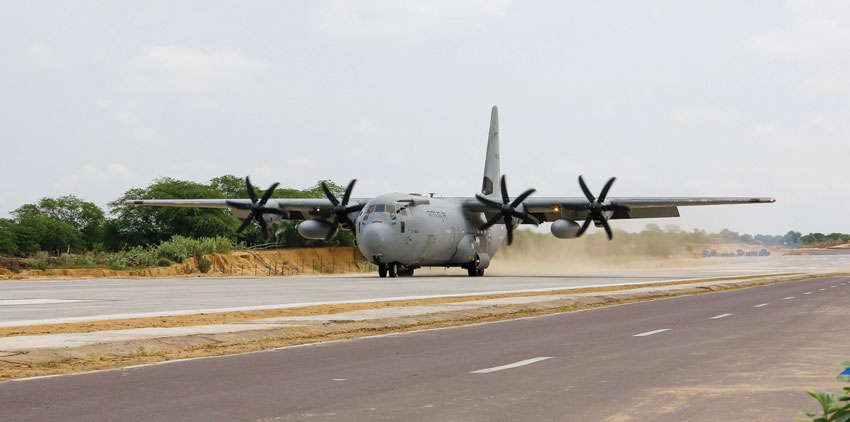
The road would need to be swept to remove any debris before use by aircraft. The pole-based streetlights are removed so that the airplanes’ wings get a clear room while landing, and a makeshift ATC (air traffic control) centre is established which is manned by the air force. Road-runways can however also be quite small. In some countries like Sweden, the short runways built are commonly just 800 metres in length. The STOL (short take-off and landing) capability of the Viggen and Gripen allowed for such short runways to be made in Sweden. In the case of Finnish road-based airbases, the space needed for landing aircraft is reduced by means of a wire, similar to the CATOBAR system used on some aircraft carriers.
India’s tryst with road-runways
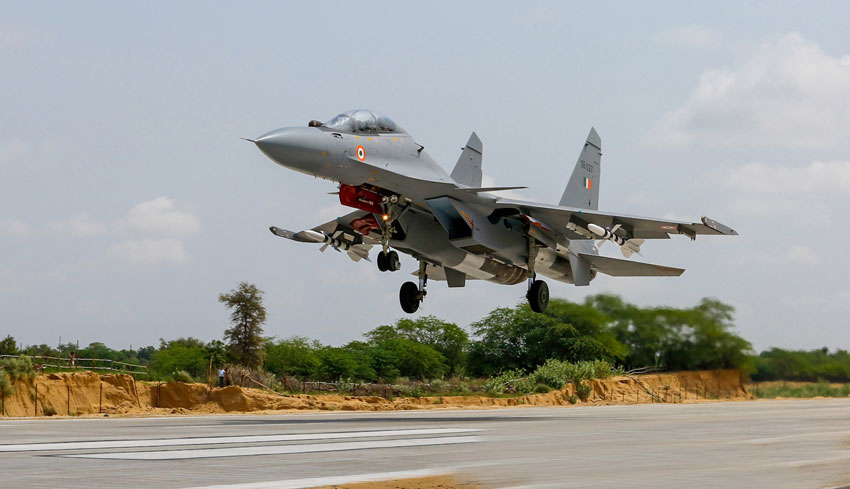
While the concept of road-runways on national highways is quite new in India, the Indian armed forces have gained some experience in operating military aircrafts from expressways. India successfully tested its runway strip on a stretch of the Yamuna Expressway in Uttar Pradesh on May 21, 2015, which was built at a cost of Rs. 130 billion for its combat jets of the IAF, a first for military aviation in the country. In June 2016, the Minister for Road Transport and Highways, Nitin Gadkari had announced that the government was considering developing 'Road Runways' for commercial operations as well. India successfully tested another runway-based airstrip on a stretch of the Agra-Lucknow Expressway in Uttar Pradesh on October 24, 2017. A September 9, 2021 landing of an IAF C-130J Super Hercules aircraft on the NH-925A in Andhra Pradesh further took this legacy forward. Meanwhile the union government has finalised 29 more stretches of national highways in the country which will be developed as emergency landing strips in the very near future.
The stretches which have been identified for development include Phalodi-Jaisalmer Road, Barmer-Jaisalmer Road, Kharagpur-Balasore Road, Kharagpur-Keonjhar Road, Near Panagarh/KKD, Chennai, Puducherry Road, Nellore-Ongole Road, Ongole-Chilakaluripet Road, Mandi Dabwali-Odhan Road, Sangrur, Bhuj-Naliya Road, Surat-Baroda Road, Banihal-Srinagar Road, Leh-Nyoma area, Jorhat-Baraghat Road, Bagdogra-Hashimara Road, Hashimara-Tezpur route, and Hashimara-Guwahati Road. While various works related to fencing of the roads on either side of the airstrips on national highways is progressing, the IAF is also coordinating with the National Highway Authority of India (NHAI) for the upkeep of the airstrips.
Strategic implications of highway strips
Highway-based airstrips are primarily constructed as alternative landing zones for military aircrafts during wars and other unprecedented natural disaster-related contingencies. India’s hostile neighbours- Pakistan and China possess formidable terrain-hugging cruise missile capabilities and high precision heavy artillery-based rocket systems which have the potential to cause immense damage to India’s conventional airbases during the opening hours of a full-scale war. It is quite possible that many of India’s airbases are taken out of operation by the enemy’s cruise missile barrage at a time when a significant number of Indian aerial assets are already airborne during a military confrontation with a hostile neighbour. During such emergencies, the secondary airstrips being built on the highways will act as the primary backbone for refuelling operations of Indian warplanes and will also facilitate launching offensive strikes against the enemy after rearming the aerial assets. So, these highway strips are being strategically positioned on roads near existing airbases which serve the western, eastern as well as north-eastern frontiers of the nation. Some of these highway strips will also be used to defend peninsular India during potential naval confrontations with Pakistan and China in the future. Planning these ELFs near existing airbases also ensure that all logistics are easily and rapidly mobilised for executing military aircraft operations from these highway strips.
Tactical advantages gained by China and Pakistan
In 1989 China conducted its first highway strip drills. The Chinese exercises of landing on highways have since been conducted at later dates and in different areas of the communist country. In 2014 Chinese forces landed warplanes on a highway strip in Henan province for the first time. Similarly, Pakistan is also not far behind China. In Pakistan, The M-1 Motorway (Peshawar-Islamabad) and the M-2 Motorway (Islamabad-Lahore) include four emergency runway sections of 2.7 km length. These four emergency runway sections become operational by removing removable concrete medians using forklifts. The Pakistani Air Force has used the M2 motorway as a runway on two occasions- for the first time in 2000 when it landed an F-7P fighter, a Super Mushak trainer and a C-130; and again in 2010. On the last occasion, the Pakistanis used a runway section on the M2 motorway on April 2, 2010 to land, refuel and launch two fighter jets, a Mirage-III and an F-7P, during their Highmark-2010 exercise. In March 2019, Pakistan also used a section of M2 motorway to land its fighter jets to demonstrate its capability.
An expansionist China and Pakistan operationalising such capabilities are a serious cause of concern for South Asia’s geopolitical stability. Hence, India has rightfully taken the logical step forward by deploying similar capabilities in this domain.

By AMARTYA SINHA
(The author is a Delhi-based defence journalist.)
(The content of this article reflects the views of writers and contributors, not necessarily those of the publisher and editor. All disputes are subject to the exclusive jurisdiction of competent courts and forums in Delhi/New Delhi only)





















Leave Your Comment