


DR. AMAR PATNAIK
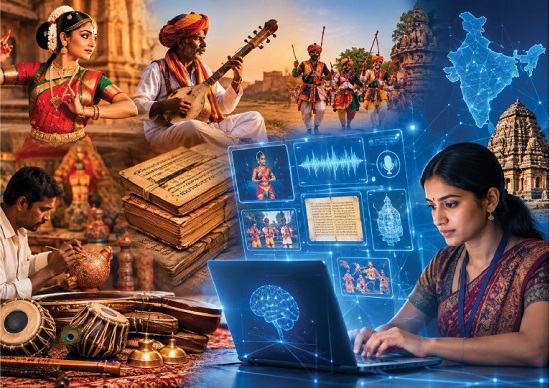
As discussions around Artificial intelligence (AI) become part of our everyday life and the government looks to regulate its use across sectors, there’s one aspect of AI that has remained largely unexplored : how AI can be used to protect India’s Intangible Cultural Traditions (ICT). These include oral traditions, rituals, festive events, performing arts, social practices, any knowledge and practice about the nature and the universe & the knowledge or skills about traditional crafts. These traditions have developed over centuries by communities and are an important part of our cultural heritage that have been passed from generation to generation.
ICT are protected through schemes like the Scheme for Safeguarding the Intangible Heritage and Diverse Cultural Traditions of India. This scheme was released by the Ministry of Culture to reinvigorate and revitalize “various institutions, groups, individuals, identified non-Ministry of Culture (MoC) institutions, non-government organizations, researchers and scholars” in order to enable them to engage in activities/projects for strengthening, protecting, preserving, and promoting the rich intangible cultural heritage of India.
AI’s role in preserving ICT
While this scheme is promising, preserving India’s vast ICT is a mammoth task. As a result, our ICT continue to face the threat of extinction due to a lack of adequate preservation efforts.AI presents an unprecedented opportunity for the preservation and dissemination of ICT. For instance, the Indian government has recently launched the Traditional Knowledge Digital Library (TKDL) initiative that is supported by the World Health Organization (WHO), which is an AI-powered platform that digitizes knowledge about traditional Indian medicine like Ayurveda, Unani, Siddha, Sowa Rigpa, and Homoeopathy.
By using machine earning and natural language processing, TKDL can convert a large number of pages of Sankrit, Tamil, Persian, Arabic and other languages into digital records that are both structured and searchable.
Apart from making traditional medicine wisdom more accessible, the launch of TKDL is also helpful in India’s fight to combat biopiracy. This is because the codification of the traditional knowledge about medicines will now be available to the international patent offices as time stamped and encrypted entries. This means information about India’s traditional medicine will now be documented, and their credit will be attributed to India. This will ensure that any disputes regarding patentability- like those involving turmeric, neem, etc. that happened in the past, will now be avoided due to AI powered documentation.
In his monthly radio program Mann Ki Baat, Prime Minister Narendra Modi highlighted how India is actively deploying Artificial Intelligence (AI) to reconstruct, decode, and preserve its ancient manuscripts. During the 131st episode of Mann Ki Baat (broadcast on February 22, 2026), he shared how global leaders at the India AI Impact Summit in New Delhi were completely amazed by India's tech-driven preservation of its ancient knowledge systems.
How AI is Being Used to Reconstruct & Decode Manuscripts
Using technology to bridge ancient heritage with contemporary times, the initiative focuses on several core AI capabilities :
• Image Enhancement : Advanced digital AI tools enhance the visual quality of highly fragile, damaged, or faded ancient folios.
• Handwritten Text Recognition (HTR) : AI models convert complex, old, and handwritten scripts—which few humans can read today—into clear, machine-readable digital text.
• AI Avatars for Reading : Once converted, specialized AI avatars are used to read out loud the machine-readable texts.
• Global Translation : AI translates this newly uncovered ancient knowledge from classical scripts into multiple modern Indian and international languages.
Examples Highlighted by the Hon’ble Prime Minister
• The Sushrut Samhita Display : PM Modi highlighted the display of ancient medical texts like the Sushrut Samhita undergoing this AI transformation.
• The Udhampur Manuscript : He mentioned a rare ancient manuscript preserved at the Amar Santosh Museum in Udhampur (Jammu), which was digitally enhanced and translated using AI.
• The Modi Script (Modi Lipi) : Educational institutions, such as IIT Roorkee, have developed specialized AI models to read and revive the historical Modi script (used primarily to write the Marathi language centuries ago), unlocking thousands of historical texts.
The Broader Vision : Gyan Bharatam Mission
These efforts are heavily synchronized under the Indian Government's Gyan Bharatam Mission. Over 44 lakh (4.4 million) manuscripts have already been documented, with a goal to scale up to over 1 crore (10 million) texts spanning sciences, philosophy, mathematics, and arts.
All AI-processed texts are being cataloged into a cloud-based National Digital Repository (NDR), allowing students, researchers, and citizens worldwide to seamlessly tap into India’s civilizational wisdom.
It is important to keep in mind that these preservation efforts for ICT cannot be solely carried out by the Government. The involvement of the private sector in these efforts is of utmost importance. Projects like ELLORA by Microsoft that digitize rare languages is an example of how Big Tech companies can play an important role in preserving India’s ICT. Similarly, Google Deep Mind’s AI unit launched a project ‘Multimodal Representation for India’ (Morni) that seeks to develop an AI model that can understand & represent 125 Indian languages & dialects. This will ensure that even those languages that are not well-known or spoken by a small portion of the population are able to be understood & represented in the digital space.
Use of AI to preserve ICT across the world
The Council of Europe has the AI Policy Guidelines in place that includes the safeguarding of culture, creativity, and cultural heritage within its ambit. This policy document is an extensive resource that encapsulates the benefits of leveraging AI to protect ICT, such as democratizing access to cultural heritage, lowering accessibility barriers to understand cultural heritage and traditions, fostering international collaboration, etc.
Similarly, China has been making proactive use of AI to preserve its ICT. Illustratively, in Dongyuan village of East China’s Zhejiang Provine, AI powered VR technology is used to demonstrate the use of preserved wooden movable printing skill. This skill is recognized as a national intangible cultural heritage of China that forms part of UNESCO’s list of Intangible Cultural Heritages in Need of Urgent Safeguarding. Building on its use of AI, the China Mobile Communications Group has been using technologies like holographic images, VR, and 5G to revitalize ICT.
What Should India Do
The benefits of using AI to preserve our ICT need to be expanded further through research and by replicating and customizing to Indian context models that are being adopted globally. India can look at these models to use AI for recapturing dying or almost dead ICT. The Sangeet Natak Akademi (SNA), the nodal agency under the Ministry of Culture that is responsible for digital documentation and archiving of performing arts and other ICH, needs to harness AIto streamline its archiving process as has been done in the case of TDKL library that has been discussed above.
While AI’s use can go a long way in protecting our cultural heritage, it also has the potential to result in large-scale copyright violations and harming the rights of those communities that have developed these cultural traditions.
While there are individual cultural traditions that are protected by intellectual property rights(IPR),that is not the case for our vast ICT. It is crucial that AI is not used to commercialize these traditions at the cost of the community that is responsible for their creation.
(Author is former Member of Parliament in the Rajya Sabha from Odisha.)
(The content of this article reflects the views of writer and contributor, not necessarily those of the publisher and editor. All disputes are subject to the exclusive jurisdiction of competent courts and forums in Delhi/New Delhi only)





















Leave Your Comment