


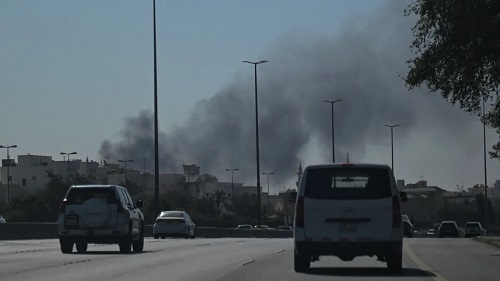
Several United States military aircraft crashed in Kuwait on Monday morning as Iran continued its wave of missile and drone strikes across the Gulf region. Kuwait's Ministry of Defence confirmed the incidents, stating that all crew members survived and were transferred to hospital in stable condition.
The incident marks a significant escalation in the ongoing conflict between US-allied forces and Iran, raising alarm over the safety of American military assets and personnel stationed across the Gulf.
In an official statement, the Kuwaiti Ministry of Defence spokesperson confirmed the crash of multiple US military aircraft and outlined the immediate emergency response that followed.
"The spokesperson for the Ministry of Defence stated that several US military aircraft crashed this morning, confirming the complete safety of their crews. He explained that the relevant authorities immediately initiated search and rescue procedures, whereby the crews were evacuated and transferred to the hospital to check on their health status and provide the necessary medical care, noting that their condition is stable," the statement read.
The ministry further noted that direct coordination had been conducted with US forces to address the circumstances of the incidents. Joint technical measures were also undertaken, and an investigation was launched to determine the precise causes of the crashes.
Kuwait urged the public to obtain information only from official sources as the investigation remains ongoing.
Iranian state broadcaster Press TV amplified the incident on its Telegram channel, publishing what it claimed was a photograph of the American pilot whose US Air Force F-15 Strike Eagle fighter jet was downed over Kuwait. The post, captioned "American pilot after his fighter jet crashed in Kuwait," was shared widely across social media platforms.
Press TV also released visuals of Iran's drone fleet alongside footage purportedly showing Iranian strikes on US and Israeli targets across the Gulf. The imagery was intended to signal the scale and reach of Iran's offensive capabilities as the conflict entered a new phase of intensity.
The F-15 Strike Eagle is one of the United States Air Force's most capable air superiority and multirole fighters. Its downing, if confirmed, would represent one of the most significant losses of US military hardware in the region in decades.
The Kuwait aircraft incidents occurred within a broader and rapidly escalating military confrontation. After a brief overnight lull, Iran resumed its offensive on Monday with fresh missile and drone attacks targeting Israel and Gulf states alike.
Among the most consequential strikes reported was an attack on Saudi Aramco's Ras Tanura refining facility — one of the largest crude oil export terminals in the world. Multiple news outlets, including Russia Today, Press TV Iran, and Israel's i24 News, reported a drone strike on the complex.
The Jerusalem Post, citing a Semafor correspondent, reported that a small, isolated fire had broken out at the facility following the apparent drone strike but was quickly brought under control. The full extent of the damage to infrastructure at Ras Tanura remained unclear at time of publication.
The targeting of Ras Tanura carries significant implications for global energy markets. The facility handles an enormous volume of crude oil exports and is considered a linchpin of global crude flows. Any sustained disruption to the site could send shockwaves through international oil prices and supply chains.
Analysts and energy market observers were closely monitoring the situation, with early reports suggesting oil futures had already begun reacting to news of the strike and the broader regional instability.
The events of Monday represent a stark deterioration in Gulf security. The simultaneous crashing of multiple US aircraft in Kuwait — whether through enemy action, technical failure, or circumstances yet to be determined — combined with Iran's sustained offensive posture, paints a picture of a region pushed to the edge of open warfare.
Investigations by both Kuwaiti and US military authorities are underway. The results of those inquiries will be critical in determining whether the aircraft were brought down by Iranian action or succumbed to other causes — a distinction with enormous geopolitical consequences.






















Leave Your Comment