


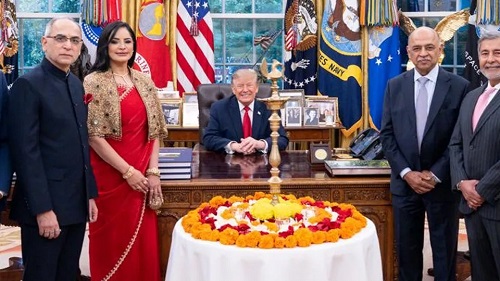
In a significant move towards recognising the cultural diversity of the United States, a group of American lawmakers has renewed its efforts to make Diwali a federally recognised holiday. Led by Congresswoman Grace Meng, the legislation seeks to give the festival, celebrated by millions of Hindus, Sikhs, Jains and Buddhists, a place in the country's official holiday calendar. The renewed initiative also comes amid growing concerns over anti-Hindu and anti-South Asian hostility, adding a wider message of inclusion and recognition to the proposed legislation.
US lawmakers have reintroduced the Diwali Day Act in the House of Representatives, seeking to designate the festival of lights as a federal holiday. The initiative, led by Congresswoman Grace Meng, has secured the support of 19 co-sponsors, among them Indian-origin lawmakers Ami Bera, Raja Krishnamoorthi, Suhas Subramanyam, Shri Thanedar and Ro Khanna.
Meng, who chairs the Congressional Asian Pacific American Caucus (CAPAC), said the legislation was intended not only to acknowledge an important religious and cultural celebration but also to help Americans appreciate the traditions and contributions of diverse communities. She maintained that official recognition would strengthen the country's commitment to inclusiveness and send a clear message that the cultural identities of its people deserve respect.
Explaining the significance of the proposal, Meng said Diwali symbolises the victory of good over evil and knowledge over ignorance. She also pointed to the rise in anti-Hindu and anti-South Asian hostility, arguing that recognising the festival at the federal level would demonstrate that Hindus, Sikhs, Jains and Buddhists are valued members of American society.
The renewed legislative effort follows an earlier attempt by Meng in 2023. She first introduced the Diwali Day Act in the House of Representatives on May 15 that year, during the 118th Congress under President Joe Biden. The proposal was referred to the House Committee on Oversight and Accountability but failed to advance beyond the committee stage and was never brought to a vote.
The original bill had 13 co-sponsors, including Ami Bera, Pramila Jayapal, Ro Khanna, Andy Kim, Josh Gottheimer and Brian Fitzpatrick. Its support subsequently expanded, with a congressional tracking document in November 2024 recording 16 co-sponsors. The latest reintroduction, with 19 lawmakers backing the measure, indicates that the campaign for official recognition continues to attract bipartisan attention.
The proposed legislation seeks to amend Section 6103(a) of Title 5 of the US Code, which specifies the country's federal holidays, by incorporating Diwali Day into the list. If approved by both chambers of Congress and signed into law by the President, Diwali would become the 12th federally recognised holiday in the United States. Federal employees would receive a day off, while the designation would provide formal national recognition to a festival observed by millions across the country.
The proposal has significance beyond the question of an additional holiday. CAPAC has drawn attention to incidents involving vandalism at Hindu places of worship, an attempted mass shooting during Navratri celebrations at a temple in Illinois, and the disruption of a Diwali event in Washington state. The caucus has called for such incidents to be taken seriously and investigated by federal authorities.
For supporters, making Diwali a federal holiday would represent a public acknowledgement of the religious, cultural and social diversity that defines contemporary America. It would also recognise the growing presence and contribution of South Asian communities to the country's national life.
Meng has pursued a similar approach towards the recognition of other cultural celebrations, including Lunar New Year, through separate legislation known as the Lunar New Year Day Act. Whether the renewed Diwali proposal can overcome the legislative hurdles that stalled its earlier version remains to be seen. However, its reintroduction has once again brought the question of Diwali's place in America's national calendar into the congressional debate.


















Leave Your Comment