


India’s nuclear-energy story is often told through reactors, scientists and landmark technological achievements. Yet beneath that visible architecture lies a less discussed but equally critical foundation—the ability to locate, mine, process and manage the uranium required to sustain the nuclear fuel cycle. As the Uranium Corporation of India Limited (UCIL) enters its Diamond Jubilee Year, its six-decade journey offers an important perspective on how India gradually built indigenous capability in a strategically sensitive sector. The celebrations at Jaduguda on October 4, 2026, were therefore not merely a commemoration of the past, but a reminder of the technological, institutional and human capacity that will become increasingly important as India expands the role of nuclear energy.
Established on October 4, 1967, UCIL has been an integral part of India’s efforts to develop indigenous uranium mining and processing capabilities. Its significance extends well beyond the extraction of a mineral. Uranium is a strategic resource, and the ability to develop domestic expertise in mining and processing is closely linked to the larger objective of strengthening national capability in nuclear energy.
Over six decades, UCIL has developed expertise spanning underground and opencast mining, ore handling and processing, technology development, occupational safety, radiation protection and environmental management. The evolution demonstrates how a specialised mining organisation can gradually become an important component of a sophisticated technological ecosystem.
The Diamond Jubilee celebrations at Jaduguda brought together scientists, engineers, technical personnel, employees, senior officials, media representatives and other stakeholders. Their presence highlighted an often-overlooked dimension of strategic industries: institutions are sustained not merely by infrastructure, but by generations of skilled personnel who acquire specialised knowledge and pass it forward.
Ms. Seema Jain, Member-Finance, Atomic Energy Commission, who attended the celebrations as Chief Guest, underlined this institutional continuity. She paid tribute to Dr Homi Jehangir Bhabha and the pioneers who laid the foundations of India’s uranium-mining and processing capabilities, while recognising the dedication of UCIL personnel who have worked in challenging conditions.
That history matters because India’s nuclear ambitions are entering a new phase. The Nuclear Energy Mission envisages a greater role for nuclear power in meeting the country's long-term energy requirements. Such an expansion will require not only new generating capacity, but also stronger capabilities across the entire nuclear-energy value chain.
One of the most significant features of the Diamond Jubilee programme was the Journalists’ Workshop at the Information Centre, Narwapahar. Its importance went beyond being a media event. Nuclear technology is frequently surrounded by technical complexity and public apprehension. Providing journalists with direct exposure to mining, milling and associated technologies can help bridge the gap between specialised scientific work and public understanding.
The participating media delegates visited UCIL’s uranium mining and milling facilities and interacted with scientists, engineers and technical experts. Such first-hand exposure allows reporting on nuclear energy to move beyond abstract debates and towards a more informed understanding of the systems, safeguards and people involved.
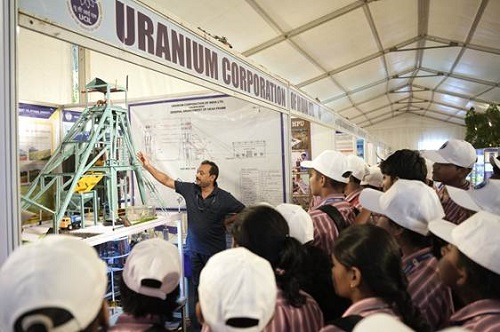
The accompanying DAE Technology Exhibition added another dimension. Organised especially for school students, it showcased industrial and societal applications emerging from the Department of Atomic Energy’s units and institutions. This outreach is significant because the future of India's nuclear programme will depend not only on infrastructure and investment but also on a sustained pipeline of scientific and technical talent.
Introducing students to nuclear technology at an early stage can help demystify the subject and demonstrate that atomic energy has applications extending beyond electricity generation. It can also encourage young people to view nuclear science as a field of innovation, research and national development.
The Diamond Jubilee celebrations also provided an opportunity to look at UCIL’s technological future. Ms. Seema Jain visited the Technology Demonstration Pilot Plant at C, R&D, Jaduguda, as well as the proposed new site of the Dark Matter Laboratory of the Saha Institute of Nuclear Physics at the 815-metre level of the Jaduguda underground mine.
These visits illustrate an interesting convergence of mining infrastructure, scientific research and advanced technology. They also underline the broader scientific ecosystem associated with the Department of Atomic Energy.
UCIL Chairman and Managing Director Dr Kacham Anand Rao described the anniversary as a proud milestone for the organisation and highlighted its continuing work in technology, safety and environmental management. His emphasis is particularly relevant because the credibility of any modern mining organisation increasingly depends on how responsibly it manages occupational safety, environmental concerns and technological risks.
The next phase, therefore, cannot simply be about producing more uranium. It must involve improving efficiency, strengthening safety systems, modernising technologies, developing human resources and maintaining public confidence.
The message from the Diamond Jubilee celebrations is consequently larger than the anniversary itself. UCIL represents six decades of accumulated expertise in an area that remains strategically important to India. As the country seeks to expand nuclear energy as part of a broader low-carbon and energy-security strategy, institutions supporting the nuclear fuel cycle will inevitably assume greater importance.
UCIL’s journey from its establishment in 1967 to its Diamond Jubilee Year in 2026 reflects the long-term nature of strategic nation-building. Nuclear capability cannot be created overnight; it is built through institutions, technology, infrastructure and generations of specialised personnel.
The celebrations at Jaduguda thus looked simultaneously backwards and forwards. They honoured the pioneers who established India’s uranium-mining capabilities, recognised the employees who sustained them and pointed towards a future in which technological innovation and responsible resource management will be central to India’s nuclear-energy ambitions.



















Leave Your Comment