


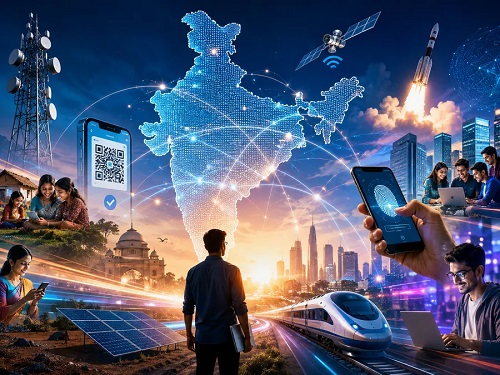
India is steadily emerging as a global technology innovator, moving beyond its traditional role as a consumer of technological products and services to becoming a creator of indigenous solutions. Union Communications Minister Jyotiraditya Scindia has highlighted this transformation, pointing to the country's rapidly expanding startup ecosystem, unprecedented growth in digital connectivity and declining data costs as indicators of its technological progress. Addressing the Telecom Startups and MSME Conclave 2026 in New Delhi, Scindia said India's next big ambition was to achieve technological self-reliance and eventually make the world depend on its innovations.
India's telecommunications sector is undergoing a significant transformation, with domestic innovation, expanding digital infrastructure and entrepreneurial growth increasingly shaping the country's technological ambitions. Union Communications Minister Jyotiraditya Scindia has asserted that India has moved decisively from being a consumer of technology to becoming a creator, reflecting the growing capabilities of its indigenous technology ecosystem. Addressing the Telecom Startups and MSME Conclave 2026 in New Delhi, he said the country was progressing towards a future in which technological dependence would increasingly shift in India's favour, with the world looking towards Indian innovations and solutions.
Highlighting the expansion of India's startup ecosystem, Scindia said the number of startups had increased from just a few hundred in 2014 to more than two lakh today. This expansion, he indicated, reflected the growing confidence of entrepreneurs, improved opportunities for innovation and the emergence of a supportive environment for new businesses. The telecommunications sector has been an important contributor to this transformation, with digital connectivity reaching unprecedented levels. India now has more than 110 crore internet connections, compared with approximately 25 crore in 2014. Broadband connectivity has witnessed equally remarkable growth, rising from around six crore connections to more than 104 crore. The country's total telephone connections have also crossed 133 crore, demonstrating the scale at which communication infrastructure has expanded.
One of the most significant changes has been the sharp reduction in mobile data costs, which has made internet access increasingly affordable for millions of people. According to Scindia, the price of data has fallen by approximately 97 per cent, declining from ₹269 per GB in March 2014 to around ₹8 per GB. This reduction has helped expand digital participation, strengthened access to online services and created new opportunities for businesses, students and entrepreneurs. Affordable connectivity has also enabled digital services to reach smaller towns and rural communities, bringing more people into the country's expanding digital economy.
The minister emphasised that India's technological journey was now entering a more ambitious phase, with self-reliance emerging as a central objective. The focus, he suggested, should no longer remain limited to expanding access to technologies developed elsewhere but should increasingly involve designing, developing and manufacturing indigenous products that can compete in international markets. Such a transition would strengthen domestic capabilities, reduce dependence on imported technologies and position India as a significant contributor to global telecommunications innovation.
Scindia also underscored the importance of micro, small and medium enterprises (MSMEs), describing them as the backbone of the Indian economy. Their contribution to employment generation, industrial development and entrepreneurship makes them indispensable to the country's broader economic ambitions. In the telecommunications sector, MSMEs and startups can play a particularly important role by developing specialised technologies, creating innovative products and providing solutions to emerging industry requirements. However, their ability to grow depends on access to investment, research facilities, skilled manpower, markets and opportunities to collaborate with established industry players.
During the conclave, Scindia inaugurated an exhibition featuring startups and MSMEs working in the telecommunications and technology sectors. The event brought together emerging entrepreneurs, domestic manufacturers, industry leaders and other stakeholders on a common platform to showcase indigenous technologies and examine the challenges confronting homegrown innovators. Dedicated exhibition stalls provided startups and smaller enterprises with an opportunity to demonstrate their products and solutions, connect with potential partners and explore possibilities for commercial expansion.
The conclave also sought to encourage discussions on scaling up domestic innovations and taking locally developed telecom solutions to wider markets. For startups and MSMEs, such interactions can help bridge the gap between technological experimentation and commercial success. Greater cooperation between entrepreneurs, established companies and policymakers will be essential to building a competitive domestic telecom manufacturing ecosystem.
India's expanding digital infrastructure has created a substantial foundation for this next phase of development. The challenge now is to translate the country's growing connectivity and entrepreneurial strength into globally competitive products, intellectual property and technological capabilities. Scindia's message at the conclave reflected this larger ambition: India wants to move beyond being a large market for technology and establish itself as a country that develops solutions for the world.






















Leave Your Comment