



VAIBHAV DANGE
If one were to capture the first twelve years of the Modi era in a single word, that word would be connectivity.
Connectivity of roads and highways. Connectivity through railways and airports. Connectivity through ports and waterways. Connectivity of cities through metro systems. Connectivity of remote regions to the mainstream economy. Above all, connectivity between aspiration and opportunity.
As the Narendra Modi government completes twelve years in office, there will be many debates about politics, ideology, welfare programmes and electoral strategies. However, one area where the impact of governance is visible, measurable and difficult to ignore is infrastructure.
Roads, highways, railways, airports, ports, waterways, metro systems, logistics parks, tunnels, bridges and digital infrastructure have emerged as defining symbols of governance during the Modi era. More importantly, these are not isolated projects concentrated in a few metropolitan regions. The transformation is visible across geographies and sectors—from the mountains of Kashmir to the coasts of Kanyakumari, from the North-East to Gujarat, from border districts to tourist circuits, from Tier-2 cities to some of India’s most remote regions.
Infrastructure has become the most visible manifestation of governance. While political narratives often divide opinion, a new expressway, a modern railway station, a newly operational airport or a metro network reducing daily travel time creates an impact that citizens experience directly. It changes lives, expands opportunities and strengthens economic activity.
The story of the last twelve years is therefore not merely a story of construction. It is the story of a governance model that placed execution, delivery and connectivity at the centre of national development.
Infrastructure Transformation by Numbers
The scale of infrastructure expansion over the last twelve years becomes evident when one looks at the numbers across sectors.
Roads and Highways
In 2014, India’s National Highway network stood at approximately 96,000 kilometres. Today, it has expanded to more than 1.46 lakh kilometres, making it one of the largest and fastest-growing highway networks in the world.
The pace of highway construction increased dramatically from around 11 kilometres per day in 2014 to over 35 kilometres per day during the peak years of the Modi government.
Projects such as the Delhi-Mumbai Expressway, Dwarka Expressway, Bengaluru-Chennai Expressway, Delhi-Dehradun Expressway, multiple economic corridors and access-controlled highways are transforming mobility across India. Travel times that once took an entire day are now being reduced by several hours.
The Bharatmala programme has further strengthened border connectivity, coastal roads, economic corridors and inter-state transportation networks. Highways are no longer merely transport projects; they are economic growth corridors connecting manufacturing centres, logistics hubs, tourist destinations and rural markets.
Railways
Indian Railways has undergone one of the most extensive modernization drives in its history.
More than 45,000 route kilometres have been electrified since 2014, taking India close to complete electrification of its broad-gauge network. This has reduced fuel dependence, improved efficiency and lowered operating costs.
The introduction of Vande Bharat trains has transformed passenger expectations regarding speed, comfort and reliability. Simultaneously, the redevelopment of more than 1,300 railway stations under the Amrit Bharat Station Scheme is modernising India’s railway infrastructure at an unprecedented scale.
Perhaps the most significant structural reform has been the completion of large sections of the Dedicated Freight Corridors. For decades, freight and passenger traffic competed for the same rail infrastructure, causing inefficiencies. Dedicated Freight Corridors are changing that equation by improving logistics efficiency and enabling faster movement of goods across the country.
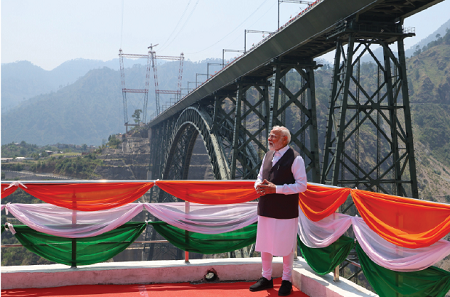
Major engineering accomplishments such as the Chenab Rail Bridge and rapid expansion of rail connectivity in the North-East further demonstrate the government’s commitment to integrating every region into the national growth story.
Aviation and Airports
Few sectors demonstrate the government’s connectivity vision more effectively than civil aviation.
In 2014, India had approximately 74–75 operational airports. Today, the number has crossed 150 airports, heliports and water aerodromes.
The UDAN (Ude Desh ka Aam Nagrik) scheme has fundamentally altered regional connectivity by linking smaller cities and remote regions to India’s aviation network. Airports have emerged not only in major urban centres but also in regions that historically remained disconnected from mainstream economic activity.
For millions of Indians, air travel is no longer a luxury. It has become a practical transportation option. Improved connectivity has boosted tourism, business activity, healthcare access and investment opportunities in numerous regions.
Metro Rail and Urban Transport
Urban transportation has witnessed a revolution.
In 2014, metro rail services were operational in only about five to six Indian cities. Today, metro systems are operational in more than 23 cities, while several others are under construction.
India’s metro network has expanded from roughly 250 kilometres in 2014 to well over 1,000 kilometres today. Cities such as Pune, Nagpur, Ahmedabad, Kanpur, Agra, Kochi, Hyderabad, Mumbai and Bengaluru have witnessed major metro expansion.
The Regional Rapid Transit System (RRTS), multimodal transport hubs and modernization of urban transit systems reflect a broader vision of improving urban productivity and quality of life.
Ports and Waterways
India’s maritime infrastructure has also witnessed substantial growth.
Port capacity has nearly doubled during the last decade. Through the Sagarmala programme, investments have been made in port modernization, connectivity projects and coastal economic development.
Equally significant has been the revival of inland waterways. For decades, waterways remained underutilized despite being one of the most cost-effective modes of transportation. Today, inland waterways are increasingly being integrated into India’s logistics architecture.
The development of river-based cargo movement and multimodal transport systems has opened a new chapter in India’s transportation strategy.
Logistics and Multimodal Connectivity
Infrastructure today is not merely about roads, railways or ports individually. It is about creating an integrated logistics ecosystem.
Dedicated Freight Corridors, multimodal logistics parks, industrial corridors, freight terminals and PM GatiShakti have fundamentally altered India’s approach towards logistics planning.
For decades, high logistics costs reduced India’s competitiveness. The effort today is to create seamless movement of goods across highways, railways, ports and airports, thereby reducing costs and improving efficiency.
Taken together, these investments represent not isolated achievements but a comprehensive transformation of India’s physical infrastructure ecosystem.
Connectivity Beyond Metropolitan India
One of the most remarkable aspects of the last twelve years is that infrastructure development has not remained confined to a few urban centres.
Historically, infrastructure investment often concentrated around major cities. Under Prime Minister Narendra Modi’s leadership, connectivity has increasingly reached regions that were once considered peripheral to India’s growth story.
The North-East provides perhaps the strongest example.
New highways, rail projects, bridges and airport infrastructure have brought the region closer to the national economic mainstream. Areas that once struggled with connectivity are now increasingly integrated into national markets and supply chains.
Jammu & Kashmir has witnessed transformational investments in tunnels, highways, rail infrastructure and strategic connectivity projects. Engineering marvels such as the Chenab Rail Bridge, Z more and Zozila tunnel symbolize not merely technological achievement but national integration.
Border regions have received unprecedented attention. Connectivity is now viewed not merely through the lens of national security but also through the lens of economic development.
Tourism circuits have similarly benefited.
Whether it is Char Dham connectivity, Buddhist circuits, coastal tourism, heritage destinations, spiritual centres or eco-tourism hubs, improved infrastructure has unlocked enormous economic opportunities.
The impact is visible across the country. Better roads mean farmers can access markets faster. Better airports bring tourists and investment. Better railways reduce transportation costs. Better logistics create employment opportunities.
Infrastructure has become the bridge connecting aspiration with opportunity.
Why Was This Transformation Possible?
The obvious question is why this scale of transformation became possible during the last twelve years.
Several factors explain the success.

The Prime Minister, Shri Narendra Modi dedicates to the nation the World’s longest
Highway tunnel - Atal Tunnel, in Manali, Himachal Pradesh on October 03, 2020.
Massive Increase in Capital Expenditure
The first and perhaps most important factor is the government’s sustained emphasis on capital expenditure.
For decades, Indian politics often focused disproportionately on short-term consumption expenditure. The Modi government consciously shifted the focus towards long-term asset creation.
Public capital expenditure has increased several-fold over the last decade, crossing ₹11–12 lakh crore annually.
This sustained investment created the financial foundation necessary for large-scale infrastructure expansion.
Unlike short-term spending, infrastructure creates productive assets that continue generating economic benefits for decades.
PM GatiShakti and Integrated Planning
Historically, infrastructure development suffered from fragmented planning.
Roads, railways, ports, power networks and urban development projects were often executed in silos.
PM GatiShakti introduced a fundamentally different approach.
Through technology-driven planning and coordination among multiple ministries, projects could be designed and executed with greater efficiency. Infrastructure stopped being a collection of individual projects and became part of a larger national strategy.
Faster Decision-Making and Execution
One of the recurring criticisms of previous eras was policy paralysis and project delays.
The Modi government prioritized time-bound approvals, continuous monitoring and faster decision-making.
Thousands of stalled projects were revived. Ministries were encouraged to focus on execution rather than announcements.
The emphasis shifted from laying foundation stones to completing projects.
This cultural change in governance significantly accelerated infrastructure delivery.
Technology as an Enabler
Technology has played a critical role in improving efficiency.
Digital project monitoring, GIS-based planning, FASTag, DigiYatra, satellite mapping, electronic procurement systems and real-time tracking mechanisms have transformed how infrastructure is planned and executed.
Technology has reduced delays, increased transparency and improved accountability.
In many ways, India’s infrastructure revolution has also been a governance technology revolution.
Transparency and Corruption-Free Processes
A significant contributor to faster execution has been the emphasis on transparency.
Digital tendering, online approvals, direct monitoring and technology-based governance mechanisms have reduced opportunities for leakages and discretionary decision-making.
Supporters of the government argue that one of the reasons infrastructure delivery accelerated was because public resources increasingly reached projects rather than getting trapped in inefficiencies.
Whether one looks at roads, railways, airports or logistics projects, the emphasis on transparent processes has strengthened execution capacity.
Leadership Vision and Relentless Execution
Large-scale infrastructure transformation does not happen merely through budgetary allocations. It requires political vision, administrative coordination and relentless execution.
Prime Minister Narendra Modi placed infrastructure at the centre of governance from the very beginning of his tenure. Unlike earlier approaches where infrastructure development was often treated as a sectoral issue, the Modi government viewed connectivity as the foundation for economic growth, national integration and social mobility.
However, vision alone is not enough. The distinguishing feature of the last twelve years has been the government’s ability to translate vision into execution.
A key role in this transformation has been played by ministers who combined political commitment with execution capabilities. Union Minister for Road Transport and Highways, Nitin Gadkari, emerged as one of the most effective faces of infrastructure delivery. Known for his extraordinary execution capabilities, problem-solving approach and ability to cut through administrative bottlenecks, Gadkari became synonymous with India’s highway revolution.
Whether it was accelerating stalled projects, innovating financing mechanisms, adopting new construction technologies or ensuring strict monitoring of project timelines, the focus remained firmly on delivery.
The same execution-oriented approach became visible across ministries responsible for railways, aviation, ports and urban infrastructure. The result was a government machinery that increasingly focused on outcomes rather than announcements.
This combination of leadership vision at the top and execution capability within the government created the conditions for infrastructure expansion on a scale not witnessed in independent India.
The story of the last twelve years is therefore not merely about roads, railways or airports. It is about the ability of political leadership to conceive ambitious goals and build institutions capable of delivering them on the ground.
Infrastructure as Political Capital
One of the defining features of contemporary Indian politics is that governance and delivery have increasingly become electoral issues.
Citizens today are more aspirational than ever before. They seek jobs, mobility, opportunities, better quality of life and improved public services.
Infrastructure directly addresses these aspirations.
A young entrepreneur benefits from better logistics. A student benefits from improved connectivity. A tourist destination benefits from better roads and airports. A manufacturer benefits from lower transportation costs.
Infrastructure therefore creates visible evidence of governance.
This explains why infrastructure has become one of the strongest pillars of the Modi government’s political appeal. Unlike many political promises, infrastructure can be seen, experienced and measured.
The government has successfully built a reputation around delivery-oriented governance. For many voters, particularly younger Indians, governance is increasingly evaluated through outcomes rather than rhetoric.
For supporters of the government, this transformation represents proof that decisive leadership, transparent governance, sustained capital investment and relentless execution can alter the trajectory of a nation. For political observers, it offers an important lesson: governments are ultimately judged not only by what they promise, but by what they build.
And in the India of today, few achievements are as visible, as consequential and as politically significant as the infrastructure revolution that has unfolded over the last twelve years.
(The content of this article reflects the views of writer and contributor, not necessarily those of the publisher and editor. All disputes are subject to the exclusive jurisdiction of competent courts and forums in Delhi/New Delhi only)




















Leave Your Comment