


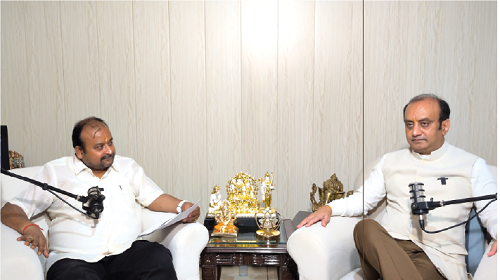
Over the last twelve years, Narendra Modi has emerged as one of the most influential political leaders in contemporary India. His supporters describe this period as an era of transformation, while his critics continue to raise questions about his policies and governance. To dwell on the achievements, challenges, and legacy of these twelve years, Deepak Kumar Rath spoke to BJP National Spokesperson and Rajya Sabha Member, Dr. Sudhanshu Trivedi. Dr. Trivedi is known for his deep knowledge of Indian history, politics, economics, culture, and civilizational thought. Whether it is the Ramayana, Mahabharata, Bhagavad Gita, constitutional issues, or contemporary political debates, he is regarded as one of the BJP’s most articulate voices. Given below are excerpts of this discussion.
To understand the significance of Narendra Modi’s leadership, we must first understand the historical importance of 2014. When the BJP came to power under Modi’s leadership with a clear majority, it was viewed by many as a watershed moment in Indian politics. I often recall an editorial published in a London newspaper shortly after the election results. The editorial described Modi’s victory as India’s “Second Tryst with Destiny,” drawing a comparison with Jawaharlal Nehru’s famous speech on the eve of Independence.
The reason for this comparison, according to the editorial, was that after Independence, India was governed for decades by political forces that continued to carry the intellectual and administrative legacy of British colonial rule. For the first time, a government had come to power with a clear mandate and with an ideological conviction that sought to free India from those lingering colonial influences. The argument was that India had achieved political freedom in 1947, but many institutions, laws, and systems continued to operate under a colonial mindset. Modi’s government sought to address this.
One can see this in many areas. There has been an effort to restore confidence in India’s civilizational heritage, to strengthen national identity, to reform governance, and to modernize infrastructure. Initiatives related to digital governance, direct benefit transfers, infrastructure expansion, financial inclusion, and welfare delivery have transformed the way the government interacts with citizens. At the same time, issues that were once considered politically impossible, such as the movement toward a Uniform Civil Code in some states, have entered mainstream policy discussions. Uttarakhand, Gujarat and Assam have adopted Uniform Civil Code and Madhya Pradesh is moving forward in this direction.
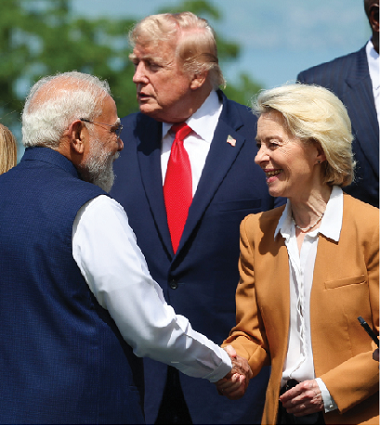
PM interacting with world leaders at the G7 Summit venue in Evian, France on June 16, 2026.
No government can claim perfection. We must remember the circumstances under which Modi’s second and third terms have been conducted. The world experienced a once-in-a-century pandemic. The COVID-19 crisis disrupted economies across the globe. Then came the Russia–Ukraine conflict, which created uncertainty in energy markets and global supply chains. More recently, instability in the Gulf region has added further pressure to the global economy.
Had these extraordinary circumstances not occurred, India might have progressed even further than it has. If there is one area where I would have liked to see complete success, it is the elimination of terrorism. Consider the challenge India has faced for decades. Yet even here, I would argue that the limitation is not solely governmental. India may be one of the few countries where political leaders from the opposition have, at times, appeared reluctant to take a unified position against terrorism. There have been occasions when convicted terrorists have received sympathy from political figures. Such attitudes weaken national unity on a critical issue. Had there been complete consensus across the political spectrum, India could have moved much closer to becoming entirely free from terrorism.
The best answer is to compare facts rather than rhetoric. Let us look at India before 2014. Inflation was frequently above ten per cent. Economic growth had slowed considerably. Investor confidence was weakening. Terrorist attacks occurred with alarming frequency across major cities. Bomb blasts were reported in Delhi, Mumbai, Jaipur, Bengaluru, Varanasi, Lucknow, Guwahati, and many other places.
Now compare that with the present situation. India remains one of the fastest-growing major economies in the world. The International Monetary Fund has projected growth rates significantly higher than the global average and has repeatedly stated that India’s economic fundamentals remain strong. The World Economic Forum has described India as one of the most attractive destinations for investment under current global conditions.
We also have concrete examples. Major technology companies have announced significant investments in India. Global manufacturers have expanded their operations here. India has become a major production hub for advanced smartphones and electronics. These developments are not based on political speeches; they are decisions made by international investors based on economic realities.
Therefore, when Rahul Gandhi claims that India’s progress has slowed, one must ask: compared to what? Compared to a period when inflation was in double digits and growth had weakened? The facts simply do not support that argument.
I believe the comparison itself is problematic because the two leaders came from entirely different circumstances. Jawaharlal Nehru belonged to one of India’s most influential and privileged families. Narendra Modi rose from a humble background through decades of political work and public engagement.
Their journeys were fundamentally different. Modi’s rise was based on grassroots politics and repeated electoral validation. He became Prime Minister after receiving a clear democratic mandate and has maintained public support through multiple elections.
Supporters of Modi often emphasize this contrast. Nehru entered leadership during a unique historical moment as India emerged from colonial rule. Modi, by contrast, became Prime Minister through a competitive democratic process in a mature electoral system. The social backgrounds, political experiences, and challenges faced by the two leaders were entirely different.
There is no doubt that post-Independence governments contributed to institution-building. However, the narrative that India’s scientific and technological achievements began only after 1947 is historically inaccurate.
Now come to this point that Nehru elevated science and technology in the country. When was the first thermal power plant built in the country? It was in 1897 in Kolkata when Nehru was eight years old. When was the first hydel power plant built? It was the Shiv Samudram power project, which was built by the Maharaja of Mysore, when Nehru was two years old. Indian Institute of Science in Bengaluru was constructed by Maharaja of Mysore in 1916. The first dam of the country was constructed by Sir M. Visvesvaraya in 1922-24. Sir M. Visvesvaraya led major engineering and irrigation projects.
Long before Independence, India produced world-class scientists and innovators. Sir C. V. Raman won the Nobel Prize in Physics in 1930. Satyendra Nath Bose made foundational contributions to modern physics. Jagadish Chandra Bose pioneered research in wireless communication. Meghnad Saha gained international recognition for his work in astrophysics and he should have been awarded the Nobel prize. But it could not have been done because of our weak government.
India’s scientific capabilities did not suddenly emerge after Independence. They were built over generations by talented individuals, many of whom worked before 1947. Likewise, significant infrastructure projects, including hydroelectric facilities and irrigation systems, existed before Independence. Therefore, it would be unfair to suggest that all progress can be credited to one political party or one era.
Because governance is ultimately about delivery. Citizens judge governments not by slogans but by outcomes. People want to see roads, railways, airports, digital services, and improvements in their daily lives.
Under Modi’s leadership, there has been a strong emphasis on implementation. Welfare benefits increasingly reach citizens directly. Technology has reduced leakages in government programs. Infrastructure projects are completed more quickly. Public services have become more accessible through digital platforms.
Good governance is not an abstract concept. It must be visible and measurable. When citizens experience tangible improvements, they develop confidence in leadership. That is one reason why Modi’s governance model resonates with a large section of the electorate.
But to counter this image, the opposition and other destructive powers are resorting to Sam, Dam, Dand and Bhed. Earlier, there was only a Hindi-Tamil fight. Now to divide the country, there is Hindi- Kannada fight, Hindi-Marathi fight. So much so that the TMC government in Bengal is out, otherwise there would have been a Hindi Bangla fight too. There is the Agda-Pichhda fight, north-south fight and so on and so forth.
Not entirely. If public perception were genuinely negative, Narendra Modi would not have been elected Prime Minister three times. Electoral success itself indicates that a significant portion of the public has a favorable view of his leadership.
That said, there is indeed a battle of narratives. India’s rise on the global stage is not welcomed by everyone. As India grows economically, strategically, and diplomatically, there are forces—both domestic and international—that may prefer to slow or challenge that rise.
What many people describe as a perception problem is actually a contest between competing narratives about India’s future. One narrative emphasizes confidence, growth, and national strength. Another focuses on division and criticism. This struggle over narratives is becoming increasingly important in modern politics.
Historically, there are four methods of influencing or weakening a nation: persuasion, incentives, pressure, and division. In Indian political thought, these are often described as Saam, Daam, Dand, and Bhed.
My argument is that India has increasingly resisted persuasion, inducements, and external pressure. Therefore, division becomes the preferred strategy for those who wish to weaken national unity.
Today we see narratives that seek to create divisions between North and South, between states, between linguistic communities, and between social groups. Statements suggesting that one region subsidizes another or that one community is superior to another can be highly damaging.
India’s greatest strength has always been its ability to remain united despite immense diversity. If citizens begin to view one another through the lens of regional or linguistic hostility, national cohesion suffers. Therefore, we must remain vigilant against attempts to deepen such divisions.
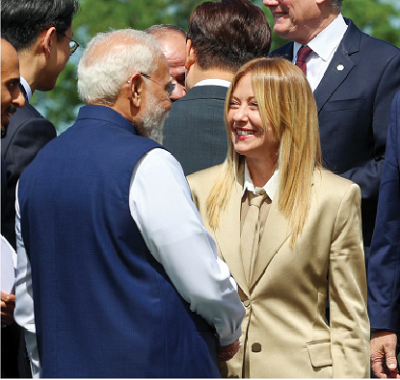
PM Modi interacting with Italian PM Georgia Melony at the G7 Summit venue in Evian, France on June 16, 2026.
Before we conclude, let me ask about a recent controversy. Congress leaders have questioned why the RSS is not registered in the same way as many other organizations. What is your response?
The RSS has been debated and scrutinized for decades. Various governments, including Congress governments, imposed restrictions on it at different times. Yet each time, the matter ultimately came before legal and judicial institutions. My body is dedicated, my mind is dedicated, and this entire life is dedicated. I wish to offer even more to the soil of this nation." And I want to tell Priyank Kharge: In the North-East, hundreds of RSS workers and pracharaks have sacrificed their lives. They have lost their lives in Kerala. They have sacrificed their lives in Bengal, where even your own party workers were killed and your leaders could barely speak out.
Whether in Kashmir, during the period of terrorism in Punjab, while fighting communists and extremists, during the Emergency when they went to jail, or when they were targeted under the so-called false narrative of "Hindu terrorism" promoted by your government, they continued their work without expecting anything in return.
Let me also explain what was traditionally expected from someone joining the Sangh. First, you should have a good career and strong qualifications. Then, you must be willing to leave that career behind, give up your profession, your job, your home, your family life, your wealth, and your possessions. You should be prepared to live a life of simplicity, almost like living in a hostel throughout your life.
Not only that, you must be ready to go wherever in the country you are asked to serve, even if it means putting your life at risk. How can such dedication be measured in material terms? The work they do is priceless.
Your mindset, however, can be understood from your own political culture. Even the wife of your former Punjab Congress president, Navjot Sidhu, once remarked that no one could even aspire to become Chief Minister without having at least ₹500 crore. In your states, funds meant for welfare schemes can become entangled in corruption.
On the other hand, look at the cases involving Sonia Gandhi and Rahul Gandhi, who are out on bail in legal matters. Critics argue that assets associated with institutions connected to the freedom movement were treated as if they belonged to a private organization.
The Sangh’s philosophy is entirely different. It teaches that everything should be dedicated to the nation—our dreams, our efforts, our questions, our aspirations, and even our lives.
Its message is: "Everything is dedicated to the nation."
Whereas your approach appears to be the opposite: "Everything should be dedicated to me."
That is why I believe there is a vast difference—a difference as wide as the distance between the earth and the sky—between these two ways of thinking.
The key point is that courts and tribunals repeatedly examined the evidence. If allegations were made, they were tested through legal processes. Therefore, discussions about the RSS should be based on facts and judicial findings rather than political accusations.
My view is simple: if someone wishes to criticize an organization, they should do so with evidence. Public discourse becomes healthier when arguments are grounded in facts rather than assumptions.
Rahul Gandhi undertakes so many foreign trips to damage the image of India. Recently, he went to the Andaman & Nicobar Island to protest against a project that will serve as India's lifeline in that region strategically and militarily. So, why does he do this?
There has been no other Leader of Opposition in the Lok Sabha who has undertaken as many foreign trips as Rahul Gandhi and there he speaks ill of the country. Just two sessions ago, he went to Germany to understand the Congress party. Why did he go to Germany to understand Congress? If anyone was going to go, party president Kharge or general secretary Venugopal should have gone instead. In 2023, he went to Texas in a university, where he said that China has controlled its unemployment, whereas there was 21 per cent unemployment and the condition was so threatening that China stopped giving data about it. You may be having ill-will against India, but why do you want to damage the interests of Bharat? Before 2004, India was exporting more and importing less. Then what happened in a decade, after 2004, that we were a 34 billion dollars trade deficit country with China. At that time there was more trade duty on the components of a mobile from China than that on the whole of a mobile.
Now we come to the Andaman and Nicobar project. China itself has admitted that the Strait of Malacca is a bottleneck for its ships carrying fuel, energy, petro-products and other items. Against this backdrop, the Andaman and Island project will keep an eye on this bottleneck as our navy strength will increase many-fold.
Finally, Dr. Trivedi, if you had to summarize Narendra Modi’s legacy after twelve years in a few words, what would those words be?
I would summarize it through five broad themes: governance, economic growth, national security, global recognition, and cultural confidence.
Governance, because there has been a sustained emphasis on implementation and accountability. Economic growth, because India has remained one of the fastest-growing major economies. National security, because the government has adopted a more assertive approach toward terrorism and border challenges. Global recognition, because India’s voice carries greater weight in international affairs today. And cultural confidence, because there has been a renewed effort to reconnect India with its civilizational roots and heritage.
History will ultimately judge every leader. Different people will reach different conclusions. But there is no doubt that Narendra Modi’s twelve years in office have had a profound impact on India’s political landscape, its national aspirations, and its place in the world.




















Leave Your Comment