


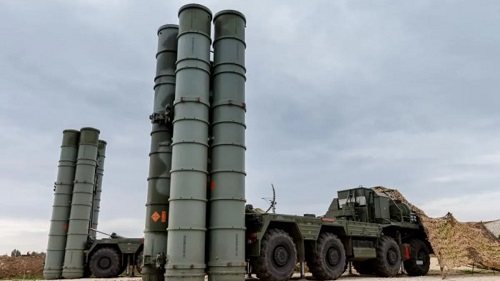
Turkiye has reportedly agreed to sell its Russian-made S-400 Triumf air defence system to a Gulf nation, a move that could pave the way for the restoration of defence ties with the United States and revive Ankara's long-standing ambition to acquire the fifth-generation F-35 stealth fighter jets. While there has been no official confirmation from the Turkish government, reports in the country's pro-government daily Hurriyet suggest that the deal has been finalised and is expected to be announced soon.
According to Hurriyet columnist Abdulkadir Selvi, Türkiye has completed the sale of the S-400 system to a third country, believed to be either the United Arab Emirates (UAE) or Qatar. Selvi claimed that Ankara had also resolved "certain issues" surrounding the transaction and that the Russian-made missile defence systems would soon be transferred to a Persian Gulf nation. The reported development comes at a crucial time when Ankara is seeking to normalise defence cooperation with Washington.
The reported sale follows remarks by US President Donald Trump during the NATO summit held in Türkiye on July 7-8, where he signalled that Washington was prepared to reconsider the sale of F-35 stealth fighters to Türkiye. Speaking after meeting Turkish President Recep Tayyip Erdogan, Trump praised Türkiye's role within NATO and indicated that the United States would seriously consider supplying the advanced combat aircraft.
"Turkey has been, in many ways, much more loyal than other countries that we think would be loyal. It's a great plane, the best plane by far, and it's certainly something we will consider," Trump told reporters.
Türkiye's purchase of the S-400 system from Russia in 2017 triggered one of the biggest defence disputes within NATO. Ankara signed a USD 2.5 billion agreement with Moscow to procure four divisions of the advanced air defence system, arguing that it was necessary to strengthen its national security.
However, the acquisition drew sharp criticism from the United States, which argued that deploying the Russian system alongside NATO equipment could compromise the security of the F-35 programme. In response, Washington removed Türkiye from the multinational F-35 project and imposed sanctions under the Countering America's Adversaries Through Sanctions Act (CAATSA).
For years, US lawmakers have maintained that Türkiye would have to part with its S-400 systems before any discussion on restoring F-35 sales could move forward. Trump's latest remarks, combined with reports of the S-400 sale, have fuelled speculation that Ankara and Washington may finally be moving towards resolving one of their most contentious defence disagreements.
The developments surrounding Türkiye have also renewed attention on India's own S-400 air defence capability. Unlike Türkiye, India procured the S-400 under a separate strategic arrangement with Russia and has continued with the programme despite concerns raised by Washington.
India signed a USD 5.43 billion agreement with Russia in October 2018 for five squadrons of the S-400 Triumf system. Four squadrons have already been inducted into service, while the delivery of the fifth has been delayed due to disruptions caused by the ongoing Russia-Ukraine conflict.
The S-400 is regarded as one of the world's most advanced long-range air defence systems, capable of engaging aircraft, cruise missiles and ballistic missiles at varying ranges. Indian defence officials have credited the system with significantly strengthening the country's air defence network.
The missile system also reportedly demonstrated its operational effectiveness during Operation Sindoor last year, when it played a key role in helping the Indian Armed Forces counter Pakistani attempts to target Indian military installations and civilian infrastructure.
If Türkiye's reported sale of the S-400 is officially confirmed, it could mark a major turning point in Ankara's defence policy, potentially ending years of friction with the United States while reshaping the strategic balance within NATO and the broader Middle East. At the same time, India's continued deployment of the S-400 highlights the differing geopolitical considerations that influence defence procurement decisions across major regional powers.




















Leave Your Comment