


US President Donald Trump’s decision to waive sanctions and tariffs targeting purchases of Russian oil and gas has exposed a fundamental contradiction in his approach to international trade and geopolitical pressure. After threatening countries buying Russian energy with tariffs of up to 100 per cent, and repeatedly pressuring India to reduce its dependence on Moscow, Trump has now invoked American national interest to suspend the very measures his administration sought to enforce. The decision offers relief to India, China and other energy-importing nations, but it also raises an uncomfortable question: if purchasing Russian oil can be justified by Washington’s economic and strategic requirements, why was India subjected to punitive pressure for pursuing the same objective?
US President Donald Trump’s latest decision on Russian oil has brought a familiar feature of his presidency back into focus: the readiness to impose economic pressure on other countries in the name of international security, followed by a retreat when American interests demand a different course. By waiving the sanctions, restrictions and duties envisaged under the Lindsey O. Graham Sanctioning Russia and Iran Act, Trump has effectively acknowledged that access to Russian energy cannot be treated as an exclusively geopolitical question. It is also an economic necessity, shaped by prices, supply requirements and domestic political calculations.
The timing of the decision is particularly significant. According to the announcement, Trump issued the waiver on Friday evening, just a day before the measures were due to take effect, and submitted a certification to Congress stating that suspending them was in the national interest of the United States. The move may provide immediate relief to countries concerned about the consequences of purchasing Russian oil and gas. Yet it simultaneously weakens the moral and political force of Washington’s earlier pressure on those countries.
India has been among the most prominent targets of Trump’s campaign against Russian energy purchases. The American president repeatedly criticised New Delhi for continuing to buy Russian oil and threatened tariffs of up to 100 per cent against countries procuring Russian energy. Such pressure placed India in an uncomfortable position, forcing it to defend decisions rooted in domestic economic requirements and its longstanding commitment to strategic autonomy.
Now, with Washington itself stepping back from the proposed restrictions, the inconsistency in this approach has become difficult to ignore.
The central contradiction in Trump’s policy lies in the selective interpretation of national interest. When the United States needs to secure energy supplies, reduce domestic fuel pressures or protect consumers from rising prices, flexibility becomes a legitimate instrument of policymaking. When India seeks to secure affordable energy for its large population and expanding economy, however, its decisions have been treated as grounds for punitive trade measures.
National interest is not an exclusive privilege of the United States. India, like every sovereign nation, has the responsibility to protect its economic stability, ensure reliable energy supplies and minimise the burden of international crises on its citizens. Its energy policy cannot be expected to follow Washington’s preferences regardless of the consequences for Indian consumers, businesses and industries.
India’s position has been straightforward: its energy procurement decisions must be guided by national requirements and the realities of global markets. As one of the world's major energy consumers, the country must consider price, availability, transportation costs and supply reliability. Rejecting an available source of oil simply because another government objects to it could increase costs and expose the domestic economy to unnecessary risks.
This does not mean that India must disregard the geopolitical implications of Russian energy purchases. It means that those implications must be weighed against legitimate domestic priorities through an independent assessment rather than dictated by external pressure.
Trump’s waiver makes this distinction particularly relevant. By invoking the national interest of the United States, he has effectively accepted that economic considerations can justify a departure from an otherwise restrictive sanctions policy. The same principle should apply to India.
The proposed tariff of up to 100 per cent was among the most aggressive instruments contemplated under the Graham legislation. Named after the late Senator Lindsey Graham, a staunch supporter of Ukraine, the legislation was designed to expand the economic pressure on Russia and penalise countries continuing to purchase its oil and gas.
The underlying argument was that buyers of Russian energy help sustain Moscow’s financial resources during its conflict with Ukraine. By threatening secondary tariffs against those buyers, Washington sought to make continued purchases prohibitively expensive and encourage countries to reconsider their commercial relationships with Russia.
However, the approach carried a significant flaw: it assumed that the economic consequences of pressuring energy-importing countries could be separated from the interests of American consumers and businesses.
Energy markets do not operate according to political declarations alone. Russian oil that is excluded from one market may be redirected to another, while restrictions on supply can affect prices, freight costs, refining margins and global trade flows. Countries facing higher costs may pass them on to consumers, potentially worsening inflation and weakening industrial competitiveness.
A 100 per cent tariff threat also risks turning a dispute over Russia into a broader confrontation with important trading partners. India is a major economy with growing global influence, and its relationship with the United States extends far beyond energy. Trade, defence, technology, investment and Indo-Pacific security all depend on sustained cooperation. Using punitive tariffs to force an immediate change in Indian energy policy risks damaging these wider interests.
Trump’s decision to waive the measures suggests that the costs of rigid enforcement may have become more difficult to justify. If the restrictions could be suspended because they threatened American national interests, their application to other countries was never a straightforward question of principle.
The apparent inconsistency becomes even more pronounced when the waiver is considered alongside Trump’s reported oil agreement with Russia.
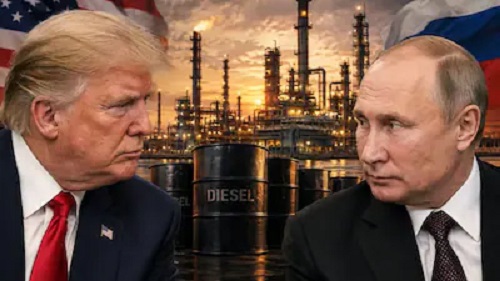
According to the supplied report, Trump recently announced a deal under which Russia would provide more than 300,000 tonnes of diesel for the American and global markets. He also indicated that supplies would rise to 500,000 tonnes in November, followed by a further one million tonnes immediately thereafter.
The reported arrangement drew criticism from Ukrainian President Volodymyr Zelenskyy, who characterised the move as an “investment in a war” and called for genuine de-escalation with Moscow. His objection reflects Kyiv’s longstanding concern that Russian energy revenues help sustain the country's war effort.
The American president’s reported willingness to secure Russian diesel supplies while maintaining pressure on countries purchasing Russian energy raises an obvious question about the consistency of his policy. If commercial engagement with Moscow is acceptable when it serves American energy requirements, on what basis should India be expected to accept punitive economic consequences for its own purchases?
There may be differences between particular transactions, the legal treatment of specific products and the sanctions applicable to different entities. Those distinctions matter, and the reported diesel arrangement should not automatically be equated with every form of Russian crude-oil purchase. Nevertheless, the broader political contradiction remains: Washington cannot credibly present economic engagement with Russia as inherently unacceptable while making exceptions whenever domestic considerations favour it.
The problem is not that the United States has chosen to protect its own energy interests. That is a legitimate responsibility of any government. The problem is using those interests as a justification for flexibility at home while demanding economic sacrifice from partners abroad.






















Leave Your Comment