


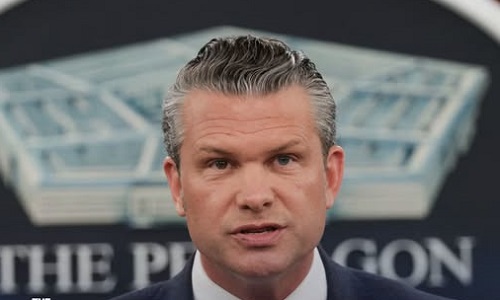
The Republican leadership in the US House of Representatives has rallied behind President Donald Trump and Defence Secretary Pete Hegseth, blocking an attempt to initiate impeachment proceedings against the Pentagon chief. The move came amid growing political tensions following the Republican Party's disappointing midterm election performance and exposed divisions within its ranks over the administration's military decisions. Despite an aggressive push by Republican Congressman Thomas Massie, party leaders joined hands with the White House to prevent the impeachment resolution from reaching the House floor for debate.
In a narrow 211-204 vote on Tuesday night, the House agreed to send the impeachment resolution against Hegseth to a committee, effectively preventing an immediate debate or direct vote on the proposal. The procedural decision marked a significant victory for Trump, whose administration had worked behind the scenes with Republican lawmakers to ensure that the measure did not advance. According to CNN, senior White House officials coordinated with House Republican leaders to secure sufficient support and maintain party unity during the crucial vote.
The impeachment effort was initiated by Republican Representative Thomas Massie, who introduced a privileged resolution containing eight articles against Hegseth. The allegations centred on the Defence Secretary's handling of US military operations abroad, particularly strikes against Iran and Yemen that Massie claimed were authorised without obtaining congressional approval. He accused Hegseth of violating constitutional provisions and the War Powers Act, which establishes limits on the president's authority to engage US forces in military hostilities without congressional authorisation. The resolution also questioned Hegseth's alleged involvement in overseeing the operation that resulted in the capture of Venezuelan President Nicolás Maduro.
The defeat of the measure does not necessarily bring the impeachment controversy to an end. With Democrats expected to assume control of both the House and Senate in January, the political circumstances surrounding Hegseth could change considerably. A Democratic-controlled Congress may revive scrutiny of the Pentagon chief's decisions and revisit questions concerning the administration's use of military power overseas.
Trump welcomed the House decision and portrayed the outcome as a decisive rejection of his political opponents. Shortly after the vote, he took to Truth Social to celebrate the Republican backing for Hegseth, describing the Democratic-led impeachment attempt as a "miserable failure". He also singled out Massie for criticism, calling the Republican congressman a "major LOSER" for breaking ranks with his party and supporting the impeachment initiative.
"The Democrats’ attempt to impeach Secretary of War Pete Hegseth has miserably FAILED! Every single Republican, except Thomas Massie, a major LOSER, voted in favor of Pete," Trump wrote.
Defending Hegseth's leadership at the Pentagon, the President pointed to what he described as military achievements in Venezuela and Iran, alongside a surge in recruitment for the armed forces. Trump claimed that the military was witnessing unprecedented enlistment figures, with waiting lists of prospective recruits, and praised the renewed enthusiasm within its ranks. He portrayed these developments as evidence of Hegseth's effectiveness and said the Defence Secretary had been vindicated by the congressional outcome.
Trump also accused Democrats of turning congressional authority into a political weapon against his administration. Calling for an end to what he described as the misuse of American institutions, he reiterated his political message, concluding his post with the slogan, "MAKE AMERICA GREAT AGAIN."
The episode highlights the importance of Republican unity in protecting key members of Trump's administration, even as disagreements emerge within the party over presidential authority and military intervention. While Massie's initiative failed to gain immediate traction, the debate has brought renewed attention to the constitutional boundaries governing the use of American military power and the role of Congress in authorising overseas operations.






















Leave Your Comment