


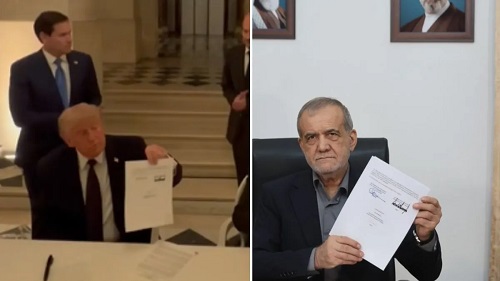
A historic agreement aimed at ending months of conflict in the Middle East was signed on Wednesday (local time) by US President Donald Trump and Iranian President Masoud Pezeshkian, marking a significant diplomatic breakthrough with potentially far-reaching implications for regional stability, global energy markets, and international trade.
The peace accord, signed digitally after days of intensive negotiations, seeks to halt hostilities that have disrupted global supply chains and heightened tensions across the region. Speaking before signing the agreement, President Trump acknowledged the complexity of the negotiations, describing the deal as a hard-fought achievement.
“This was not easy,” the Republican leader remarked in a video that quickly gained traction across social media platforms.
Following the signing ceremony, Trump displayed the agreement, while French President Emmanuel Macron welcomed the development, calling it an important step toward restoring peace and stability in the region. Macron emphasized that the agreement could facilitate the reopening of the Strait of Hormuz, a crucial maritime route for global energy shipments.
In a post on X, Macron said the deal represented “an important step in the right direction” and expressed hope that it would contribute to lower energy prices and renewed economic confidence worldwide.
While Tehran welcomed the agreement, Iranian officials framed it as evidence of Washington’s inability to achieve its objectives through confrontation. Iran’s Parliament Speaker and chief negotiator, Mohammad Bagher Ghalibaf, described the accord as a “record of US failure,” arguing that the outcome demonstrated Iran’s resilience under pressure.
Ghalibaf also reiterated that Iran would implement provisions related to maritime transit through the Strait of Hormuz. Under the agreement, vessels will reportedly enjoy a 60-day fee-free transit period before a new maritime services framework comes into effect.
“The agreement is a record of US failure. People will see it and judge,” Ghalibaf stated, adding that Iran would exercise its sovereign rights over the strategic waterway while charging fees for maritime services after the initial grace period.
The peace framework contains several key provisions designed to reduce tensions and promote economic recovery. Foremost among them is a commitment by all parties to cease military operations across the region, including conflict zones in Lebanon.
The agreement also focuses on restoring maritime trade. Washington has agreed to remove naval restrictions affecting commercial navigation, while Tehran will reopen the Strait of Hormuz, one of the world’s most important energy corridors. Iran and Oman are expected to hold consultations regarding the future management and operational services of the waterway.
A major economic component of the accord is a US-backed reconstruction and development package valued at approximately USD 300 billion. The initiative is intended to support Iran’s economic recovery, infrastructure development, and long-term growth following years of sanctions and regional instability.
On the nuclear front, Iran has reaffirmed its commitment not to pursue nuclear weapons. The agreement further requires Tehran to cooperate with international inspectors in disposing of its stockpile of enriched nuclear material through a monitored dilution process overseen by the International Atomic Energy Agency (IAEA).
Analysts view the agreement as one of the most consequential diplomatic developments in the Middle East in recent years. If successfully implemented, the accord could reduce geopolitical tensions, restore confidence in global shipping routes, stabilize energy markets, and open a new chapter in relations between Washington and Tehran.
The coming months will determine whether the ambitious framework can translate into lasting peace and sustained regional cooperation. For now, however, the signing of the Trump-Pezeshkian agreement has generated cautious optimism that one of the world's most volatile regions may be moving toward a more stable future.




















Leave Your Comment