


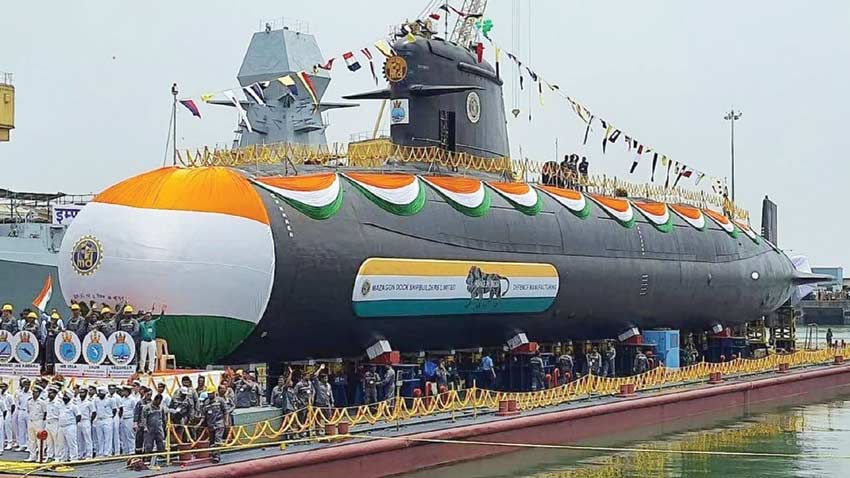
India’s second Arihant-Class submarine ‘INS Arighaat’ was commissioned into the Indian Navy on August 29, 2024 at Visakhapatnam in the presence of Defence Minister Rajnath Singh. In his address, the defence minister exuded confidence that ‘Arighaat’ will further strengthen India’s nuclear triad, enhance nuclear deterrence, help in establishing strategic balance and peace in the region, and play a decisive role in the security of the nation. He described it as an achievement for the nation and a testament to Prime Minister Shri Narendra Modi-led Government’s unwavering resolve to achieve ‘Aatmanirbharta’ in defence.
Defence Minister Rajnath Singh commended the Indian Navy, DRDO and the industry for their hard work and synergy in achieving this capability. He termed this self-reliance as the foundation of self-power. He appreciated the fact that the country’s industrial sector, especially MSMEs, have received a huge boost through this project, and more employment opportunities have been created.
Recalling former Prime Minister Atal Bihari Vajpayee’s political will which put India at par with a full-fledged nuclear weapon state, the defence minister said: “Today, India is surging ahead to become a developed country. It is essential for us to develop rapidly in every field, including defence, especially in today's geopolitical scenario. Along with economic prosperity, we need a strong military. Our government is working on mission mode to ensure that our soldiers possess top-quality weapons and platforms made on Indian soil”.
The advent of INS Arighaat
The construction of INS Arighaat involved the use of advanced design and manufacturing technology, detailed research and development, utilisation of special materials, complex engineering and highly skilled workmanship. It has the distinction of having the indigenous systems and equipment which were conceptualised, designed, manufactured & integrated by the Indian scientists, industry and Naval personnel.
The technological advancements undertaken indigenously on this submarine make it significantly more advanced than its predecessor Arihant. The presence of both INS Arihant and INS Arighaat will enhance India’s capability to deter potential adversaries and safeguard its national interests.
Strategic significance of submarines
Since the end of the Second World War in 1945, submarines have always played a critical role in both strategic and tactical level battlefields. From launching cruise missile strikes at the enemy’s high value assets, facilitating amphibious landing of special forces commandoes in hostile territories, attacking and sinking enemy warships, and even launching devastating nuclear weapon strikes on enemy cities when required, underwater military capabilities of a nation can tip the balance in the aggressor’s favour during the beginning moments of the war. Thus, an undersea striking capability plays a very important part in shaping a nation’s strategic doctrine. Submarines are popularly known as ‘Sharks of Steel’ due to their predatory nature in stealthily detecting targets and destroying them instantly.
India’s nuclear submarine journey
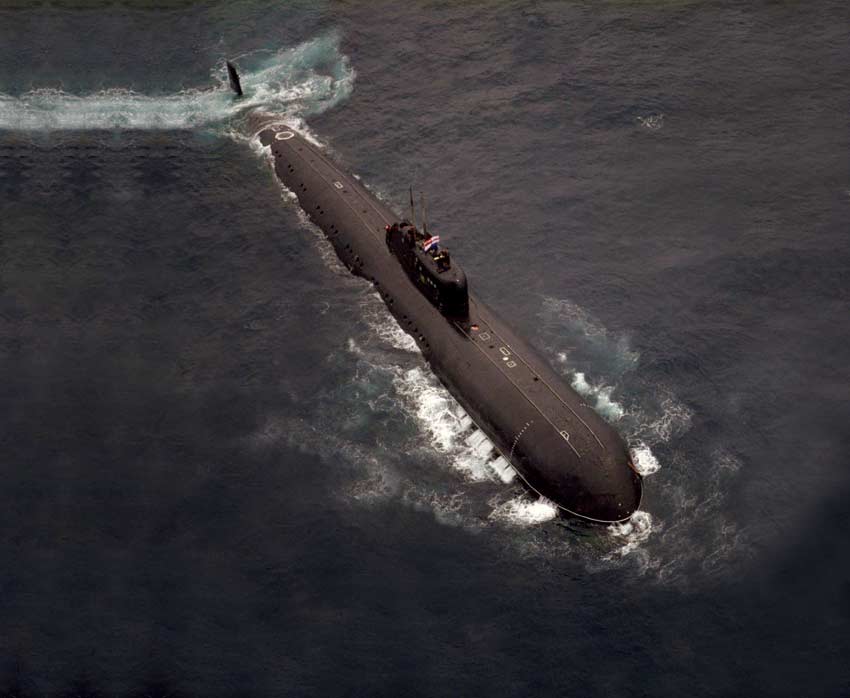
With the growing battlefield requirements of precision strike weapons in theatre-level warfare, in 1987, the Indian Navy leased a nuclear-powered attack submarine (SSN) armed with cruise missiles and torpedoes, christened as the ‘INS Chakra’ (K-43). The deal was stuck with Russia for a 10-year lease period. The boat had an overall length of 94 metres, a beam of 10 metres and a draft of 8 metres. It displaced 4,000 tonnes (while surfaced) and 5,000 tonnes (while submerged). It was equipped to carry around 100 crew members. The boat had one five-blade propeller powered by a VM-5 pressurised water nuclear reactor. It was capable of achieving a maximum speed of 16 knots (30 km an hour) when surfaced and 23 knots (43 km per hour) when submerged. The K-43 could carry up to 8 SS-N-7 Starbright nuclear capable anti-ship cruise missiles. It had six 533 mm torpedo tubes which could carry 12 torpedoes or 12 SS-N-15 Starfish anti-submarine missiles.
Although the Indian Navy personnel acquired some first-hand operational experience of handling a nuclear-powered submarine, the gains were not significant as the boat was partially manned by Russian navy sailors and Indian troops were not allowed to enter the missile room and the reactor compartment. The 10-year lease agreement was finally terminated by India in 1990 and the submarine was handed back to the Russians.
Future capacity build-up
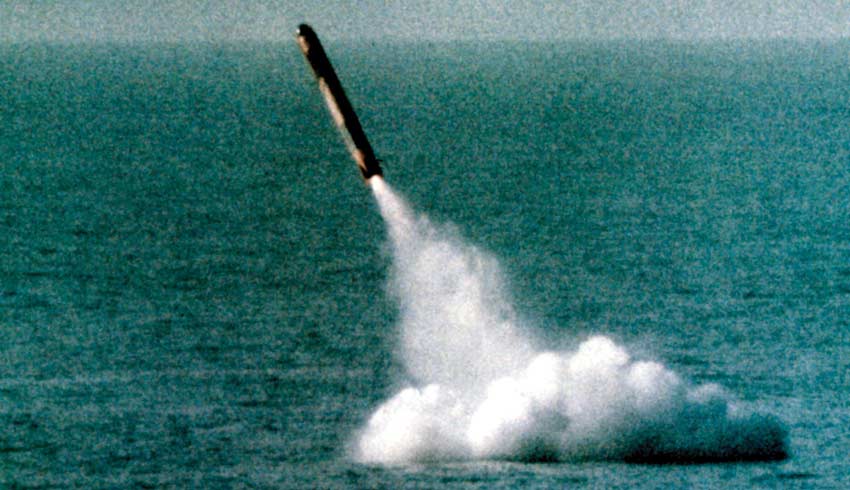
While the indigenously developed nuclear powered ballistic missile submarines (SSBN) are getting ready for operational deployment. The first submarine of Arihant series (INS Arihant) has already been inducted and deployed by the Indian Navy. The Arihant-class submarines are 112 metres long with a beam of 11 metres, a draft of 10 metres, displacement of 6,000 tonnes, a diving depth of 300 metres. Every boat can carry a team of around 95 naval personnel. The boats are powered by a single seven blade propeller powered by an 83 megawatt (111,000 horsepower) pressurised water reactor fuelled by highly enriched Uranium and can achieve a maximum speed of 12–15 knots (22–28 km an hour) when surfaced and 24 knots (44 km per hour) when submerged. The submarines have four launch tubes in their hump and can carry up to 12 units of K-15 Sagarika ballistic missiles with one warhead each (with a range of 750 km) or four K-4 ballistic missiles (with a range of 3,500 km). The second boat in the series which has been christened as INS Arighaat is now ready for combat patrols after official induction. The third boat named as INS Aridhaman was also silently launched in November 2021, and may be inducted by 2025.
There are also growing indications that an Akula-class nuclear submarine may be leased from Russia for 10 years, so that Indian sailors can get more operational experience by the time the next generation of larger indigenous nuclear submarines (S-5-class) come up for operational deployment.
While the Arihant-class SSBNs have reached the levels of final sea trials and near-operational deployment, the union government is also looking forward towards Project-75 Alpha (also code named as Project-77) which aims to procure new indigenously developed nuclear-powered attack submarines. The Government of India’s Cabinet Committee on Security (CCS) approved the construction of six of such submarines in February 2015. This new class of boats will be designed by the Indian Navy's in-house Directorate of Naval Design (now Warship Design Bureau) and built in India at the Shipbuilding Centre at Visakhapatnam. The construction was expected to commence in 2024-25 while the first submarine is expected to enter service in 2032.
Time to boost up nuke warhead production
At a time when the Indian government with its serious political will, is enabling the loading of MIRV (Multiple Independent Re-entry Vehicle) warheads on intercontinental range ballistic missiles like the Agni-V, as demonstrated through Mission Divyastra on March 11, 2024, India must ramp up the production of active nuclear and thermonuclear warheads. The Agni-VI, K-4, K-5 and K-6 ballistic missiles will also have MIRV capability. Hence, India must be ready to produce as many as 400-500 nuclear warheads every year instead of 160-170 per year. This will enable the provision of adequate number of nuclear and thermonuclear weapons in operational configurations for a credible second-strike capability during contingencies.
Time to get back to work
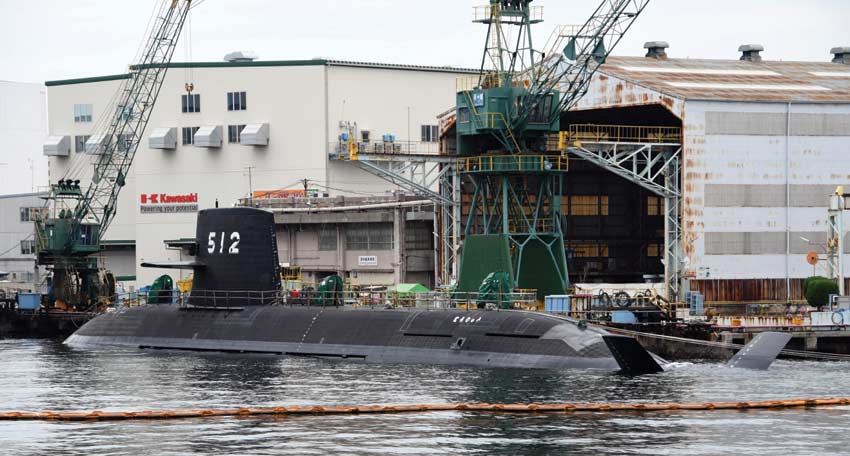
As India’s hostile neighbours- China and Pakistan are going through a rapid military modernisation drive, the country is yet to witness significant levels of R&D and investments in strategic technologies. China possesses one of the largest submarine fleets comprising anything between 68 to 85 boats spread across nine different classes, a far cry from the Indian inventory. Even Pakistan which has a much smaller navy has five conventional submarines with an order of eight more from China. While the Indian Navy requires a fleet of at least 30 submarines for countering a two-front war situation with Pakistan and China, the union government needs to lay more stress on building more numbers of nuclear-powered ballistic missile submarines and nuclear-propelled attack submarines. There is also an urgent need to operationalise the indigenous Air Independent Propulsion (AIP) system developed by DRDO for deployment onboard all future SSNs, SSKs and SSBNs. The much-delayed K-5 and K-6 submarine launched ballistic missile (SLBM) projects with an estimated ranges of 8000 km and 12,000 km respectively, should also be quickly developed and tested at the earliest. There is also an urgent need to develop an entire new class of nuclear-powered ballistic missile submarines which will be capable of launching intercontinental range ballistic missiles. The proposed programme to develop S-5 class of SSBNs which will outweigh the Arihant-class boats and will be able to launch the next generation K-6 nuclear missiles will prove to be a huge force-multiplier for the strategic level battlefield. Moreover, at a time when countries like Japan are researching on next-generation (Soryu-class) submarines which will be powered by Lithium-ion batteries, India should also take up similar initiatives and projects, so that the nation does not miss the bus on cutting-edge technologies. Lithium-ion batteries are lighter and have a higher energy density, meaning that a kg of Lithium-ion cells can hold more electricity than traditional Lead-acid batteries. Lithium-ion batteries can also hold their charge longer and are faster to recharge. The ageing subsurface boats of the Indian Navy need to be replaced at the earliest and newer weapon systems need to be deployed soon. Submarines form the basic backbone of a nation’s blue-water naval capability and the incumbent union government can’t afford to compromise on this front.

By Amartya Sinha
(The content of this article reflects the views of writers and contributors, not necessarily those of the publisher and editor. All disputes are subject to the exclusive jurisdiction of competent courts and forums in Delhi/New Delhi only)




















Leave Your Comment