


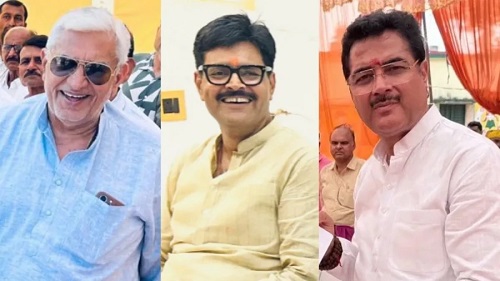
The defection of three Samajwadi Party (SP) legislators to the Bharatiya Janata Party (BJP) has delivered a political setback to Akhilesh Yadav in Uttar Pradesh, bringing renewed attention to the opposition party’s internal cohesion and its ability to retain leaders with independent political ambitions. Rakesh Pratap Singh, Abhay Singh and Vinod Chaturvedi, who entered the Uttar Pradesh Assembly on SP tickets in 2022, joined the BJP on October 14, 2026. Their move formalises a political distance that had become evident during the 2024 Rajya Sabha elections, when all three reportedly voted for the BJP candidate despite being members of the SP.
The three MLAs bring different political backgrounds and constituency-level networks to the BJP, making their defection significant beyond the immediate question of legislative numbers. Their decision also underlines a persistent challenge for regional parties: maintaining organisational discipline while accommodating leaders whose local influence and political calculations may not always align with the central leadership.
For Akhilesh Yadav, the departures are an uncomfortable reminder that electoral success does not necessarily guarantee long-term loyalty. The SP secured victories in Gauriganj, Gosainganj and Kalpi in the 2022 Assembly elections, but the legislators who won these seats have now chosen to align themselves with its principal rival in Uttar Pradesh. The shift raises questions about the party’s ability to manage dissent and sustain relationships with influential regional leaders.
The 2024 Rajya Sabha elections provided an early indication of this estrangement. Cross-voting by the three MLAs had already exposed a breach in party discipline. Their formal entry into the BJP suggests that the differences were not merely temporary disagreements over a particular election but had developed into a broader political realignment.
The three MLAs’ entry into the BJP strengthens the ruling party’s political position by bringing former SP legislators into its fold. It also gives the BJP an opportunity to project the defections as evidence of dissatisfaction within the opposition. For the SP, the immediate damage is reputational as well as organisational: the departure of elected representatives can create questions about leadership, internal communication and the party’s ability to keep its ranks united.
Now, for Akhilesh Yadav, the priority will be to prevent individual departures from becoming a broader pattern of dissatisfaction. That requires more than disciplinary measures. It calls for sustained engagement with legislators, stronger constituency-level coordination and a political message capable of keeping competing ambitions within the party.
Ultimately, the entry of Rakesh Pratap Singh, Abhay Singh and Vinod Chaturvedi into the BJP marks a setback for the SP, but it is also a test of how both parties manage political realignment. The BJP must turn the new entrants into an organisational advantage, while the SP must demonstrate that the loss of three legislators will not weaken its wider political campaign. The real measure of this development will not be the announcement of party membership alone, but its consequences for voter confidence and electoral competition in Uttar Pradesh.






















Leave Your Comment