


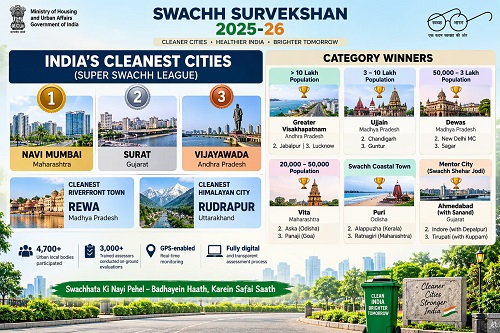
Navi Mumbai has claimed the distinction of being India's cleanest city, bringing an end to Indore's remarkable eight-year dominance in the national cleanliness rankings. The results of Swachh Survekshan 2025-26, announced at an award ceremony in New Delhi, placed Surat second and Vijayawada third, highlighting the growing competition among urban centres to improve sanitation, waste management and public cleanliness. President Droupadi Murmu presented the awards to the winning cities, recognising their efforts towards building cleaner and more sustainable urban environments.
The latest edition of the annual survey witnessed participation from more than 4,700 urban local bodies across the country. Indore, which had consistently occupied the top position for eight consecutive years, was placed in a separate category this time. It secured the second position in the newly introduced Mentor City category under the 'Swachh Shehar Jodi' initiative, alongside its partner town Depalpur. Ahmedabad topped this category with Sanand as its partner, while Tirupati and Kuppam jointly secured the third position. The initiative seeks to encourage better-performing cities to share their experience, administrative practices and cleanliness models with other urban centres.
The survey also recognised achievements across different population groups and geographical categories. Greater Visakhapatnam emerged as the cleanest city among urban centres with populations exceeding 10 lakh. In the category of cities with populations between three lakh and 10 lakh, Madhya Pradesh's Ujjain secured the top position. Among cities with populations ranging from 50,000 to three lakh, Dewas ranked first, followed by the New Delhi Municipal Council in second place and Sagar in third. In the 20,000-50,000 population category, Maharashtra's Vita emerged as the winner, while Aska in Odisha and Panaji in Goa secured the second and third positions, respectively.
The survey also highlighted the performance of cities located along rivers, coastal regions and Himalayan areas. Madhya Pradesh's Rewa was declared the cleanest riverfront town, with Bilaspur and Varanasi occupying the next two positions. In the Swachh Coastal Town category, Odisha's Puri secured first place, followed by Alappuzha in Kerala and Ratnagiri in Maharashtra. Rudrapur was recognised as the cleanest Himalayan city, while Jammu and Shopian secured second and third positions, respectively.
This year's Swachh Survekshan was conducted under the theme 'Swachhata Ki Nayi Pehel - Badhayein Haath, Karein Safai Saath'. According to the Union Housing and Urban Affairs Ministry, the assessment involved more than 3,000 trained evaluators who undertook extensive field inspections across the country. GPS-enabled monitoring was used to strengthen transparency and ensure that the evaluation reflected actual conditions on the ground. The entire assessment process, from the submission of supporting evidence to its verification, was conducted digitally and subjected to multiple quality checks.
An important outcome highlighted by the ministry was the improvement recorded by cities participating in the Mentor City initiative. Their performance in the Visible Cleanliness parameter increased from 48 per cent in Swachh Survekshan 2024-25 to 70 per cent in the latest edition. The improvement indicates that knowledge-sharing between established performers and emerging urban centres can help strengthen sanitation standards and improve public spaces.
The latest rankings underline that urban cleanliness is no longer confined to a handful of consistently high-performing cities. Navi Mumbai's rise to the top, alongside the achievements of cities across different regions and population categories, reflects the expanding reach of the cleanliness movement. At the same time, Indore's transition from an eight-time champion to a mentor city signals a shift towards a broader approach in which successful urban models are expected to inspire improvements elsewhere. The challenge now lies in ensuring that these achievements translate into sustained cleanliness, efficient waste management and better civic habits in everyday urban life.





















Leave Your Comment