


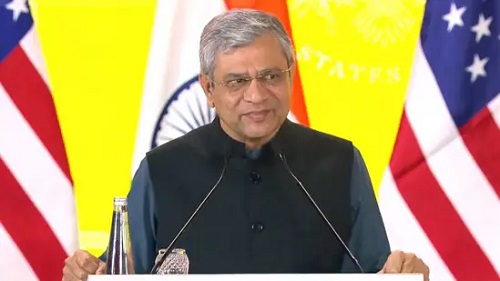
In a ceremony marked by high strategy and sharp political satire, India formally joined the United States’ flagship technology alliance, Pax Silica, at the AI Impact Summit in New Delhi on Friday. While the signing of the declaration marks a significant leap for India’s semiconductor ambitions, it was Union Minister Ashwini Vaishnaw’s blistering, sarcastic attack on the political opposition—delivered without naming a single party—that became the immediate talking point of the event.
Taking the stage after formalizing the pact with US Under Secretary of State Jacob Helberg and US Ambassador to India Sergio Gor, Vaishnaw turned a technical discussion about microchips into a metaphor for governance. Drawing a sharp contrast between his government’s focus on high-tech manufacturing and what he characterized as the opposition’s distraction tactics, the minister launched a "potato chip" jibe that landed with precision.
"There are some people who talk about 'chips' which only remind me of 'potato chips'," Vaishnaw said in Hindi, sparking knowing chuckles in the audience. "Let them be, they will keep crying. Sometimes they cry in the Parliament, sometimes somewhere else. All that will keep going on, but we must keep moving forward in a clear direction."
The remark was widely interpreted as a dismissal of opposition parties who have frequently criticized the government’s economic policies and the perceived slow pace of job creation. For Vaishnaw, the contrast was deliberate: while his ministry oversees the establishment of ten semiconductor plants and the design of advanced 2-nanometer chips, he suggested the opposition remains mired in negativity.
The minister did not stop there. In a broader critique of India’s pre-2014 political landscape, Vaishnaw lamented what he described as decades of missed opportunities. "If this spirit had remained since 1947, you all cannot imagine how much compounding would have happened in India's growth," he told the gathering of industry leaders and tech professionals. "No problem, even if it's from 2014. Your generation will benefit from this compounding."
His comments were a direct endorsement of the Modi government’s track record, implicitly criticizing the Congress-led UPA era for a lack of the "spirit" required to build a modern industrial base. He framed India’s current technological ascent as a direct result of the political stability and clear direction provided by the Prime Minister.
Thanking his colleagues External Affairs Minister S. Jaishankar and Commerce Minister Piyush Goyal, as well as Prime Minister Narendra Modi, Vaishnaw credited them for "making it all possible"—referring not just to the summit, but to "the silicon supply chain that we are building, and that huge set of new opportunities which are coming for the young population."
While the political barbs dominated the room, the substance of the event was the formalization of India’s role in a strategic realignment of global tech power.
US Ambassador Sergio Gor provided the clearest definition of the initiative, describing Pax Silica as "a strategic coalition being formed to shape the 21st-century economic and technological order, securing the full silicon stack—from critical minerals and chip manufacturing to AI deployment." He emphasized that the partnership aims to "replace coercive dependencies with trusted industrial partnerships that empower free markets" .
Gor was unequivocal about India’s importance to the bloc. "India’s participation is not just symbolic. It is strategic and essential," he stated, citing the country's engineering talent, strides in mineral processing, and its role in strengthening US-India tech cooperation .
The alliance, which already includes Australia, Japan, Israel, the UAE, Singapore, South Korea, and the UK, among others, was launched in Washington in December 2025 . Its core mission is to secure supply chains from the mining of critical minerals to the deployment of trusted AI systems, creating a counter-weight to supply chain concentrations that are viewed as geopolitical liabilities.
Jacob Helberg, the US Under Secretary of State for Economic Affairs, brought a historical and philosophical weight to the signing. Drawing a parallel to ancient history, he invoked Alexander the Great’s encounter with the Indian subcontinent. "It was in India that he finally met his match and turned back. He did not know India, and India said no," Helberg remarked. "Today, as we sign the Pax Silica Declaration, we say no to weaponised dependency, and we say no to blackmail" .
Helberg stressed that the alliance is not merely a trade agreement but a declaration of intent by "free people" to build the future. "Pax Silica is a declaration that the future belongs to those who build," he said .
Vaishnaw placed the partnership within the context of India’s unique demographic trajectory. "India today is a young nation, with a median age of 28 years. It has a long growth path ahead. Even in 2047, India will remain a young nation, with a median age of 37 years," he noted. "That means that beyond 2047 as well, there will be a growth period of another 50 years" .
The minister highlighted the tangible progress on the ground: ten semiconductor plants are either established or in the pipeline, with the first unit set to begin commercial production shortly. Crucially, he pointed out that "the most advanced 2 nanometre chips are being designed in India" right now, underscoring that the country is moving up the value chain from assembly to high-value design .
With the semiconductor industry projected to need one million more skilled professionals, Vaishnaw projected confidence that India’s talent pool would fill that gap.
As the summit concluded, the message from the stage was twofold: a warning to geopolitical rivals that the "free world" is consolidating its tech base, and a warning to domestic rivals that the government’s momentum is unstoppable. As Vaishnaw put it, the country now has a "direction" and a "clear goal" to achieve global leadership in semiconductors—potato chips be damned.


















Leave Your Comment