



Viral Desai
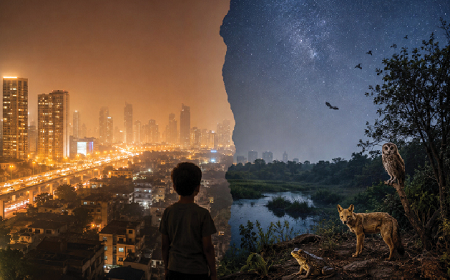
The modern human civilization has long equated light with progress. From the early days of discovering fire to the electrification of global metropolises, the eradication of darkness has been a definitive marker of human advancement. However, this relentless pursuit of illumination has birthed a silent, glowing crisis: light pollution. A recent, alarming report indicates that the nights over India’s major metropolitan cities are now up to sixty times brighter than naturally dark skies. This blinding artificial glow does not simply mask the stars; it fundamentally alters the nocturnal environment. Satellites tracking the earth at night capture India as a brilliant, sprawling web of luminescence, but beneath that dazzling facade lies an ecological disruptions of catastrophic proportions. By erasing the natural boundary between day and night, urban India is inadvertently waging a war against its own biodiversity, disrupting human biology, and fracturing the delicate web of life that relies on the sanctity of the dark.
At the heart of this environmental crisis is a profound disruption of chronobiology, the internal biological clocks that govern almost all living organisms. For millennia, life on Earth evolved under a predictable, binary cycle of light and dark. This cycle dictates the release of hormones, behavior patterns, and metabolic functions. In humans, the paresence of darkness triggers the pineal gland to produce melatonin, a vital hormone responsible for regulating sleep-wake cycles, supporting the immune system, and acting as a powerful antioxidant. When urban environments are flooded with high-intensity artificial light at night (ALAN), particularly the blue spectrum prevalent in modern LED streetlights and commercial billboards, melatonin production is severely suppressed. The health consequences for urban populations are severe and well-documented. Chronic sleep deprivation, metabolic disorders, increased vulnerability to cardiovascular diseases, and elevated risks of certain hormone-driven cancers have all been linked to the erosion of the natural night. The metropolis never sleeps, and consequently, its human inhabitants are losing the biological restorative power of true rest.
Beyond the concrete structures and human habitats, the ecological toll on wildlife is even more devastating. The impact on avian populations is particularly pronounced. Birds rely heavily on celestial cues, the earth's magnetic field, and natural light horizons for navigation during migration. Brightly lit skyscrapers, massive digital advertisements, and high-voltage sports arenas act as disorienting beacons. Migrating birds are lured off their paths into urban traps, where they circle blindly until they collapse from exhaustion or die from collisions with glass facades. Furthermore, the natural reproductive cycles of urban and peri-urban birds are being severely skewed. Artificial light tricks avian biology into believing that days are longer, prompting birds to sing earlier in the morning and enter breeding cycles prematurely. This temporal mismatch means that chicks are often born before their natural food sources, such as specific insect populations, are available, leading to high mortality rates and gradual species decline.
The crisis deepens when examining the nocturnal animal kingdom and the insect world. Predators and prey have evolved sophisticated strategies based on the cover of darkness. For many small mammals and reptiles, the night provides a shield against predators. When artificial glare illuminates the forest floors and urban green spaces, prey species are left exposed, entirely upending natural predator-prey dynamics. Simultaneously, the reproduction of nocturnal animals is severely compromised, as mating rituals that require darkness are disrupted by the pervasive urban glow. Perhaps the most catastrophic, yet overlooked, impact of light pollution is the rapid decline of nocturnal insects. Insects are the unsung heroes of global ecosystems, serving as vital pollinators and the foundational base of the food chain. Thousands of species of moths, beetles, and fireflies are fundamentally nocturnal. Attracted to artificial lights like a vortex, these insects exhaust themselves flying around bulbs, succumb to predators waiting nearby, or die from direct heat contact. The collapse of nocturnal insect populations directly threatens the pollination of nocturnal flora and deprives insectivorous birds, bats, and amphibians of their primary food source.
The scale of this issue requires looking closely at the specific nature of modern lighting. The global shift toward energy-efficient LED lighting, while beneficial for reducing carbon emissions and electricity consumption, has worsened light pollution. Most commercial LEDs emit a high concentration of blue light. Blue light scatters more easily in the atmosphere than longer wavelengths of light, contributing significantly to "skyglow"...the dome of light that hangs over cities, obscuring the night sky for miles outside the urban perimeter. This means that even protected forests, wetlands, and rural areas adjacent to major Indian hubs like Mumbai, Delhi, Bengaluru, and Chennai are no longer truly dark. The skyglow bleeds into natural habitats, expanding the ecological footprint of light pollution far beyond the physical boundaries of city municipal corporations.
Addressing this ecological emergency does not mean plunging our cities back into the dark ages; rather, it demands a paradigm shift toward smarter, responsible illumination. Light pollution is one of the few forms of pollution that can be mitigated almost instantaneously through conscious design and policy interventions. Urban planning must incorporate "dark sky" principles. This involves mandating the use of fully shielded light fixtures that direct light downward precisely where it is needed on walkways and roads, preventing light from spilling upward into the sky or sideways into residential windows and natural habitats. Additionally, switching from harsh blue-white LEDs to warmer, amber-toned lighting can significantly reduce both the atmospheric skyglow and the biological disruptions caused by blue wavelengths. Implementing smart lighting systems equipped with motion sensors and dimmers during late-night hours, alongside strict regulations on commercial architectural lighting and digital billboards after midnight, can dramatically lower urban glare.
Ultimately, recognizing the night sky as a natural resource is the first step toward conservation. Darkness is not an empty void to be conquered; it is a biological necessity for health, a critical habitat for biodiversity, and an essential part of our planet's ecological equilibrium. As India’s megacities continue to expand, integrating light pollution mitigation into environmental protection policies is no longer optional. Protecting the night is a fundamental duty to the ecosystems that sustain life, ensuring that the progress of the day does not permanently extinguish the vital rhythms of the night.
(The author is a known Environmentalist and the pioneer of Satyagraha Against Pollution movement, viraludayindia@gmail.com )
(The content of this article reflects the views of writer and contributor, not necessarily those of the publisher and editor. All disputes are subject to the exclusive jurisdiction of competent courts and forums in Delhi/New Delhi only)





















Leave Your Comment