


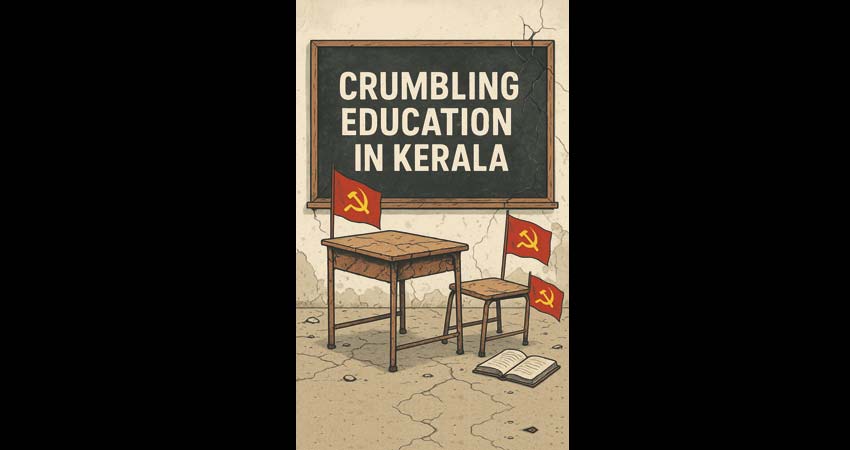
This article examines how Kerala’s once-admired education system has been turned into a political tool, tracing its evolution, key players, and the heavy cost to the state’s intellectual integrity.
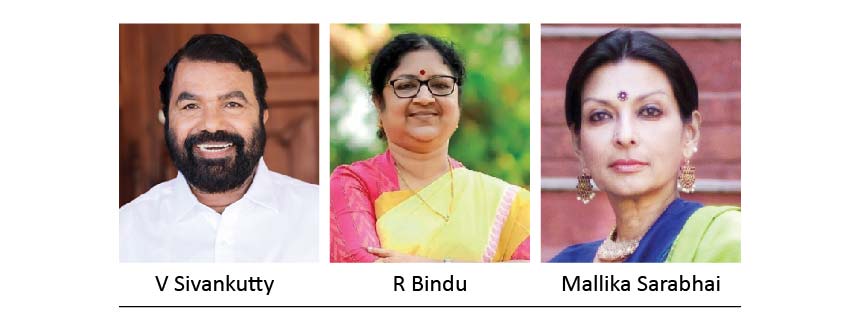
Recently, when noted classical dancer and activist Mallika Sarabhai accused Kerala’s Left establishment of “systematically capturing the state’s academic and cultural spaces,” her words struck a deep chord. Known for her liberal credentials and long association with progressive causes, Sarabhai’s criticism was both unexpected and powerful. In a widely discussed interview with the New Indian Express, she spoke of how intellectual and artistic institutions in Kerala have been “walled in by ideology,” leaving little room for dissent or diversity of thought. Her outburst reopened a long-suppressed conversation — how deeply has politics, particularly Marxist politics, infiltrated the state’s education system?
For decades, Kerala has prided itself on being India’s most literate state, where education was seen as the ladder of social mobility and enlightenment. Yet, behind this celebrated façade lies a troubling story — one of systematic politicisation, recruitment bias, ideological indoctrination, and the gradual erosion of academic freedom. From universities and teachers’ unions to student organisations and curriculum boards, the shadow of political influence is unmistakable. The recent controversies — over backdoor appointments, manipulated syllabi, and the silencing of dissenting voices — are not isolated incidents but symptoms of a deeper malaise.
From Model State to Political Battlefield
Kerala once stood as India’s proud symbol of enlightenment and empowerment. The missionary schools of the 19th century and the educational renaissance led by Sree Narayana Guru, Chattambi Swamikal, and Ayyan Kali transformed the state into a beacon of literacy and reform. But what was once a movement for intellectual freedom has been reduced to a political battlefield. The Communist movement, which claimed credit over the legacy of these saints, converted educational spaces into ideological nurseries producing cadres instead of enlightened citizens. For decades, the Left has exercised suffocating control over teachers’ appointments, student unions, and university administration. Merit and professionalism have given way to political loyalty. Today, Kerala’s once-celebrated model is collapsing under the weight of corruption, bureaucracy, and ideological rigidity — a decline recently laid bare by the courageous revelations of Mallika Sarabhai, Chancellor of Kerala Kalamandalam. Her statements about how political interference has crippled academic freedom have exposed the depth of decay in the state’s educational and cultural institutions.
The PM SHRI Controversy and Financial Distress
The recent controversy over the PM SHRI programme to upgrade schools into model institutions perfectly illustrates the government’s misplaced priorities. When the Central Government launched the initiative, the Left administration in Kerala initially refused to implement it, calling it an attempt to “saffronize” education. Only after mounting public criticism did the government reluctantly accept the plan, but following pressure from its coalition partner, the CPI, the CPM soon backtracked on the issue.
Meanwhile, the financial mess deepens. Many schools struggle to fund mid-day meals or maintain infrastructure. Shockingly, in several institutions, teachers and headmasters pay for students’ meals from their own pockets. Even in cities, classrooms deteriorate as funds dry up. The “Kerala model,” once cited worldwide, is now a cautionary tale.
Politicised Teachers and Collapsing Professionalism
One of the gravest dangers to Kerala’s education system is the rampant politicisation among teachers. Teachers’ unions operate as extensions of political parties, especially the CPI(M). Promotions, transfers, and disciplinary actions are determined by allegiance, not merit. Faculty members participate in political campaigns during working hours, while dedicated educators are sidelined. The result is a culture where excellence is neither valued nor rewarded — a system producing conformity instead of curiosity.
Backdoor Appointments and Party Cadre Domination
Perhaps the most visible form of corruption is the backdoor recruitment of party cadres. Thousands of politically connected individuals have secured posts in schools, colleges, and universities through opaque procedures. The Public Service Commission, once a pillar of fairness, now faces allegations of bias and irregularity. In some universities, appointment lists are prepared before official notifications are issued; new posts are even created to suit particular candidates. This blatant misuse of power has shattered public faith and demoralized genuine aspirants.
Cultural and academic institutions have not been spared. Mallika Sarabhai’s sharp criticism of Kerala Kalamandalam — once a proud custodian of performing arts — revealed how political contamination and administrative incompetence have crippled creativity. Her account of untrained staff promoted to officer ranks, inability to handle basic correspondence, and resistance to reform has forced the public to confront the depth of Kerala’s institutional rot.
SFI Control and Campus Intolerance
On college campuses, the Students’ Federation of India (SFI), the CPI(M)’s student wing, exerts near-total control. Under the guise of student activism, campuses have turned into arenas of fear where dissenting voices are silenced. Rival student organisations face intimidation, their posters torn down, and their meetings disrupted. Students who express alternative opinions risk physical attack or academic victimisation. Universities that should nurture dialogue and debate have degenerated into spaces of coercion and propaganda.
The Hijab Controversy and Selective Secularism
The recent hijab controversy in a Christian management school further exposed the hypocrisy of Kerala’s political class. When a Muslim student, reportedly influenced by the SDPI, demanded to wear a hijab against the school’s uniform policy, the government and mainstream parties remained silent. Instead of defending the school’s right to enforce discipline, they pandered to sectarian interests. This selective secularism — where minority appeasement overrides principle — underscores how politics of identity have invaded classrooms, eroding their neutrality and sanctity.
Decline in Academic Standards
The consequences of this politicisation are visible in plummeting academic standards. Once among India’s top-ranked universities, Kerala’s institutions now perform poorly in national assessments. Research output is minimal; innovation is almost absent. The brightest students increasingly migrate to other states or abroad. The curriculum, heavily influenced by Marxist ideology, distorts historical narratives and downplays India’s spiritual and civilisational heritage. In its obsession with political correctness, the system has lost its soul — students graduate without grounding in culture, ethics, or independent thought.
The Culture of Strikes and Disruption
Kerala’s campuses are now synonymous with strikes and boycotts. Hardly a month passes without some protest — many driven by political theatrics rather than genuine issues. Academic calendars are disrupted, exams delayed, and valuable teaching days lost. Students and parents bear the cost of this chaos, while unions treat confrontation as routine. The long-term casualty is the very idea of learning as a disciplined, creative process.

Private Schools under Pressure
Private and aided schools, which educate a large share of Kerala’s students, are equally suffocated by political overreach. Managers face harassment and endless regulations, with little financial support from the state. Appointing a teacher often requires “clearance” from political functionaries. Merit is secondary to connections, eroding institutional independence. Many of these schools, once known for excellence, now struggle to retain credibility.
Data Doesn’t Lie: A Structural Decline
Statistics confirm what experience already reveals. Independent studies and national assessments show measurable slippage in Kerala’s learning outcomes and school quality. Despite increased spending, outcomes decline — pointing not to lack of intent but to failed governance. Politicised appointments, weak accountability, and misplaced resource allocation have combined to corrode the very foundation of public education. The decline of government schools and flight of students to private institutions reflect an alarming public trust deficit.
Curriculum Stagnation and Economic Mismatch
Kerala’s higher education system, long dominated by traditional and theoretical subjects, shows little connection to contemporary economic realities. The absence of industry linkages, research hubs, and skill-oriented courses has produced a mismatch between education and employability. Thousands of graduates, trained in outdated syllabi, leave the state each year seeking opportunities elsewhere. Once a ladder of social mobility, Kerala’s education system has become an assembly line of degrees without direction.
Teacher Morale and the Talent Drain
Demotivated by politicisation and opaque promotions, many teachers have lost enthusiasm for their profession. New educators see limited growth prospects within the system. As a result, Kerala suffers a steady outflow of academic talent to other states and countries. Salary alone cannot ensure quality; what teachers crave is professional respect and autonomy — both missing in the current system. The result: declining classroom engagement and learning outcomes.
Public Distrust and Two-Tier Education
As public education weakens, middle-class families increasingly turn to private and CBSE schools, coaching centres, and out-of-state options. This creates a two-tier system where quality becomes a privilege, not a right. The egalitarian foundation of Kerala’s social development — the idea that every child, regardless of background, can access quality education — is being dismantled. For a state that once prided itself on equality through education, this growing divide is morally corrosive.
What Mallika Sarabhai’s Outburst Revealed
Dr. Mallika Sarabhai’s candid criticism of Kerala Kalamandalam — that “political interference and corruption have destroyed the sanctity of our institutions” — was not a casual outburst but a warning bell. Her experiences illustrate how ideological capture and administrative incompetence have crippled one of India’s premier cultural universities. She described an institution where even basic operational work was beyond staff capabilities, where merit was replaced by favour, and where creative freedom was stifled. Her remarks triggered a storm of reactions across Kerala — most of them acknowledging what insiders have long known but feared to say aloud.
Public responses mirrored the frustration of ordinary citizens: “Don’t just stuff posts with party men — can’t they find anyone competent?” one comment read. Another lamented that “even university officers don’t know how to draft a letter in English.” Many pointed out how Kerala’s so-called cultural elites had risen not through excellence but through political connections. These sarcastic but painful remarks reflect a society disillusioned by the hypocrisy of those who once claimed to champion enlightenment.
The Deeper Malaise
The tragedy of Kerala’s education crisis lies not merely in administrative decay but in moral collapse. The same Left parties that once fought for equality have created an elitist system serving their own networks. Academic institutions — from universities to cultural academies — have become instruments of control rather than creativity. The “Kerala miracle” that once drew admiration now risks turning into a cautionary tale of how ideology can corrode intellect.
The Way Forward
Kerala urgently needs a non-partisan educational revival.
1. Depoliticise institutions: Appointments and promotions must be merit-based, with independent selection committees and transparent processes.
2. Empower teachers: Establish long-term training and career ladders linked to performance, not party loyalty.
3. Ensure accountability: Conduct regular audits and publish learning outcomes to restore trust.
4. Modernise curriculum: Create industry linkages, research hubs, and vocational pathways to align learning with real-world needs.
5. Protect cultural institutions: Reform governance in bodies like Kalamandalam to ensure autonomy, competence, and artistic freedom.
Reclaiming the Public Mission
Education is not a political trophy; it is the foundation of civilisation. Kerala’s downfall began the moment education became a weapon of ideology. Citizens, parents, and teachers must now reclaim it from partisan control. The state’s future depends on restoring the purity of purpose that once defined its educational mission — to enlighten minds, not enslave them.
The Left still claims to be the guardian of Kerala’s social model. To honour that legacy, it must first free education from its own grip. Otherwise, the state once hailed as India’s intellectual pride will be remembered instead as a sobering example of how power, when unchecked, can destroy the very enlightenment it once promised to protect.
From Teacup to Vice-Chancellor: A Marxist Success Story
Dr. Mallika Sarabhai’s fiery outbursts have set Kerala’s social media ablaze — and the replies are nothing short of poetic justice. “Don’t just stuff posts with politicians,” one quips, “can’t they at least find someone with a bit of common sense?” Poor Mallika ji — she merely said that except for the Vice-Chancellor and Registrar, no one at Kalamandalam even knows how to send an email. Little does she know — once upon a time, Kerala University had a Vice-Chancellor who couldn’t even draft a letter in English! If that’s the qualification, perhaps we should all start applying.
Officials, people joke, don’t know what their job is — better to let them sit at home and still pay them. “Madam doesn’t get it,” someone remarks kindly, “she’s seen the world and wasn’t born in Kerala.” Because if she were, she’d know that our “cultural icons” and “intellectuals” are not born — they are manufactured. They climb the Marxist ladder with the grace of acrobats: from “progressive” to “intellectual” to “cultural leader.” Commitment to art or society? No, no — it’s all about the next chair, the next committee, the next title.
Most of these “thinkers” started off by bribing their way into private colleges, where they discovered that the surest path to success is not teaching but tutoring the party. From there begins the sacred pilgrimage — serving tea at the local committee, writing slogans, making capsules, and delivering justification lectures for the CPM. It’s a kind of tapasya, really — not to gain wisdom, but to gain a post.
And then there are those rare, scholarly “leaders” who return to university late in life — not to learn, but to earn a PhD, preferably in record time and with record errors. Their theses are often delightful works of fiction, sprinkled generously with misquotes, invented sources, and footnotes that defy logic. Some even manage to quote Marx as if he were discussing modern Kerala politics — truly visionary! University committees, of course, applaud these masterpieces with standing ovations; after all, how can one fail a comrade who has already “passed” through the party school of dialectical diplomacy? The only real research question seems to be: how many typos can a doctoral dissertation survive and still get a red-carpet viva?
Of course, there are shortcuts. If you’re related to someone in the party, no need for all this drama. Just marry a leader! If you lack the qualifications, don’t worry — the post will be redesigned to fit you perfectly. As one wit put it, “In Kerala, love and Marxism are the two fastest ways to get tenure.”
And why all this struggle? Simple — so that when you die, your obituary can proudly declare: Former Vice-Chancellor of Something. Even if you never taught a single class, you’ll still enjoy a UGC salary till sixty and a pension for life. Is that not socialism at its finest?
Here, teaching is optional, attendance is theoretical, and mediocrity is a merit badge. No need to study the syllabus, no need to inspire students — just mumble something about Dalits, minorities, and Hindutva, and you’re suddenly an academic revolutionary. Poor Mallika ji — she doesn’t understand this beautiful ecosystem. She was never part of a teachers’ union; she still thinks competence matters.
Take poet Vijayalakshmi, who topped her M.A. in Malayalam in 1980 and still didn’t get a teaching job. She had to work in the post office with her tenth-standard marks — while the same bribed teachers now teach her poems in class. Isn’t that poetic irony? And there’s Balachandran Chullikkad — brilliant, outspoken, a postgraduate dropout. He saw through the circus early, wrote the L.D. Clerk test, and joined the Treasury. At least he can retire with his dignity — and a pension earned honestly.
Meanwhile, Kerala’s youth — the bright, restless kind — are fleeing abroad faster than rats from a burning house, terrified by what they see in our universities: professors who can’t send emails, officials who can’t define their jobs, and “cultural icons” who think Marx wrote the syllabus. What’s left behind is a paradise of degrees without depth, intellect without integrity, and slogans without sense.
And in this grand performance of progress, the audience can only laugh — because crying would mean you’ve understood it.
In Kerala’s academia, ignorance isn’t a drawback — it’s a qualification with full pension benefits.
By Pradeep Krishnan
(The content of this article reflects the views of writer and contributor, not necessarily those of the publisher and editor. All disputes are subject to the exclusive jurisdiction of competent courts and forums in Delhi/New Delhi only)



















Comments (3)
J
Superb article with actual facts.
A
Excellent article - opening the eyes.
G
very nicely presented article Truth is bitter they say but it is always triumphant????This politics in campus has to be banned if we want progress of our younger generation Now it’s a case of secondary type of caste ideology Party politics superior to everything else