


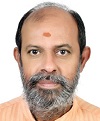
Pradeep Krishnan
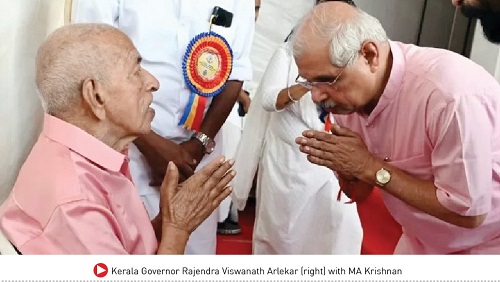
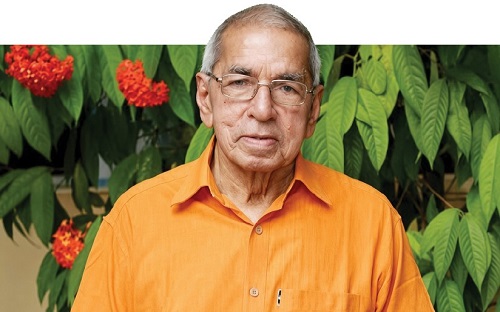
With the passing of Sri M.A. Krishnan on September 29, affectionately revered as M.A. Sir, Kerala has lost one of its foremost cultural visionaries and institution-builders, and India has bid farewell to a lifelong servant of its civilisational ideals. His departure marks not merely the end of a distinguished life, but the conclusion of an era that profoundly shaped the cultural and intellectual landscape of modern Kerala.
To confine M.A. Sir to any single description—whether as an RSS pracharak, Sanskrit scholar, teacher, editor, thinker, or organiser—would be to overlook the remarkable breadth of his contribution to society. He seamlessly combined all these roles in a life dedicated to national service, intellectual pursuit, and institution-building. Belonging to a distinguished generation of selfless nation-builders, M.A. Sir devoted his life to nurturing institutions, shaping generations of young minds, inspiring transformative initiatives, and strengthening the civilisational founda-tions of society—always with quiet dedication and little concern for personal acclaim.
For several decades, M.A. Sir stood at the intersection of culture, spirituality, education, journalism, and social awakening. His influence extended far beyond the organisations with which he was associated. Through his ideas, writings, speeches, and organisational initiatives, he helped create a cultural renaissance in Kerala that continues to inspire thousands even today. With his departure, Kerala has lost one of its most influential cultural visionaries. Yet, the insti-tutions he built, the values he nurtured, and the generations he inspired ensure that his legacy will endure.
A Childhood Rooted in Tradition
M.A. Krishnan was born in 1929 in Iverkala village in Kollam district of Kerala. He grew up during a period of profound political and social transformation in India. The freedom struggle was gathering momentum, traditional institutions were facing unprecedented challeng-es, and new ideas were reshaping society.
From an early age, he displayed an exceptional aptitude for learning. His interest in Sanskrit, Indian philosophy, and classical thought led him to pursue higher studies at the San-skrit College in Thiruvananthapuram. There he distinguished himself by obtaining the prestig-ious qualification of Mahopadhyaya in Tarka Shastra (Logic and Philosophy).
The rigorous training in Sanskrit and Indian philosophical traditions left a lasting imprint on his mind. It equipped him with a deep understanding of India's intellectual heritage and sharpened his analytical abilities. Throughout his life, he would combine scholarship with ac-tion, demonstrating that philosophy was not merely an academic pursuit but a guide for national and cultural regeneration.
The Call of a Larger Mission
After completing his studies, M.A. Krishnan joined Vazhoor High School in Kottayam district as a teacher. Teaching was a natural profession for someone of his intellectual calibre and commitment to learning. Yet destiny had prepared a larger role for him. During his stay in Vazhoor, he came under the influence of Sri Vidyananda Theerthapada Swamigal, the revered head of Vazhoor Theerthapadashram. At the same time, he was deeply inspired by the teach-ings of Swami Vivekananda and the nationalist vision that sought to rebuild India through char-acter, culture, and service.
His association with the Rashtriya Swayamsevak Sangh had begun much earlier, around 1947. Through senior leaders and spiritual personalities, he became acquainted with the ideals of national service and cultural awakening. Gradually, he realised that his life's purpose lay not in a conventional career but in dedicating himself entirely to the service of society.
In 1954, after only a year as a school teacher, he resigned from his position and became a full-time RSS Pracharak. The decision was neither easy nor common. At a time when secure employment was highly valued, giving up a respectable teaching career demanded tremendous conviction and idealism. M.A. Krishnan made that sacrifice willingly, convinced that the ser-vice of the nation was a sacred calling.
Building Organisation Through Personal Contact
As a pracharak, M.A. Sir worked in several districts including Kottayam, Ernakulam, Alappuzha, and Kollam. These were formative years not only for him but also for the growth of the Sangh in Kerala. The Kerala of the 1950s and 1960s was a complex social landscape. Ideological contestations were intense, and cultural questions often became subjects of political conflict. In such circumstances, building a grassroots organisation required patience, clarity, and immense personal commitment. M.A. Sir possessed all these qualities in abundance.
Those who worked with him recall his simplicity, discipline, and remarkable ability to connect with people from diverse backgrounds. He believed that social transformation begins through personal relationships. Whether interacting with students, teachers, intellectuals, artists, or ordinary villagers, he displayed genuine warmth and respect. His strength did not lie in dra-matic public gestures but in the patient cultivation of individuals and institutions. Many later leaders in cultural and social organisations acknowledged his role in shaping their thinking and inspiring their public life.
Transforming a Weekly into a Cultural Institution
A defining phase of M.A. Sir's life began in 1964 when he assumed charge as the editor of Kesari Weekly. At the time, Kesari was largely perceived as a publication associated with RSS volunteers. M.A. Sir recognised that Kerala needed a broader cultural platform capable of engaging intellectuals, writers, historians, artists, and ordinary readers alike.
Under his stewardship, Kesari underwent a remarkable transformation. From 1964 to 1990, he served as its Chief Editor, guiding the publication through one of the most significant periods in its history. His editorial vision was expansive. Rather than limiting the magazine to organisational matters, he opened its pages to discussions on history, culture, philosophy, litera-ture, temple traditions, heritage conservation, and national issues.
As a result, Kesari gradually emerged as a respected voice in Kerala's intellectual and cultural life. Distinguished scholars such as M.G.S. Narayanan, K.K.N. Kurup, and many other historians and writers contributed to the magazine. Articles on Kerala's temples, forgotten his-torical figures, cultural traditions, and civilisational heritage found a regular place in its pages.
Through these efforts, M.A. Sir helped cultivate a new cultural consciousness among readers. Many important public discussions concerning Kerala's heritage first gained visibility through Kesari during his tenure. The magazine ceased to be viewed merely as an organisa-tional publication and came to be recognised as a forum for cultural discourse. This transfor-mation remains one of M.A. Sir's enduring achievements.
Journalism as Cultural Service
For M.A. Sir, journalism was never simply a profession. It was a means of cultural ser-vice. He believed that newspapers and magazines should not merely report events but help so-ciety understand its civilisational roots. Journalism, in his view, carried a responsibility to pre-serve collective memory and encourage informed reflection.
His writings reflected clarity, scholarship, and conviction. Yet they were never inaccessible. He possessed the rare ability to communicate profound ideas in language that ordinary readers could understand.
Under the pen name "Shakalyan", he wrote columns that became widely read. His observations combined humour, insight, and social commentary. Readers eagerly awaited these pieces, which often addressed contemporary issues while remaining rooted in larger cultural perspectives. His editorial leadership demonstrated how media can become an instrument of cultural renewal rather than merely a vehicle for information.
The Architect of Balagokulam
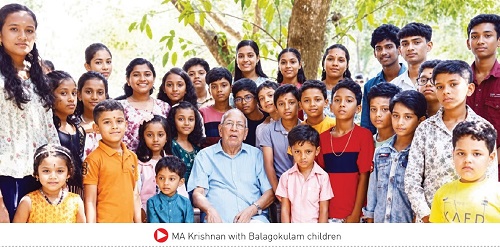
Among all his contributions, none has had a more far-reaching impact than Balagoku-lam. Today Balagokulam is recognised as one of the world's largest cultural movements for children. Generations of Malayali children have grown up participating in its activities. Behind this remarkable achievement stood the vision and dedication of M.A. Sir. He understood a fun-damental truth: lasting cultural continuity depends upon the younger generation.
Many social and cultural movements focus primarily on adults. M.A. Sir chose a differ-ent path. He realised that values, identity, and cultural confidence are most effectively nurtured during childhood. The result was Balagokulam.
Through storytelling, songs, games, competitions, festivals, value education, and com-munity activities, Balagokulam introduced children to the civilisational heritage of Bharat in a joyful and engaging manner. Its most visible expression became the annual Sri Krishna Jayanthi processions, where thousands of children dressed as Krishna, Radha, Hanuman, and other characters from India's sacred traditions. These processions gradually became iconic cultural events across Kerala.
Many observers have remarked that M.A. Sir gifted the image of Unnikannan (Child Krishna) to modern Malayali childhood. This observation captures an important truth. Through Balagokulam, he offered children a positive cultural role model rooted in joy, innocence, cour-age, devotion, and dharma. Today countless professionals, teachers, artists, administrators, and community leaders trace their early cultural formation to Balagokulam activities. That may well be his greatest legacy.
Building a Cultural Ecosystem
M.A. Sir was not content with creating a single organisation.He understood that cultural renewal requires a network of institutions working in different spheres of society. Accordingly, he played a crucial role in nurturing initiatives such as Tapasya, the cultural and literary forum; Amrita Bharati; Bala Sahithi Prakashan; Bala Samskara Kendrams; the International Sri Krish-na Centre; and other educational and cultural projects.
Each institution addressed a different dimension of cultural life—literature, arts, educa-tion, heritage, children's development, or intellectual engagement. Taken together, they formed a comprehensive ecosystem dedicated to preserving and promoting Bharatiya values. The long-term impact of these institutions cannot easily be measured. Their influence is reflected in countless cultural programmes, publications, artistic initiatives, educational activities, and com-munity movements that continue to flourish decades later.
The Thali Temple Movement
One of the notable public movements in which M.A. Sir played an important role was the Thali Temple Worship Rights Movement of the late 1960s. The historic Thali Mahadeva Temple at Angadipuram in Malappuram district, once an active centre of worship, which was attacked and ransacked by the notorious Tipu Sultan during his invasion of the Malabar, had fallen into neglect and was under the control of the Archaeological Department. The absence of regular worship had become a matter of concern for many devotees.
As editor of Kesari, M.A. Sir helped bring public attention to the issue. He used the weekly as a platform to highlight the temple's condition and the significance of restoring wor-ship there. He also engaged with community leaders and public figures, helping to build wider support for the cause. Notably, he interacted with veteran nationalist leader K. Kelappan, fa-mously known as Kerala Gandhi, and others who later became associated with the movement.
The movement became a landmark in Kerala's public life and encouraged similar efforts to revive neglected temples and heritage sites across Malabar. While M.A. Sir was not a front-line agitator, his role in generating awareness, shaping public opinion, and connecting key indi-viduals was widely acknowledged by those associated with the campaign.
A Scholar Beyond Academia
Though widely known as an organiser, M.A. Sir was fundamentally a scholar. His knowledge of Sanskrit literature, Indian philosophy, history, and culture was extensive. Yet he never wore his scholarship as an ornament. Unlike many intellectuals who remain confined to academic circles, he brought knowledge into public life. He believed that scholarship should strengthen society and help ordinary people reconnect with their heritage.
This practical orientation distinguished him from many contemporaries. His lectures at-tracted students, teachers, activists, artists, and spiritual seekers alike. Listeners frequently re-marked upon his ability to illuminate complex subjects with clarity and simplicity. He exempli-fied the ancient Indian ideal of the scholar who serves society.
A Cultural Visionary
Perhaps the most remarkable aspect of M.A. Sir's life was the consistency of his cultural vision. Whether he was writing editorials, organising children's programmes, guiding institu-tions, or participating in public movements, the underlying objective remained the same: cultur-al regeneration. His politics, economics, and social philosophy all flowed from this cultural per-spective.
He believed that enduring social change could not be achieved through political power alone. Societies become strong when they possess cultural confidence, historical awareness, moral values, and spiritual depth. This conviction shaped every major initiative he undertook.
Even individuals who differed from him ideologically often respected his sincerity, in-tegrity, and commitment. Many intellectuals from diverse backgrounds found in him a thought-ful interlocutor rather than a dogmatic adversary. His influence therefore extended beyond or-ganisational boundaries.
The Man Behind the Public Figure
Those who knew M.A. Sir personally often speak first of his humility. Despite his ac-complishments, he remained simple in lifestyle and modest in personal habits. He was ap-proachable, affectionate, and deeply attentive to others. He preferred institution-building to self-promotion.
He believed that ideas mattered more than personalities and that organisations should outlive their founders. This self-effacing attitude enabled him to devote his energies entirely to nurturing others. His life reflected the traditional Indian ideal of seva—service performed with-out expectation of recognition.
An Enduring Legacy
The true measure of a life lies not in titles held or positions occupied but in the lasting impact left upon society. By that standard, M.A. Krishnan's contribution is immense.
The thousands of Balagokulams functioning today, the countless children inspired by Sri Krishna Jayanthi celebrations, the cultural initiatives nurtured through Tapasya and related institutions, the intellectual legacy of Kesari, and the broader cultural awakening witnessed in Kerala over several decades all bear his imprint.
His work reminds us that cultural renewal is not achieved through sudden revolutions. It emerges through patient effort, institution-building, education, dialogue, and the steady trans-mission of values from one generation to the next. M.A. Sir dedicated his entire life to that mis-sion.
As Kerala bids farewell to this distinguished son of Bharat, it also celebrates a legacy that will continue to inspire future generations. The institutions he built remain vibrant. The values he championed remain relevant. The countless lives he touched remain grateful. A great cultural architect has departed, but the edifice he helped build continues to stand strong.
In an age often dominated by transient headlines and short-lived movements, M.A. Krishnan demonstrated the power of patient, lifelong commitment to a civilisational cause. His was a life rooted in scholarship, guided by spirituality, dedicated to service, and devoted to cul-tural awakening. Such lives do not truly end. They become part of the collective memory of a people. M.A. Sir belongs to that enduring tradition. Om Shanti.
(The content of this article reflects the views of writer and contributor, not necessarily those of the publisher and editor. All disputes are subject to the exclusive jurisdiction of competent courts and forums in Delhi/New Delhi only)




















Comments (2)
S
Great contribution.... Good assessment ????????????
R
Great ????