



Dr Vikas Bhardwaj
India has been running its farms on an underground overdraft. For decades, tube wells have pumped groundwater faster than rain and rivers can refill it, and the country has treated this as a local, seasonal inconvenience rather than a national one. It is neither. India draws about 60 percent of everything it can safely take from the ground each year, a share that has barely moved in over a decade (Government of India 2024a). Agriculture alone accounts for 87 percent of that draw, against 11 percent for domestic use. The fix is not glamorous: small earthen check dams that let monsoon runoff soak back into the ground instead of running off unused (Mahapatra n.d.). Building them at national scale would do more for farm incomes, food prices and rural stability than another round of subsidised diesel for tube wells (NITI Aayog 2018).
A Country Built on a Four-Month Season
India's exposure is structural, not incidental. The country holds 18 percent of the world's population but only 4 percent of its renewable freshwater, and it is already the largest user of groundwater on the planet, drawing more each year than the next two largest users combined (Eco-Business 2025; FAO 2023). Its farm calendar still answers to a single, four-month window: the southwest monsoon supplies the bulk of the country's annual rainfall between June and September, and a large share of the net sown area still lacks assured irrigation, leaving output at the mercy of a system that can swing between drought and deluge within the same decade (Columbia Climate School 2014). Groundwater has quietly filled that gap for fifty years. The arrangement worked as long as recharge kept pace with withdrawal. Punjab's July shows how thin that margin has become (Tribune 2026; Government of India 2024a).
What Gopalpura Already Proved
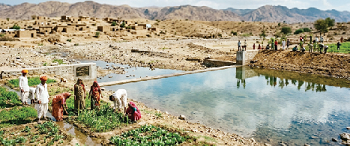
In 1975, a group of students and professors from the University of Rajasthan founded an organisation called Tarun Bharat Sangh in Jaipur, with no particular plan to become a water movement (Global Indian 2024). Ten years later, in 1985, one of its young members, Rajendra Singh, a trained Ayurvedic doctor, arrived in Gopalpura, a village in Rajasthan's Alwar district, intending to open a rural health clinic (Ramon Magsaysay Award Foundation n.d.; CEEW 2026). The villagers told him medicine could wait; they needed water (Ramon Magsaysay Award Foundation n.d.). Singh and the villagers rebuilt a johad, a crescent-shaped earthen dam that catches rainwater and lets it seep back into the aquifer, using nothing but mud, stone and local labour (CEEW 2026). The first johad held water through the dry season and refilled nearby wells within a year, and by 1988 the community had built two dozen more across Gopalpura and its neighbours (CEEW 2026). Over the following decades, the model spread to more than 1,000 villages across the district, reviving at least five rivers that had run dry for years, the Arvari, Ruparel, Sarsa, Bhagani and Jahajwali, using barely three percent of the district's total rainwater (Mahapatra n.d.; Global Indian 2024). Field documentation found that every 100 rupees spent on these structures generated roughly 400 rupees in additional village income, financed almost entirely by local labour and community contribution rather than government budgets (Mahapatra n.d.). Singh won the Ramon Magsaysay Award in 2001 and the Stockholm Water Prize in 2015 for this work (Global Indian 2024). The method has not changed since. What has been missing, for forty years, is the money to build it everywhere else.
The Same Story, at National Scale
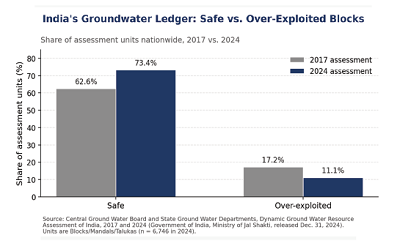
Gopalpura is not an isolated success story; national figures show the same pattern at scale. Recharge from tanks, ponds and small conservation structures nearly doubled between 2017 and 2024, climbing from about 14 billion to over 25 billion cubic metres a year (Government of India 2024a). Over that same period, the share of groundwater blocks rated “safe” rose from 63 percent to 73 percent, while the over-exploited share fell from 17 percent to 11 percent (Government of India 2024a).
The gain is real, but it is uneven: it shows up mostly in states that already invested in these structures, while Punjab, Haryana and western Uttar Pradesh, the very districts now facing this year's monsoon shortfall, remain the most over-exploited in the country (Government of India 2024a).
Why This Is Strategic, Not Just Rural
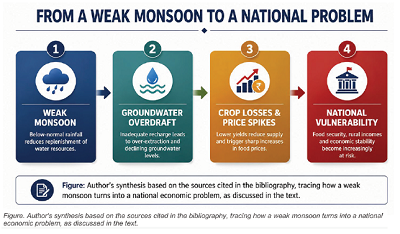
This is why water belongs in the same conversation as energy security, not in a separate file marked rural welfare. NITI Aayog has warned that unmanaged water stress could cost India six percent of its GDP by 2050, and that roughly 600 million Indians already live with high to extreme water shortage (NITI Aayog 2018). A bad monsoon does not stay a farming problem: it shows up as costlier wheat and vegetables in city markets, as fewer days of paid work in villages, and as pressure on a state budget that already subsidises food and fertiliser (NITI Aayog 2018). Cape Town offers a preview of what happens when a city waits too long to act. In 2018, with its reservoirs close to empty, the city cut its water allowance to 50 litres per person per day and warned residents of an approaching “Day Zero” when taps would run dry (SIWI 2020). Only a combination of steep tariffs, public pressure and rationing cut the city's water use by roughly half within three years, and Day Zero was narrowly avoided (SIWI 2020). Cape Town's crisis was managed through demand-side rationing under emergency conditions; India's version, arriving more slowly and across hundreds of districts, still has time to be managed through supply-side recharge instead (Government of India 2024a). Check dams will not end droughts. They buy the buffer that keeps a bad monsoon from becoming a bad year for the whole economy.
What Other Countries Got Right, and Wrong
No country's model transfers wholesale, but four cases offer sharp, usable lessons. Israel now recycles 85 to 90 percent of its wastewater for irrigation, the highest rate anywhere, and uses less water per person than almost any other OECD country (OECD 2021). Its real achievement is not any single piece of technology but sustained pricing discipline and near-universal reuse (OECD 2021). Australia lets farmers buy and sell water rights on an open market worth close to four billion Australian dollars a year, separating entitlements from land ownership so that scarce water moves toward whoever can use it most productively (Murray-Darling Basin Authority n.d.). China built check dams the way it builds highways: nearly 59,000 of them now line the Loess Plateau, funded almost entirely by the state to control erosion and sediment (Chen et al. 2025). Spain took the opposite path, leaning on long-distance inter-basin transfers and desalination rather than local conservation, and today its Segura basin still needs 132 percent more water than it has locally available (European Environment Agency n.d.).
There is also a cost argument India cannot ignore. A large dam can take a decade and thousands of crores of rupees to build, and displaces people and forests in the process; a johad takes a season, local labour, and a fraction of that cost, and it recharges the very fields it sits beside rather than water diverted from somewhere else (Mahapatra n.d.; CEEW 2026). That difference in cost and speed is precisely why decentralised recharge deserves equal billing with mega-infrastructure in the national conversation, not a smaller supporting role.
Where the Sceptics Have a Point
Critics are right about the limits. Check dams silt up and need regular desilting that many gram panchayats cannot fund on their own (Mahapatra n.d.). Rocky terrain across much of peninsular India holds far less water than Rajasthan's sandy alluvial soil, so outcomes documented in Alwar do not travel automatically to the Deccan plateau or interior Maharashtra (CEEW 2026). Large dams and canal networks still do things decentralised structures cannot: moving water across river basins, generating electricity, and holding back floods (Murray-Darling Basin Authority n.d.). None of this is an argument against check dams. It is an argument for building them alongside large dams, not instead of them.
Three Ways This Could Go
Best case. A funded national programme with satellite-based site selection pushes the safe-block share past 80 percent within ten years, and rural incomes stay steadier through weak monsoons (Government of India 2024a; NITI Aayog 2018).
Most likely case. Progress stays patchy, concentrated in states that already govern water well, while Punjab and Haryana see only marginal gains, so India buys time without closing the underlying gap (Government of India 2024a).
Worst case. Maintenance funding dries up, a run of poor monsoons like this year's pushes more districts into the over-exploited column, and rural distress and food prices rise together (Tribune 2026; NITI Aayog 2018).
Three Things to Do, Starting Now
Now: Pay for desilting and repair of existing structures under MGNREGA instead of funding only new construction, since a silted-up johad recharges nothing no matter how well it was built (Mahapatra n.d.). Hold Mission Amrit Sarovar, which has already built more than 68,000 ponds against its original target of 50,000, to a groundwater recharge target rather than a pond count alone (Ministry of Rural Development 2025).
Within five years: Give PMKSY's watershed programme a dedicated national check dam mission, with site selection run through the CGWB's own IN-GRES mapping platform and multi-year maintenance financing ring-fenced so structures do not fall apart after the ribbon-cutting (Government of India 2024a).
Over the next decade: Start metering and pricing groundwater for large agricultural users, the way Australia prices river water, and merge the Jal Shakti Abhiyan with state watershed missions so that no district ends up running two separate, uncoordinated water programmes at once (Murray-Darling Basin Authority n.d.; NITI Aayog 2018).
The Bill Comes Due Either Way
Punjab's fields are drier than normal again this July (Tribune 2026). That is not a one-off; it is what happens when a country spends down its groundwater faster than the sky refills it (Government of India 2024a). India already has a working model, built by villagers in Alwar with mud and labour forty years ago, at a cost measured in rupees per household rather than crores per project (Mahapatra n.d.). What the country has lacked is the will to fund that model at national scale before the next bad monsoon arrives, not after. The next dry July is not a matter of if. It is only a matter of how much of the rain that does fall is allowed to disappear before it can do any good.
(The content of this article reflects the views of writer and contributor, not necessarily those of the publisher and editor. All disputes are subject to the exclusive jurisdiction of competent courts and forums in Delhi/New Delhi only)




















Leave Your Comment