



Dr. Vikas Bhardwaj
For most of the post-independence era, India's defence profile was defined by a single structural characteristic: it was the world's largest, or near-largest, arms importer. SIPRI data for the period 2019–2023 confirmed India still accounted for 9.8 per cent of global arms transfers, sourcing platforms primarily from Russia (36 per cent), France (33 per cent), and the United States (13 per cent). Against this backdrop, something analytically consequential is now underway.
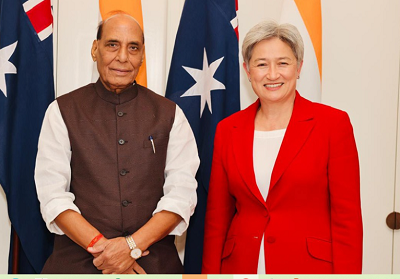
In April 2026, Rajnath Singh signed a Defence Industrial Cooperation Roadmap with Germany — a leading arms producer — and discussed a prospective US$ 8 billion submarine co-production agreement. In May 2026, he arrived in Hanoi carrying a near-finalised BrahMos missile deal estimated at ₹5,800 crore, then flew to Seoul to chair a defence business roundtable with Korean industrialists. Months earlier, in September 2025, he had inaugurated India's first defence manufacturing plant in Africa in Morocco. These are not routine events.
The strategic puzzle this paper addresses is why India is increasingly using defence diplomacy as an instrument of defence exports and geopolitical positioning — and what Rajnath Singh's recent outreach reveals about India's evolving role in the international security order.
From Importer to Exporter: The Data
India's defence export trajectory is among the most striking industrial transformations in recent strategic history. Official Ministry of Defence data, as detailed in Table 1 and Figure 1 below, documents a rise from ₹686 crore in FY 2013–14 to ₹38,424 crore in FY 2025–26 — a 56-fold increase in twelve years. Simultaneously, defence production reached an all-time high of ₹1,50,590 crore in FY 2024–25, representing 90 per cent growth since FY 2019–20 (PIB, August 2025). The defence budget grew from ₹2.53 lakh crore in 2013–14 to ₹6.81 lakh crore in 2025–26.
The policy architecture enabling this transformation — Make in India (2014), Positive Indigenisation Lists, Defence Industrial Corridors in UP and Tamil Nadu, the iDEX startup scheme, and the Defence Production and Export Promotion Policy (DPEPP) 2020 — created a protected domestic market and explicit export targets. Yet the more analytically significant story is qualitative: India has moved from exporting personal protective equipment and spare parts to delivering supersonic cruise missiles. The BrahMos delivery to the Philippines (April 2024, US$ 375 million), the Indonesia contract (2025), and the advanced Vietnam negotiations (₹5,800 crore, May 2026) mark India's entry into the tier of high-value, strategically sensitive weapons exports.
Defence Diplomacy as Military-Industrial Statecraft
Defence diplomacy, classically defined by Cottey and Forster (2004) as the "peaceful use of defence establishments to promote foreign and security policy goals," has traditionally focused on trust-building and conflict prevention. What distinguishes India's current approach is its deliberate fusion with industrial objectives — the transformation of security cooperation into what this paper terms military-industrial statecraft: the systematic use of defence agreements, training relationships, and export partnerships to advance industrial production goals and accumulate geopolitical leverage.
This is not novel in the global context. The United States has deployed its Foreign Military Sales (FMS) programme — which processed over US$ 318 billion in transfers between 2009 and 2023 — simultaneously as industrial policy, alliance management, and strategic leverage. Russia used arms transfers to create client dependencies through platform-specific spare-parts networks. China bundles defence exports with Belt and Road financing to generate debt-linked political influence. South Korea and Turkey use exports to sustain domestic industrial capacity and build diplomatic relationships. India is developing a variant of this model — combining Lines of Credit financing, non-alignment credentials, and high-performance systems such as BrahMos to market itself as an alternative supplier unconstrained by the political conditionalities of Western transfers or the strategic complications of Chinese equipment.
Rajnath Singh's Outreach: Strategic Logic, Not Diplomatic Routine
Germany (April 2026) illustrates the technology-acquisition dimension of India's statecraft. The Defence Industrial Cooperation Roadmap is designed to integrate Indian industry into European defence supply chains in niche areas — advanced radars, AI-enabled unmanned systems, sonar, and underwater technologies. Singh's visit to the Thyssenkrupp Marine Systems submarine facility in Kiel, and Pistorius' public confidence about an imminent US$ 8 billion submarine co-production agreement, signals an ambition for co-development of some of the most complex naval platforms in existence. Germany's own post-Ukraine rearmament — anchored in a €100 billion Sondervermögen — creates political receptivity to international defence-industrial partnerships. As Pistorius noted, the India-Germany roadmap could be a "good template" for wider EU cooperation with India.
Vietnam (May 2026) captures the geopolitical character of India's export strategy most vividly. The BrahMos deal — reportedly involving three to five mobile coastal-defence batteries of the shore-based anti-ship variant — would provide Hanoi with a robust Anti-Access/Area Denial shield against Chinese naval forces in the South China Sea. This is not a commercial transaction; it is a deliberate contribution to the maritime military balance in one of the world's most contested waterways. For India, it deepens security relationships with a frontline state in the India-China strategic competition, demonstrates credibility as a security provider that delivers war-winning systems, and establishes a replicable BrahMos template — built on the Philippines precedent — for broader ASEAN market penetration.
South Korea (May 2026) reflects the industrial partnership logic. Seoul is not a probable Indian export customer but a source of technology and manufacturing expertise. The Hanwha–L&T K9 Vajra partnership demonstrates the model: co-production that generates technology transfer, industrial investment, and mutual market access. The Defence Business Roundtable and meetings with the Defence Acquisition Program Administration (DAPA) are designed to identify additional co-production platforms. Morocco (September 2025) represents a third logic: manufacturing presence rather than export. Tata Advanced Systems Maroc's armoured vehicle plant is India's first African defence manufacturing facility — embedding long-term maintenance ecosystems and political relationships that transactions alone cannot create.
Defence Exports as Geopolitical Instruments
Five mechanisms explain how India's arms transfers generate strategic influence beyond their commercial value. First, training and human capital dependencies: BrahMos delivery includes operator certification and technical assistance, creating sustained institutional bonds between Indian and partner-state militaries. Second, maintenance and upgrade cycles: advanced platforms require 20–30-year after-sales relationships, binding recipient states to India's defence-industrial ecosystem. Third, interoperability networks: common platforms facilitate joint exercises, intelligence sharing, and potential combined operations — the Philippines, Indonesia, and Vietnam together represent the seeds of an Indo-Pacific BrahMos interoperability cluster. Fourth, strategic signalling: equipping Vietnam with BrahMos communicates to Beijing that New Delhi is willing to enhance the military capabilities of states in territorial dispute with China — a form of indirect deterrence. Fifth, diplomatic reciprocity: the Philippines' commitment to "more robust defence collaboration with India" following the April 2024 BrahMos delivery illustrates how successful arms transfers catalyse broader diplomatic alignment.
A Favourable Global Moment
Three structural developments in the international environment have created unusual opportunity for India's defence export ambition. The Ukraine War disrupted Russia's position as a reliable arms supplier — through delivery failures, sanctions complications, and reputational damage — opening space among states seeking to reduce Russian dependence while maintaining Soviet-era platforms that India, as a long-term operator, is uniquely placed to service. European rearmament, driven by the post-2022 strategic shock, has created demand exceeding European production capacity, making Indian industry a prospective supply-chain partner in niche segments including artillery ammunition, aerospace maintenance, and electronic systems. And the intensifying US-China rivalry has created structural demand among Indo-Pacific states for security partners who offer neither Washington's conditionalities nor Beijing's complications — precisely the diplomatic positioning that India's non-alignment brand enables.
Constraints and Policy Recommendations
Analytical honesty requires acknowledging that India's defence export ambition confronts substantial structural obstacles. Production capacity remains calibrated primarily to domestic requirements; the BrahMos Philippines delivery was delayed approximately one year. SIPRI's 2024 report confirms India still outside the top 25 global arms exporters and remaining a major importer — the import-dependence paradox undermines export credibility. After-sales infrastructure — the maintenance depots, spare-parts logistics, and technical assistance networks that sustain long-term relationships — is only beginning to be built. Competition from the US, France, Israel, South Korea, and Turkey is intense across precisely the market segments India is targeting.
Four recommendations emerge from the analysis:
Conclusion
The transformation that Rajnath Singh's diplomacy reveals is neither accidental nor merely aspirational. It is the product of a decade of policy architecture intersecting with a global strategic environment — shaped by Russia's diminished reliability, European rearmament, and Indo-Pacific security competition — that has become structurally favourable to India's emergence as a defence-industrial power. What is analytically significant about the present moment is that India is no longer merely discussing defence exports: it is delivering them. The BrahMos is in Filipino hands. The Indonesian contract is signed. The German roadmap is active. The Morocco facility is operational. These are not announcements; they are facts.




















Comments (5)
A
Nice and informative article about India's defence power .
J
In defence sector shift from a traditional, reactive importer to an assertive exporter is a massive turning point for India. Dr. Vikas Bhardwaj your analysis lays out the impressive data, but an industrial transformation is only as strong as its logistics and reliability . As you are aware that due to ongoing war Indian economy has been shattered and Indian rupee crashed to an all-time low against US dollar . This will also effect in this sector specially in production and export of defence equipments. We may wait for some time for stable economy.
S
????
S
????
V
“One of the most balanced assessments I’ve read on India’s defence diplomacy — ambitious, evidence-based, and strategically grounded.”