


By Dr. Vikas Bhardwaj
Pakistan has administered the territory it calls Azad Jammu and Kashmir for more than seven decades under a governance model designed not to serve its population but to manage a geopolitical claim. The protests that convulsed the region in 2023 and 2024 are not a departure from that history. They are its logical outcome — the accumulated cost of a constitutional architecture that presents autonomy as a fact while denying the conditions that make it real. Understanding why this crisis has intensified, why it matters beyond the territory itself, and what it portends requires moving past the events to interrogate the structure they have exposed.
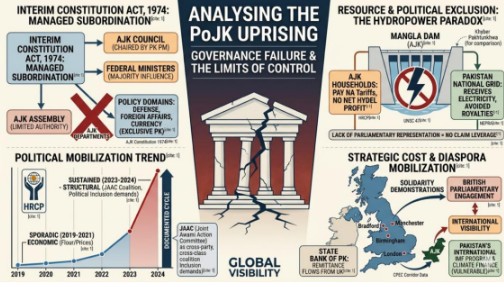
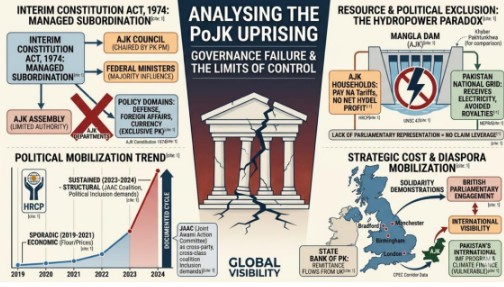
The governance mechanism is worth examining with precision because it is frequently mischaracterised. Under the AJK Interim Constitution Act of 1974, the territory operates with a legislative assembly, a prime minister, and a cabinet. These institutions exist. What they govern is the question. Defence, foreign affairs, and currency remain exclusively with Islamabad. The AJK Council — chaired by Pakistan's Prime Minister, with Pakistani federal ministers holding majority influence —exercises concurrent legislative authority over the most consequential policy domains. The territory's budget is structurally dependent on federal transfers, which means the AJK government cannot make binding economic commitments without Islamabad's approval. Most critically, AJK's estimated 4.6 million residents hold no seats in Pakistan's National Assembly or Senate. They are governed by a parliament in which they have no voice. The constitutional label of autonomy is, in practice, a mechanism of managed subordination.
This structural condition is not new, but its political consequences have reached an inflection point. The difference between previous episodes of unrest — sporadic protests over flour prices in 2019 and 2021 — and the sustained mobilisation of 2023 and 2024 is organisational and political, not merely economic. Earlier grievances were channelled through individual political parties with established patronage ties to Islamabad, limiting both their scope and durability. The Joint Awami Action Committee represents a qualitatively different actor: a cross-party, cross-class civil society coalition that has deliberately positioned itself outside the existing political bargain. The Human Rights Commission of Pakistan's documentation of the protest cycle confirms what JAAC's own statements make explicit — that demands which began with electricity tariffs and flour subsidies escalated precisely because those economic demands had nowhere to go within the existing institutional framework. Every negotiation revealed the same structural ceiling: the AJK government lacked the authority to deliver what was being demanded, and Islamabad lacked the political will to provide it.
The electricity grievance is not coincidental to that dynamic — it is its most concentrated expression. The Mangla Dam, commissioned in 1967 and one of Pakistan's most significant hydroelectric installations, sits in AJK and feeds the national grid. Residents of the territory pay electricity tariffs determined by the National Electric Power Regulatory Authority under Pakistan's national framework — a framework shaped by the severe circular debt crisis in Pakistan's power sector, which the World Bank and IMF have both documented in successive reviews. Khyber Pakhtunkhwa, by contrast, negotiated net hydel profit payments from the federal government as a form of resource royalty, a mechanism created through political leverage exercised during the 18th Amendment era. AJK has no
equivalent arrangement, not because the legal principle is inapplicable but because the territory has no parliamentary representation through which to assert the claim. The hydropower paradox — generating electricity for Pakistan while paying unaffordable tariffs and receiving no royalties — is not a policy failure. It is the economic expression of political exclusion made material in every household's
electricity bill.
The state's response to the 2023–2024 protests is equally instructive, particularly in comparison with how Pakistan's government has managed political unrest elsewhere. The HRCP documented internet shutdowns, mass arrests, curfew deployments, teargas use, and credible reports of live fire during the peak of the AJK protest cycle. Pakistan's civilian government, under comparable pressure from PTI-led protests in Islamabad between 2022 and 2023, engaged in political negotiation, legal manoeuvring, and eventually partial accommodation — partly because PTI's parliamentary presence created institutional leverage. In AJK, no such leverage exists. The calculus of repression versus accommodation is structurally different when a population has no parliamentary mechanism through
which to impose political costs on governing elites. The security-first response in AJK is not incidental authoritarianism — it is the predictable output of a system designed to foreclose political bargaining.
That design now carries a strategic cost Pakistan has not previously had to absorb at scale. The Mirpuri diaspora in the United Kingdom — concentrated in Bradford, Birmingham, Manchester, and London — is among the largest territorially-specific diaspora communities in the British Pakistani population. Solidarity demonstrations in 2023 and 2024 brought the crisis into UK public and parliamentary space. The State Bank of Pakistan records remittance inflows from the UK consistently among the highest of any single country source; the UK- Pakistan bilateral relationship involves significant financial, diplomatic, and people-to-people linkages. Diaspora mobilisation introduces political costs into that relationship at precisely the moment Pakistan requires international goodwill
for its IMF programme, debt restructuring, and climate finance ambitions. Islamabad can manage protests inside AJK through security means. It cannot manage a British parliamentary question about civilian casualties in the same way.
Gilgit-Baltistan confirms that this is not an isolated crisis but a systemic pattern. The Gilgit-Baltistan Order of 2020 granted formal provincial status, which AJK does not possess, yet reproduced the same essential template: no National Assembly representation, resource assets — minerals, water, CPEC corridor land — managed primarily for national strategic purposes, and political expression constrained by security imperatives. The CPEC dimension adds a layer of complexity absent in AJK: Chinese infrastructure investment creates an international stakeholder in GB's stability, which paradoxically gives Islamabad both a greater incentive to manage unrest and a greater vulnerability if it cannot. The structural parallel between the two territories suggests that Pakistan's governance model for its peripheries is under systemic pressure, not episodic disruption.
The strategic implication for Pakistan is stark. A territory presented internationally as awaiting a free expression of its population's political will — the basis of Pakistan's position under UN Security Council resolutions dating to 1948 — cannot simultaneously produce sustained mass protests demanding accountability from Islamabad without that contradiction becoming visible and consequential. For
India, the implication is the inverse: the most credible evidence of Pakistan's governance failures in PoJK is being generated, documented, and amplified by Pakistani civil society organisations, British diaspora communities, and international human rights bodies — not by Indian government assertions. The strategic value of that evidence depends entirely on whether India presents it through factual, third-party-sourced diplomatic advocacy rather than rhetorical amplification that invites counter-characterisation. What the PoJK crisis ultimately exposes is that coercion can suppress a protest cycle but cannot resolve a structural contradiction. Pakistan administers a territory it cannot integrate and will not genuinely autonomise. Each cycle of protest and repression leaves the population more politically sophisticated, the movement more organisationally resilient, and the international visibility of the crisis higher. The cost of structural reform — confronting the military's informal veto over AJK governance, establishing genuine revenue-sharing mechanisms, and accepting meaningful political representation — remains high. But the cost of the alternative is no longer invisible.
Sources:
AJK Interim Constitution Act 1974; Human Rights Commission of Pakistan annual reports and AJK
protest documentation (2023–2024);
World Bank Pakistan Power Sector reports;
IMF Pakistan Article IV Consultations and Programme Reviews;
NEPRA State of Industry Reports; State Bank of Pakistan remittance data;
Gilgit-Baltistan Order 2020; UN Security Council Resolution 47 (1948).
All facts and institutional characterisations are grounded in primary documents or reports from the
organisations listed. Where precise data for AJK is unavailable from public sources (e.g., district-level
price indices), the limitation is acknowledged in the text rather than estimated.



















Leave Your Comment