



Karan Kharb
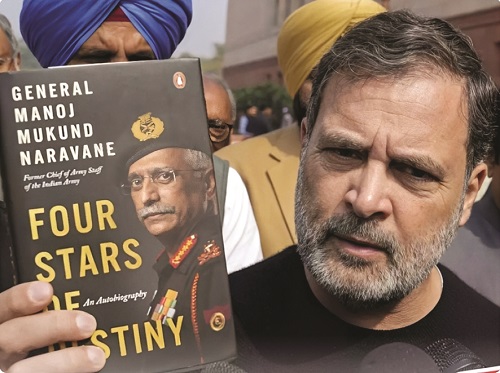
The ongoing controversy around former Army Chief General Manoj Naravane’s unpublished book has generated far more heat than light. Much of the public debate appears to be driven by selective media interpretation and misplaced assumptions about how military decision-making actually functions in a democracy. In a country where the political leadership is not expected to be trained in the complexities of military tactics, strategic options or operational art, the constitutional framework clearly places the responsibility for expert military advice upon the Chiefs of Staff. The Cabinet Committee on Security depends on this expertise, especially during situations of acute tension such as the Chinese incursions in eastern Ladakh. It is in this context that General Naravane’s statements—particularly his assertion that he “sought orders” from the Prime Minister’s Office or the Defence Minister—must be examined with sobriety, not sensationalism.
The real issue is not whether the Chief spoke to the PM and RM during a crisis—every Chief must. The real issue is: what did he expect to be told? In the rapid unfolding of a military emergency, no Prime Minister can dictate tactics, manoeuvres, fire plans, or troop dispositions. Those are squarely within the domain of the Chief. What any Chief worth his salt wants in such moments is freedom of action. And that is precisely what the political leadership gave him within minutes, as is widely reported: “You deal with the situation as you deem fit.” If this is true, then the crisis of decision-making that some commentators are trying to construct never existed. The only crisis worth examining is why our top military leadership is seeming hesitant—even apologetic—about exercising initiative during a moment that demanded firmness, clarity and professional confidence.
Civil–Military Conduct in Crisis: Lessons from History
A meaningful analysis of this controversy requires a look at how other great commanders handled their political leadership during war. Civilian supremacy is unquestioned in all democracies, but military leaders who genuinely understand the battlefield have never hesitated to assert the professional logic of their plans. In fact, the greatest commanders in history were those who ensured that political leaders listened when it mattered most.
During World War II, Field Marshal Bernard Montgomery did not merely “consult” the British Cabinet; he often insisted that decisions affecting the battlefield be made on the basis of professional military reasoning. Montgomery’s relationship with Prime Minister Winston Churchill is a case study in respectful firmness. He would outline his plans in detail, defend them vigorously, and refuse interference in operational matters. Not once did he seek tactical instructions from Churchill. Instead, he made his government understand that once the military situation was explained, the responsibility for fighting rested entirely on the chain of command. His confidence was infectious: it strengthened national morale and ensured unity of political and military effort.
In the Middle East, the example of General Ariel Sharon during the 1973 Yom Kippur War highlights another dimension of civil–military dynamics. Sharon was audacious, abrasive, and often insubordinate—traits that sometimes created friction with his superiors—but history records that his bold crossing of the Suez Canal turned the tide of the war. When higher headquarters attempted to slow his advance, Sharon famously retorted in language that was far from diplomatic. While no professional army endorses rudeness, the essence of that episode lies in Sharon’s clarity: he knew what needed to be done, he had assessed the battlefield, and he acted with absolute decisiveness. His political leadership, despite its reservations, eventually realised that giving bold commanders operational space was essential for turning crises into victories.
India itself has produced leaders of similar character. During the 1971 war, General Sam Manekshaw demonstrated how a Chief should advise, assert, and lead. When Prime Minister Indira Gandhi wanted to initiate military action in East Pakistan earlier than what the Army considered appropriate, Manekshaw simply said the Army was not ready and that an unprepared assault would be disastrous. This was not insubordination; it was professional responsibility delivered with moral courage. Manekshaw did not seek “orders” about tactics. Instead, he explained what the military could or could not do, and reminded the political leadership that military victory depended upon military preparedness, not political anxiety. The PM accepted his counsel, and the result was a swift, decisive victory that reshaped South Asia’s history.
These examples underline a fundamental principle: great commanders do not wait for political directions about how to fight; they advise the political leadership with clarity and then act with authority.
India’s Need for Decisive Military Leadership
The Chinese mobilisation in eastern Ladakh was a classic case of an adversary testing India’s political and military nerve. Satellite images, real-time surveillance and ground reports clearly indicated that the People’s Liberation Army was massing armour, infantry and artillery along friction points. Such aggressive manoeuvres demanded professional assessment and immediate military action: reinforcement of vulnerable sectors, rapid deployment of mechanised and infantry elements, creation of tactical blocks, and psychological signalling to deter further ingress.
If General Naravane, upon seeing Chinese armour advancing, “sought orders”, then it raises uncomfortable questions. What exactly was he expecting? Should the Prime Minister have told him “advance 2 kilometres”, “hold ground”, “fire”, “don’t fire”, or “mobilise formations”? These are tactical and operational decisions that lie exclusively within the realm of the Army Chief. The political leadership’s role is to establish national objectives, approve or reject large-scale escalation, and provide the political cover necessary for military action—not to dictate battlefield conduct.
In fact, as reported, the PM and the Defence Minister gave the correct response: “You have full freedom to take the necessary military decisions.” It is exactly what a responsible political leadership should say. If this response is being interpreted as indecisiveness, the fault lies not with the civilian authorities but with the military narrative being projected.
A Chief’s authority must flow downwards, not upwards. When a crisis emerges, higher commanders issue orders; they do not seek them. They brief their political masters, explain options, recommend a course of action, and then act decisively. If the Chief himself hesitates, the entire chain of command trembles!
Professional Initiative and the Commander’s Mind
A closer study of historic military leaders shows that initiative is the heart of command. General George Patton once remarked that if everyone is thinking alike, then someone isn’t thinking. What he meant was that commanders must think independently, not merely seek approval. Patton never asked President Roosevelt how to deploy his tanks; he simply acted in accordance with the overall strategy. His speed and boldness saved countless Allied lives by preventing German counter-thrusts.
In Vietnam, General Vo Nguyen Giap—though on the opposing side—demonstrated how strategic initiative can overcome even technologically superior adversaries. Giap did not ask his political leadership whether he should ambush, fall back or escalate. He defined the battlefield logic and influenced political leaders accordingly.
Even in administrative democracies such as the United States, where civilian oversight is extremely strict, military commanders do not run to the White House for tactical instructions. They brief the National Security Council, articulate risks and options, seek political sanction for broad strategic actions, and thereafter take independent operational decisions.
This is why the current debate around General Naravane is not merely about personalities; it is about the institutional culture of command initiative within the Indian Armed Forces.
The Need for Moral Courage in Uniform
Moral courage is a greater value than physical courage. Physical courage is exhibited in battle; moral courage is required in conference rooms where decisions about life and death are made. General Manekshaw possessed both. In his famous interaction with the PMO in 1971, he displayed the confidence of a commander who knew his profession intimately. He did not defer unnecessarily; nor did he inflate threats to induce panic. His honesty, even if unpalatable, enhanced the credibility of the Army.
In contrast, the impression emerging from General Naravane’s account is one of excessive deference, bordering on uncertainty. It creates the perception that the military leadership was not fully confident of its own capabilities or assessment. This may not be factually accurate, but perception matters in national security. When the Chief of Army Staff seems hesitant, it sends a negative psychological signal—internally and externally.
China, in particular, thrives on exploiting perceived weakness. Strategic ambiguity is sometimes useful, but strategic timidity never is.
Was There Really a Crisis of Decision-Making?
A sober reading of events suggests otherwise. The political leadership, despite political polarisation in the country, responded in a constitutionally appropriate manner. The Prime Minister and Defence Minister were briefed, they asked the Chief for his assessment, and they permitted him full operational freedom. This is textbook civil–military procedure.
The real controversy, therefore, arises from the way the issue has been presented publicly. When a Chief says he “sought orders”, it inadvertently conveys that he was awaiting tactical direction, which is not what professional militaries expect from their Chiefs. This single phrase has muddled an otherwise straightforward episode.
A Chief must say, “This is the situation. These are our options. My recommendation is Option A. Seek political approval for escalation beyond point X. Within the approved framework, I take full responsibility for operational decisions.” That is how Manekshaw handled 1971, how Montgomery handled North Africa, and how Eisenhower handled Normandy.
If General Naravane had framed his account along these lines, the controversy would not have arisen.
The Larger Message for India’s Military Institutions
India today faces an adversary that uses salami-slicing tactics, deception, psychological warfare and territorial brinkmanship. Against such an adversary, military leadership cannot afford to be overly cautious. Caution has its place, but decisiveness must remain the core of military command.
The Indian Army is one of the finest fighting forces in the world. Its officers are brave, committed and professionally competent. But institutional culture must evolve to encourage greater initiative among higher commanders. India cannot fight 21st-century adversaries with the 19th-century mindset of bureaucratic hesitation.
The current controversy must serve as a wake-up call: Chiefs of the future must combine professional knowledge with moral courage and strategic sharpness. They must be able to advise the political leadership forcefully and, once authorised, take decisive action without waiting for further signals.
This does not mean confrontation with the political leadership. It means clarity of professional responsibility.
Conclusion: Reclaiming the Commander’s Authority
The debate around General Naravane’s book is, at its core, a debate about command responsibility. The political leadership did its job by granting immediate freedom of action. The Army, therefore, was never prevented from acting. The controversy has arisen primarily because of how the events have been framed after the fact.
Civilian supremacy is non-negotiable, but military initiative is equally essential. History honours leaders like Montgomery, Sharon, Manekshaw and others not because they were compliant, but because they were confident, competent and courageous in advising their governments. They did not wait for instructions; they shaped them.
General Naravane’s account—if accurately reported—falls short of this standard. It inadvertently exposes a deeper malaise: an over-centralised, risk-averse, bureaucratised higher command culture that hesitates when decisiveness is needed most.
India deserves generals who make governments listen—not because they are abrasive, but because their professional judgment is compelling. That is the essence of military leadership in a democracy: respectful firmness, not timid compliance. The Ladakh episode, instead of being sensationalised, should become a moment of introspection for India’s military institutions, prompting them to cultivate boldness, clarity and self-confidence at the very top. Only then will India’s armed forces project the strength that its soldiers display daily on the frontlines.

















Leave Your Comment