


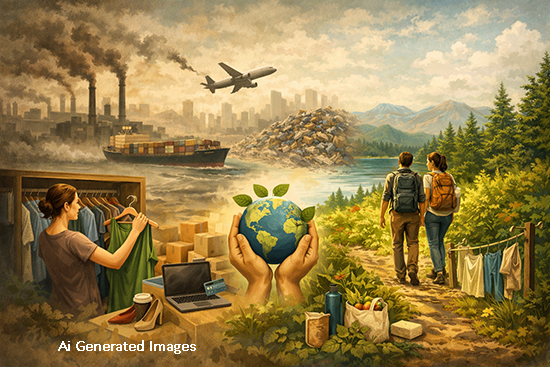
In the modern digital economy, the gap between a consumer’s desire and the fulfillment of that desire has shrunk to a mere click. While governments may find legal grounds to regulate the speed of delivery services citing labor rights or road safety the phenomenon of "Fast Fashion" presents a more complex ethical dilemma. Because fashion is deeply intertwined with personal expression, "freedom of choice," and "freedom of access," direct state intervention or bans are often viewed as overreach. However, the absence of a legislative hammer does not mean the current trajectory is sustainable. As we hurtle toward a climate crisis, we must ask ourselves: Is government intervention the only path to salvation, or is "self-regulation" the missing piece of the puzzle? To understand why our shopping habits need an urgent overhaul, we must first look at the devastating environmental footprint of the clothes we wear once and discard.
Fast fashion is defined by the rapid mass-production of inexpensive clothing that mimics the latest catwalk trends. To maintain these low prices and high speeds, the industry bypasses traditional sustainability. Globally, the fashion industry is the second-largest consumer of water and is responsible for approximately 8% to 10% of global carbon emissions more than all international flights and maritime shipping combined. The "global facts" are staggering. It takes about 2,700 liters of water to produce a single cotton t-shirt, an amount equivalent to what one person drinks in two and a half years. Furthermore, the synthetic fibers that dominate fast fashion, such as polyester, are essentially plastic derived from fossil fuels. Every time these garments are washed, they shed half a million tonnes of microplastics into the ocean annually, equivalent to 50 billion plastic bottles.
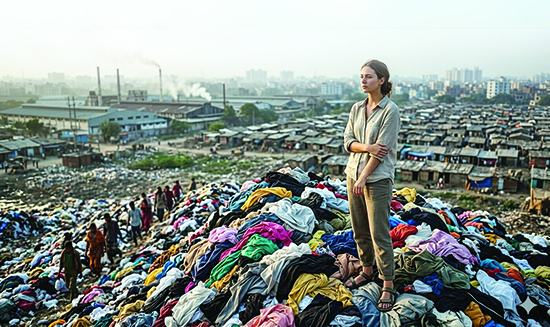
The problem extends far beyond production. Because these garments are sold so cheaply, they have become "disposable" in the eyes of the consumer. In the last 15 years, clothing production has doubled, while the number of times a garment is worn has plummeted by nearly 40%. This culture of "wear once, throw away" creates a massive waste management crisis. Every second, the equivalent of one garbage truck of textiles is landfilled or burned. Much of this waste is exported to developing nations, where it chokes local ecosystems and creates mountains of non-biodegradable trash. This is the hidden cost of our "freedom of access" a heavy price paid by the environment and communities halfway across the globe.
We must address the argument that only a government ban can solve such a systemic issue. While regulations on chemical dyes or labor standards are necessary, a ban on "shopping too much" is practically impossible in a free society. This is where the concept of self-regulation and "Atma-Niyantran" (Self-Control) becomes revolutionary. The shift from a "consumer" to a "custodian" of resources is a psychological change that no law can enforce. When we exercise self-control, we are not losing our freedom; we are exercising a higher form of it the freedom to choose a livable future over a fleeting trend. Mindful consumption involves questioning the "why" behind every purchase. Is this a need, or is it a dopamine hit triggered by a targeted social media ad?
To mitigate this environmental damage, we must pivot toward a "Circular Economy." This starts with the individual opting for quality over quantity. Investing in durable pieces, supporting slow-fashion brands that use organic materials, and embracing the "Second-Hand" revolution are powerful steps. Thrifting and upcycling are no longer just budget options; they are badges of environmental honor. Moreover, we must demand transparency from brands. If a dress costs less than a sandwich, someone, somewhere, is paying the price be it a garment worker in an unsafe factory or a river poisoned by untreated toxic runoff.
The path forward requires a synergy between ethical production and conscious consumption. We need to rediscover the art of mending and caring for what we already own. In the age of instant gratification, waiting or choosing not to buy is an act of rebellion against a system that profits from our dissatisfaction. The environmental crisis is not just a failure of technology or policy; it is a failure of restraint. By adopting a minimalist approach and recognizing that our wardrobes are linked to the health of the world’s forests and oceans, we can create a market shift. When the demand for "fast" drops, the industry will have no choice but to slow down.
In conclusion, while we wait for systemic changes or green technologies to save us, the most immediate and effective tool we have is our own discretion. "Freedom of choice" should include the choice to protect the planet. We do not need a government mandate to tell us that excessive, thoughtless consumption is harming our home. By practicing self-regulation, we reclaim our agency. We must move from being passive consumers of trends to active protectors of the environment. The next time we are tempted by an "order now" button, we should remember that the most sustainable garment is the one already hanging in our closet.
(The author is a known Environmentalist and the pioneer of Satyagraha Against Pollution movement, viraludayindia@gmail.com )
(The content of this article reflects the views of writer and contributor, not necessarily those of the publisher and editor. All disputes are subject to the exclusive jurisdiction of competent courts and forums in Delhi/New Delhi only)

















Leave Your Comment