


This phenomenon, known as a Glacial Lake Outburst Flood (GLOF), is not merely a localized natural disaster but a stark manifestation of a global climate crisis that is shattering lives and redefining our relationship with the natural world.
For centuries, the high-altitude glaciers acted as a predictable source of water, feeding the great rivers of Asia and sustaining millions. However, the accelerated melting caused by anthropogenic climate change has led to the formation of massive proglacial lakes, held back only by unstable natural dams of loose rock and debris called moraines. When these fragile barriers fail triggered by an avalanche, an earthquake, or simply the sheer pressure of accumulating meltwater..the result is a catastrophic release of water and debris that gathers momentum as it hurtles down steep mountain corridors. At 17,000 feet, the potential energy of such a volume of water is astronomical. By the time it reaches human settlements, it is no longer just water; it is a churning mass of boulders, mud, and uprooted forests, moving with a velocity that leaves no room for escape.
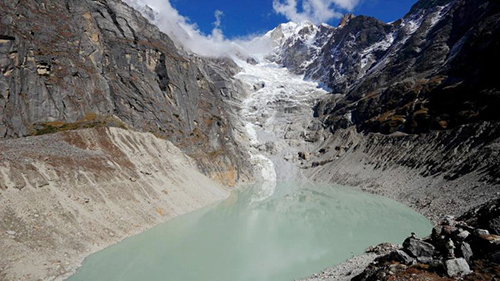
The human cost of these events is profound and multifaceted. Families who have lived in these valleys for generations find their ancestral lands erased in a matter of minutes. The physical infrastructure homes, schools, bridges, and hydroelectric projects is pulverized, but the psychological scars run even deeper.
There is a haunting sense of betrayal by the landscape that once provided life. As the WSJ report highlights, the randomness of the destruction creates a persistent climate anxiety among high-altitude communities. They live with the constant knowledge that the mountains above them are structurally changing, and the "water towers" of the world are becoming ticking time bombs. This is the frontline of climate change, where the abstract statistics of carbon parts per million translate into the visceral reality of losing everything to a wall of water.
From a climate perspective, what happened at 17,000 feet is a warning sign of 'tipping points.' The cryosphere the frozen part of the Earth is particularly sensitive to even slight increases in average temperature. In the Hindu Kush-Himalaya region, the rate of warming is significantly higher than the global average. This "elevation-dependent warming" means that the very heights that should be the coldest are experiencing the most rapid change. As the permafrost thaws, the ground that holds these glacial lakes together loses its structural integrity. We are witnessing a transition from a predictable hydrological cycle to an era of "extreme water," characterized by periods of intense drought followed by sudden, overwhelming floods.
To address this escalating threat, a shift from reactive disaster management to proactive climate resilience is imperative. The first step lies in the deployment of advanced early warning systems. While we cannot stop a glacier from melting overnight, we can monitor lake levels using satellite imagery and IoT-based sensors that provide real-time data. If a lake reaches a critical threshold or if a moraine shows signs of breach, downstream communities must have the communication infrastructure to evacuate within minutes. This "last-mile connectivity" in remote mountain regions is the difference between life and death.
Furthermore, engineering solutions such as "controlled drainage" can be employed to reduce the pressure on unstable glacial lakes. By siphoning off water or creating reinforced spillways, the volume of a potential flood can be significantly reduced. However, these are localized "Band-Aid" solutions. The broader remedy requires an international commitment to drastic carbon emission reductions. The Himalayas are melting because the planet is heating, and no amount of local engineering can withstand the total collapse of the high-altitude cryosphere. We must also reconsider the rush to build massive infrastructure, like mega-dams, in ecologically fragile high-altitude zones. Climate-resilient urban planning must prioritize the natural topography and respect the "right of way" of mountain rivers.
In conclusion, the tsunami unleashed from the heights of the mountains is a clarion call for the world. It exposes the fragility of our progress in the face of a changing climate. The shattered lives in the valleys below are a mirror to the choices we make in our cities and industrial hubs. As we look toward the peaks, we must recognize that the melting ice is not just losing volume; it is losing its ability to protect us. To prevent future catastrophes, we must integrate indigenous mountain wisdom with cutting-edge science, fostering a global responsibility to stabilize the climate. The ice at 17,000 feet is telling a story of urgency; it is time the world listens before the next deluge begins its descent.

Viral Desai
(The author is a known Environmentalist and the pioneer of Satyagraha Against Pollution movement, viraludayindia@gmail.com )
(The content of this article reflects the views of writer and contributor, not necessarily those of the publisher and editor. All disputes are subject to the exclusive jurisdiction of competent courts and forums in Delhi/New Delhi only)

















Leave Your Comment