



VIRAL DESAI
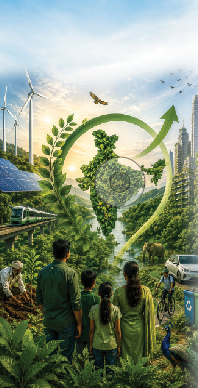
Over the past twelve years, India has embarked on an unprecedented ecological trajectory, shifting its national narrative from reactive conservation to a proactive, deeply institutionalized environmental renaissance. Guided by the defining governance philosophies of Sabka Saath, Sabka Vikas, Sabka Vishwas, and Sabka Prayas under the visionary leadership of Prime Minister Narendra Modi, the nation has engineered an extensive paradigm shift that harmonizes aggressive economic development with rigorous environmental stewardship. This period has not merely witnessed incremental changes; rather, it has been characterized by deliberate policy interventions, massive public mobilizations, and systemic structural overhauls that have collectively redefined India’s global standing. Confronted by the escalating trilemma of global climate change, intense resource constraints, and domestic environmental degradation, India has rejected the outdated Western binary that positions development and conservation as mutually exclusive pursuits. Instead, the country has successfully pioneered a holistic blueprint that leverages community engagement, institutional accountability, and technological innovation to achieve long-term ecological resilience.
Central to this green transformation is the remarkable revitalization of the country’s natural landscapes, most notably through the targeted expansion of its forest and tree cover. According to recent environmental assessments, India’s total forest and tree cover has reached an expansive 8.27 lakh square kilometers, a figure that now constitutes over twenty-five percent of the sub-continent’s total geographical area. This deliberate expansion has elevated India to the prestigious ninth position globally in terms of total forest area, an achievement that highlights the success of long-term ecological planning. This structural growth is anchored by initiatives like the Green India Mission, launched in 2015 as a flagship framework dedicated to comprehensive forest protection, biodiversity preservation, and ecosystem restoration. Far from being a top-down bureaucratic exercise, this expansion has transformed into a massive public movement, exemplified by the "Ek Ped Maa Ke Naam" campaign launched by Prime Minister Modi in 2024. By intertwining deep emotional resonance with civic duty, this initiative mobilized millions across the nation, resulting in the planting of over 262 crore saplings by December of last year. This unprecedented level of public participation underscores a profound shift in the collective consciousness, converting environmental conservation from a distant governmental obligation into an active, everyday civilian responsibility.
Parallel to the expansion of its terrestrial green canopies, India has executed sophisticated, large-scale interventions aimed at rejuvenating its complex aquatic and coastal ecosystems. Historically, major river systems had borne the heavy brunt of rapid urbanization and industrial expansion, necessitating immediate and comprehensive remedial frameworks. The launch of the Namami Gange Programme in 2014 represented a critical turning point in this domain, replacing fragmented local clean-up efforts with an integrated, basin-wide strategy designed to restore the ecological health of the River Ganga and its numerous tributaries. Out of 524 projects meticulously sanctioned under this multi-billion-dollar mission, an impressive 355 comprehensive projects have been successfully completed as of February this year, significantly reducing pollutant loads, preserving aquatic biodiversity, and restoring historical riverine pathways. This river rejuvenation strategy works in tandem with a robust national focus on the restoration of wetlands, coastal networks, and fragile mangrove ecosystems. By recognizing these natural frameworks as vital carbon sinks and crucial natural barriers against climate-induced disasters, India has institutionalized strict regulatory protections and community-led conservation zones, ensuring the long-term survival and ecological vitality of its diverse aquatic systems.
On the global stage, India’s domestic environmental successes have significantly bolstered its international credibility, transforming the nation from a cautious participant in climate negotiations into a prominent agenda-setter and leader in clean energy transitions. A prime example of this geopolitical leadership is the International Solar Alliance, co-founded by India in 2015, which has successfully positioned the nation at the center of the global shift toward renewable energy infrastructure. Furthermore, India’s aggressive domestic clean energy targets and industrial efficiency reforms have yielded extraordinary results, allowing the nation to achieve its targeted 33 to 35 percent reduction in carbon emissions intensity from 2005 levels an astonishing eleven years ahead of the original international schedule. This monumental milestone proves that rapidly developing economies can successfully decouple industrial growth from carbon output through structural efficiency and political will. Building on this momentum, India introduced Mission LiFE (Lifestyle for Environment) in 2022, a global diplomatic and behavioral framework designed to shift the international climate discourse away from macro-level policy constraints and toward sustainable, individual-led consumer choices. By positioning lifestyle-based climate action as a core component of global sustainability, India has successfully reshaped the international climate architecture, emphasizing that systemic global change is deeply rooted in collective, responsible personal behavior.
Ultimately, the story of India’s environmental evolution over the past twelve years is a powerful testament to what can be achieved when political visionary leadership aligns with comprehensive institutional action and genuine public enthusiasm. By striking a careful, deliberate balance between preservation, sustainability, and industrial development, India has crafted a unique developmental philosophy that addresses immediate economic needs without compromising the ecological inheritance of future generations. The systematic restoration of rivers, the massive expansion of carbon-absorbing forests, the early fulfillment of international climate pledges, and the mainstreaming of sustainable lifestyles all serve as interconnected pillars of a single, unifying national objective. As the international community continues to grapple with the complex, escalating challenges of an altering climate, India's comprehensive and sustained ecological transformation offers a powerful, practical model for the world. It vividly demonstrates that a nation can achieve rapid modern growth while simultaneously nurturing, restoring, and honoring the natural environment that sustains all human life.
(The author is a known Environmentalist and the pioneer of Satyagraha Against Pollution movement, viraludayindia@gmail.com )
(The content of this article reflects the views of writer and contributor, not necessarily those of the publisher and editor. All disputes are subject to the exclusive jurisdiction of competent courts and forums in Delhi/New Delhi only)





















Leave Your Comment