



Subham Saswat Prusty
The Shanghai Cooperation Organisation (SCO) Summit has revealed more than a changing Eurasian balance of power, it has highlighted the emergence of a more complex global order in which trade, energy, technology, connectivity and finance are becoming instruments of geopolitical influence. For India, the summit was therefore not merely another diplomatic gathering. It was an opportunity to engage Russia, China and the Central Asian republics simultaneously while protecting New Delhi’s strategic independence. At a time when Russia is adapting to Western sanctions, China is seeking greater international acceptance of the renminbi, and several emerging economies are exploring alternatives to excessive dependence on dollar-based financial channels, India is pursuing a more pragmatic course diversification without isolation.
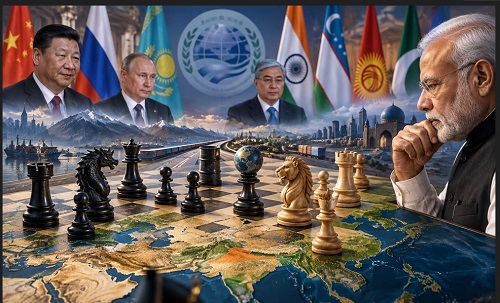
The interaction between Narendra Modi, Vladimir Putin and Xi Jinping was particularly significant because it reflected the complicated geometry of Eurasian politics. Putin and Xi have developed a close strategic partnership, while India and Russia retain a relationship built over decades of defence, energy, nuclear cooperation and diplomatic trust. India’s relationship with China is fundamentally different. Economic ties remain important, but border tensions, strategic competition and divergent interests in the Indo-Pacific continue to shape the relationship. New Delhi’s objective, therefore, is not to become part of a China-Russia bloc or an anti-Western coalition. Its larger ambition is to establish India as an independent centre of power capable of working with competing nations without becoming subordinate to any of them.
This diplomatic flexibility is being supported by an increasingly resilient Indian economy. Despite global trade tensions and geopolitical uncertainty, India remained the fastest-growing major economy, with real GDP growth accelerating to 7.6 percent in FY2025-26 from 7.1 percent in FY2024-25, according to the World Bank. India’s current account deficit was around 1 percent of GDP, while formal employment creation strengthened and manufacturing and services remained important contributors to growth. The World Bank has projected growth of 6.6 percent for FY2026-27, reflecting external risks including energy-price pressures and geopolitical disruptions. These numbers matter geopolitically. A country cannot exercise sustained strategic autonomy without economic strength. India’s growing economy gives New Delhi greater room to resist external pressure, negotiate with major powers and pursue policies based on national interest rather than immediate financial necessity. The significance of India’s growth is therefore not merely statistical. Economic expansion is gradually becoming an instrument of diplomatic power.
The financial dimension of the changing world order is equally important. The US dollar remains the dominant global reserve and settlement currency, supported by the depth of American financial markets and the reach of its banking system. Its immediate replacement is neither realistic nor necessary. What is changing is the desire of several countries to reduce excessive dependence on a single financial architecture. Russia’s experience with sanctions has accelerated this process, while China has promoted wider international use of the renminbi. India’s approach should remain distinct. New Delhi does not need an ideological campaign against the dollar, nor should it replace one form of dependence with dependence on the Chinese currency. The objective should be strategic financial autonomy. That means expanding the use of the rupee in suitable international transactions, strengthening cross-border payment systems, encouraging trade in national currencies where commercially viable and maintaining adequate foreign-exchange resilience. India should not seek the disappearance of the dollar; it should ensure that geopolitical shocks cannot easily paralyse Indian commerce.
Russia offers an important example. Western sanctions have forced Moscow to restructure its financial and trading relationships, particularly with China and India. Energy remains central to this relationship because Russia is a major energy supplier and India is one of the world’s largest and fastest-growing energy markets. For New Delhi, the lesson is clear: strategic partnerships require financial mechanisms capable of functioning during periods of geopolitical disruption. India’s response should therefore be diversification rather than confrontation. This is where India’s diplomatic performance becomes significant. New Delhi has maintained its long-standing relationship with Moscow while simultaneously deepening cooperation with Washington in defence, technology and investment. It is engaging China despite strategic competition, while expanding relations with Europe, Japan, Southeast Asia, West Asia, Africa and Central Asia. Such diplomacy is not a contradiction. It is an attempt to ensure that India has several strategic options instead of becoming dependent on one power centre.
India’s economic growth strengthens this approach further. The World Bank estimates India’s 2025 GDP at approximately $3.96 trillion, with 7.6 percent annual growth, substantially faster than global growth of about 2.9 percent. This combination of economic scale and growth gives India increasing weight in negotiations over trade, technology, energy and global governance. India’s expanding electronic payment ecosystem can support wider international transactions, but cybersecurity, data protection and technological sovereignty must remain priorities. Similarly, the International North-South Transport Corridor and connectivity through Chabahar can provide India with greater access to Central Asian, Russian and wider Eurasian markets. Geography, once considered a constraint, can thus become an instrument of strategic influence. India must also reduce vulnerabilities in critical minerals, energy and supply chains. Lithium, cobalt, rare-earth elements and other strategic resources will increasingly determine industrial and technological competitiveness. Diversifying sources, investing in domestic exploration, building recycling capacity and securing overseas resources should therefore become national priorities. Energy supplies must also be diversified even while India maintains commercially and strategically important relations with Russia.
The deeper lesson of the SCO is that geopolitical power is no longer measured only by armies and missiles. Payment systems, financial networks, energy security, critical minerals, technology platforms, manufacturing capacity and transport corridors can influence the strategic choices of nations. India’s challenge is to convert its economic growth into resilience across all these domains. The SCO should therefore not be interpreted as the beginning of the end of the dollar or as the creation of a unified China-Russia economic bloc. Its larger significance lies in the gradual diversification of the international system. India’s diplomatic achievement is that it can participate in this transformation without abandoning its links with the Western economy or becoming trapped inside a rival bloc.
The path ahead is clear. India must strengthen the rupee and its financial infrastructure, diversify energy and supply chains, secure strategic minerals, accelerate manufacturing and advanced technology, develop alternative trade corridors and deepen relations across competing power centres. At the same time, it must preserve strategic communication with China, strengthen its partnership with Russia and expand cooperation with the United States, Europe, Japan, Central Asia, West Asia and Africa.India’s greatest geopolitical advantage is therefore not the ability to choose one camp, but the ability to maintain meaningful choices. Its economic growth is giving those choices greater credibility. Its diplomacy is turning those choices into influence. On the Eurasian chessboard, India’s objective is not to become a pawn in someone else’s game. It is to build enough economic strength, diplomatic space and technological capability to shape the game itself. Strategic autonomy, backed by economic resilience, may ultimately become India’s most powerful instrument in the emerging world order.
Subham Saswat Prusty is a nanotechnology engineer, management professional and independent commentator on geopolitics, maritime affairs and civilizational history. His work explores the intersection of strategy, technology, economic development and India's civilizational heritage.
(The content of this article reflects the views of writer and contributor, not necessarily those of the publisher and editor. All disputes are subject to the exclusive jurisdiction of competent courts and forums in Delhi/New Delhi only)




















Leave Your Comment