



Sujeet Kumar
Not long ago, a simple financial transaction in India demanded substantial time, effort, and patience. For the average citizen, paying utility bills meant standing in long, exhausting queues under the sun, while sending money to families in distant villages required a physical journey to a bank branch, tedious paperwork, and days of anxious waiting.
For hundreds of millions of Indians, this infrastructural bottleneck was not merely an inconvenience but an instrument of absolute exclusion from the formal financial system. That era of structural deprivation, which kept a vast portion of our population financially invisible, is now firmly in the past.
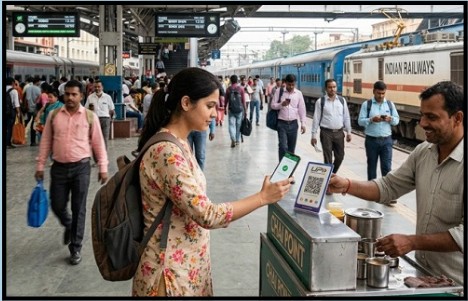
Today, the image of a street vendor, an autorickshaw driver, or a roadside tea-stall owner instantly accepting a bank-to-bank payment via a simple printed QR code has become the most iconic visual of the new India. This silent, democratic revolution has migrated from high-tech research laboratories directly into the palms of our common citizens. What we are witnessing is not merely a convenience-driven change in how India pays; it is a profound structural rebuilding of our economic foundations, serving as a powerful expressway towards the grand vision of a fully developed nation, or Viksit Bharat.
This monumental transformation did not occur by accident or through the passive play of market forces. It was the result of a deliberate, bold, and highly coordinated digital public framework championed by the government under the leadership of Prime Minister Narendra Modi. The bedrock of this revolution is the historic integration of bank accounts, unique digital identities, and widespread mobile connectivity, collectively known as the Jan Dhan-Aadhaar-Mobile alliance.
By systematically opening more than fifty-five crore zero-balance bank accounts for the underserved, establishing biometric digital identities for over one hundred and forty-two crore residents, and driving a telecommunications revolution that slashed mobile data costs from cover three hundred rupees per gigabyte in 2014 to under ten rupees, the government built a secure, high-speed highway of inclusion.
This unified foundation allowed the government to bypass corrupt intermediaries and deliver welfare benefits directly into the bank accounts of those who needed them most. As millions of ordinary citizens began engaging with these direct transfers, they built a deep, intuitive trust in digital financial systems, paving the logical path for the widespread adoption of the Unified Payments Interface, or UPI, when it was launched in 2016.
Prior to this milestone, digital transactions in India were crippled by fragmented, closed-loop systems where private wallet providers allowed transfers only within their own applications, leaving traditional bank-to-bank electronic transfers rigid and inaccessible. UPI fundamentally shattered this paradigm by connecting banks and private technology platforms through public rails, allowing different applications to communicate seamlessly and giving users complete freedom to transact with anyone, regardless of which bank or application they preferred.
The scale of UPI’s growth over the past decade stands as an unparalleled global phenomenon. What began in 2016 as a modest experiment with only twenty-one banks on board, processing a mere three hundred and seventy-four transactions in its first month, has grown into a financial powerhouse. By January 2026, the network expanded to include nearly seven hundred banks, processing more than twenty-one billion transactions worth over twenty-eight lakh crore rupees in a single month.
Cumulatively, annual transactions reached an astronomical three hundred and fourteen lakh crore rupees in the last fiscal year, representing a staggering four-thousand-fold growth in just ten years and accounting for over eighty per cent of all retail digital transactions in the country.
Yet, the true genius of the UPI revolution lies not in these massive macroeconomic numbers, but in its profound impact at the bottom of the pyramid. For decades, digital payment methods like credit cards catered strictly to high-end urban retail because of expensive terminal machines and transaction fees that made no economic sense for small vendors.
UPI compressed this massive physical infrastructure into a simple, zero-cost QR code printed on paper. As a result, the average value of a transaction has steadily declined post-pandemic, dropping from over eighteen hundred rupees in 2021 to thirteen hundred rupees in 2026, indicating that the system is now being used for the smallest, everyday micro-purchases. With street merchants now accounting for nearly two-thirds of all transaction volumes, the informal economy is undergoing rapid formalisation.
By creating a continuous, verifiable digital footprint of their daily sales, roadside vendors and small entrepreneurs who historically lacked a salary slip or property collateral can now establish an alternative credit history. Financial institutions are increasingly leveraging this secure transaction data to offer customized, cash-flow-based loans and micro-credit, bringing formal banking and credit access to the most vulnerable segments of our society. By integrating micro-credit, low-value instant transactions, and automated recurring bill payments, the government has transformed a simple payments tool into a comprehensive financial services funnel for every single Indian.
This domestic success has rapidly expanded into a powerful symbol of self-reliance, or Aatmanirbhar Bharat, establishing India as a global leader in digital innovation. Today, India’s fast-payment system handles nearly half of all real-time digital transactions globally, routinely processing more than six hundred and forty million transactions a day and surpassing major multinational payment networks like Visa.
This technological sovereignty is now actively rewriting the rules of global cross-border payments. Indeed, global leaders, including President Emmanuel Macron of France, have publicly noted India’s achievement in processing over twenty billion transactions a month through the platform, an operational scale no other real-time payments system anywhere has matched.
UPI and UPI-linked systems are now live in 11 countries-including France, the UAE, Singapore, Bhutan, Nepal, Sri Lanka, Mauritius, Qatar, and Cambodia-while the Government of India has signed Memorandums of Understanding with 23 partner nations for cooperation on Digital Public Infrastructure, carrying our digital public infrastructure model to the rest of the world as a genuine alternative to closed, proprietary payment networks.
By exporting this open-source digital public infrastructure, India is offering developing countries a new model of digital governance-one that allows partner nations to build modern financial systems while retaining absolute sovereign control over their national payments, away from monopolistic frameworks.
As we celebrate the ten-year milestone of this digital experiment, we look toward the future with the understanding that this is merely a strong beginning rather than a conclusion. The next decade of this journey will focus on integrating artificial intelligence to enable voice-led transactions for those with limited digital literacy, expanding secure offline payment solutions for remote areas, and taking Indian fintech to every corner of the globe.
Under Prime Minister Narendra Modi, UPI has demonstrated that when the common citizen is empowered with world-class technology, they do not merely participate in development-they lead it. This inclusive, technologically sovereign model of growth is the very engine that will carry India to its ultimate destination, a fully developed, prosperous, and self-reliant Viksit Bharat by 2047.
(Author is Member of Parliament, Rajya Sabha)
(The content of this article reflects the views of writer and contributor, not necessarily those of the publisher and editor. All disputes are subject to the exclusive jurisdiction of competent courts and forums in Delhi/New Delhi only)





















Leave Your Comment