



Reality Check By Prakash Nanda
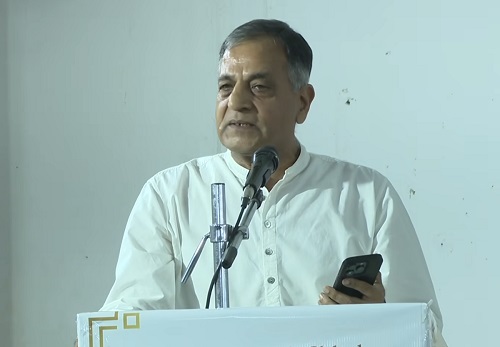
Blind critics of Narendra Modi and the Election Commission have found a new scripture. Former Election Commissioner Ashok Lavasa wrote a piece in “The Indian Express” yesterday ( September 28) on "fearing conscience" among bureaucrats.
Within hours, it was viral on WhatsApp groups and social media handles that make a living out of hating Modi. Lavasa is a hero in that ecosystem, and for one reason only — that he dissented in the Election Commission in 2019, holding that Modi had violated the Model Code of Conduct.
It is time to read that dissent, and this new sermon on conscience, with some memory.
1. Dissent cannot be Indiscipline
Election Commission of India is not a Supreme Court bench where dissent is recorded and celebrated. It is a three-member executive body that takes decisions by majority, much like a Cabinet or a Company Board. The law is clear: the majority view is the Commission's view.
In 2019, Lavasa dissented in 5 cases relating to allegations that Prime Minister Narendra Modi and then BJP President Amit Shah violated the Model Code of Conduct. But the majority decisions of the Election Commission of India (ECI) gave them clean chits.
The Fallout: Lavasa expressed discontent that his minority opinions were not being recorded in the ECI's final orders. He subsequently boycotted internal meetings, arguing that his presence was made "irrelevant".He wanted minority views recorded.
The Commission, by a majority of Chief Election Commissioner Sunil Arora and Commissioner Sushil Chandra, decided otherwise. The rule at that time did not require recording dissent in MCC violation complaints. Lavasa could have recorded his disagreement in the file and abided by the majority.
What did he do? He boycotted all subsequent meetings of the Commission. He refused to attend. For weeks, the Election Commission — during a general election — did not function as a full body. Where was his “conscience”?
If he believed so much in the sanctity of institutions, where was that sanctity when he paralysed the very institution he was part of? Sanctity means you fight inside, you record, you abide. You do not take your bat and go home because the majority did not agree with you. A bureaucrat who was Finance Secretary should have known better than to treat the Election Commission like a personal fiefdom.
2. The Chronology That Lavasa Does Not Talk About
Lavasa's fans forget who sent him to the Election Commission. He was appointed Election Commissioner in January 2018, after retiring as Finance Secretary, by the same Modi government he now postures against. He was not an outsider. He was the ultimate insider.
Months after his famous dissent in May 2019, notices appeared — Income Tax notices regarding his family's disproportionate assets and ED inquiries about Foreign Exchange violations related to his son and wife's companies. Lavasa's supporters claim this was a vendetta for his dissent.
But anyone who has been Finance Secretary knows how the government works. Income Tax and ED investigations do not start and end in 15 days. A Preliminary inquiry, search, collation of bank accounts, company registrars, foreign remittances — it takes months, often a year. If notices came in August-September 2019, investigations must have started in late 2018 or early 2019, much before the dissent.
The question that Lavasa must answer, but never does, is simple: if authorities were investigating his family for serious financial violations, was it not his duty to disclose that conflict of interest when adjudicating Model Code cases against the Prime Minister and Home Minister of the government investigating him? Could his dissent be seen as completely detached from his personal predicament?
He never recused. He never disclosed. He gave dissent and then projected himself as a victim.
And here comes the contradiction about secrecy that he himself invokes in yesterday's article.
3. The Sermon on Secrecy
In his Indian Express piece, Lavasa eloquently speaks of secrecy as the soul of institutional integrity, of how bureaucrats must not leak, must not play to the gallery.
Admirable.
But how did Lavasa come to know about Income Tax and ED investigations against his family? These are supposed to be secret, confidential inquiries. Who leaked to him? His former subordinates in the Finance Ministry — in the Income Tax and Enforcement Directorate — officers whom he had mentored, who still revered the former Finance Secretary.
So on one hand he preaches secrecy for institutions; on the other hand he benefits from the breach of secrecy by the same institutions when it suits him. And then he uses that leaked knowledge to build a narrative of victimhood in the media — that the government is after him.
If secrecy is paramount, should a former Finance Secretary not have told his former subordinates — do not tell me anything, let the law take its own course? Or was conscience selective?
4. The Final Question: Where Was Conscience in 2020?
This is the most damning fact that Lavasa's cheerleaders hide.
After all this drama of dissent, of alleged harassment, of conscience and institutional sanctity — Ashok Lavasa went as Vice President to the Asian Development Bank(ADB) in Manila in August 2020.
Who nominated him for the ADB Vice Presidency? The same Government of India — the Modi government. Under ADB rules, the Vice President is nominated by the member country's government. His name was cleared by the Appointments Committee of the Cabinet headed by Narendra Modi. He went with a fat, tax-free salary in dollars, a diplomatic passport, and all privileges.
If the Modi government was so vindictive, so fascist, so hell-bent on destroying him for his dissent, why would it nominate him to one of the most lucrative international postings? And if Lavasa had so much conscience, why did he accept nomination from the same government he accused of destroying institutions?
A man with conscience would have said: I cannot accept favour from a government I publicly accuse of vendetta. I will go through open international competition. He did not.
He took the posting, quietly resigned from the Election Commission, where he was in line to become Chief Election Commissioner in 2021 and conduct the 2024 Lok Sabha elections, and left for Manila.
That single act exposes the entire morality tale.
Institutional sanctity is not a one-way street. You cannot boycott Election Commission meetings when the majority disagrees, allow your victimhood to be spread by the media, benefit from leaks by former subordinates, and then accept an ADB vice-presidency from the same government — and then write op-eds ( quite frequently) on conscience for bureaucrats and the functioning of the EC in the media.
Lavasa's article yesterday is not about conscience. It is about convenience.
India's bureaucracy does need officers who fear their conscience. But conscience cannot be switched on in 2019 to dissent against Modi and switched off in 2020 to take Modi's nomination to ADB. That is not conscience. That is career management.




















Leave Your Comment