



Dr. Vikas Bhardwaj
Grievance in South Asia is hardly new. What has changed is its distribution — increasingly, an algorithm, not a party worker, decides which anger travels and which dies unread in a group chat. That shift, not any single protest, is the real subject of what follows.
Consider how India’s summer of 2026 actually began: not with a manifesto but with a judge’s aside. On 15 May, Chief Justice of India Surya Kant, hearing a contempt matter, likened some unemployed youth and social-media activists to “cockroaches” and “parasites” who attack institutions — remarks his office later said had been taken out of context (Britannica 2026). Within a day, Abhijeet Dipke, a Boston-based communications strategist, registered a parody outfit called the Cockroach Janta Party. Ten weeks later an Indian cabinet minister had resigned. The interesting question was never whether the joke was funny. It was where the joke stopped being one.
Treat “Gen Z” as an economic category before a political one, and the puzzle sharpens rather than dissolves. India’s under-25 population exceeds 370 million (BBC News 2025). Most of it was not mobilised, even as neighbouring capitals burned. A CSDS–Lokniti post-election survey found the ruling Bharatiya Janata Party retaining roughly forty per cent youth support through 2024, barely eroded since 2019 (BBC News 2025). What existed, by every account, was diffuse frustration over joblessness and examination fraud — not a coordinated movement waiting for a signal. The Cockroach Janta Party supplied something narrower than a cause: a name, a costume, and an algorithmic tailwind.
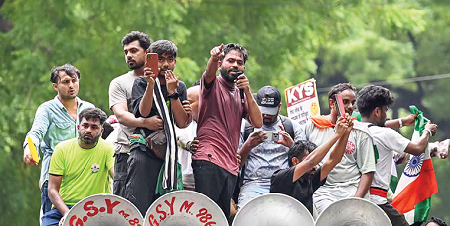
The tailwind was real. Within weeks the party’s Instagram following passed twenty million (CNBC 2026). But the fuel had been accumulating for months. In May 2026 a leak disrupted the NEET undergraduate medical-entrance examination, forcing roughly two million students to resit it; several student suicides followed, which grieving families tied to the cancellation and to years of examination mismanagement (NBC News 2026; NPR 2026). Opposition leader Rahul Gandhi, briefly detained while protesting outside the prime minister’s residence, put the number of paper leaks over the preceding decade at roughly 152 — his claim, not independently verified here. Ladakhi activist Sonam Wangchuk joined the Jantar Mantar demonstration on 28 June and began an indefinite hunger strike; his forcible hospitalisation in mid-July, after a change of Delhi Police leadership, widened the protest more than any viral post had (Al Jazeera 2026). Established Left student unions then joined a movement that had begun as satire — a pattern that recurs throughout this paper: spontaneity attracts organisation the way light attracts moths, and organisation rarely arrives disinterested.
By 20 July, tens of thousands were marching toward Parliament under the banner “Chalo Sansad,” breaching barricades before the government offered talks (Al Jazeera 2026; NPR 2026). The party’s Instagram account was then taken down; Dipke blamed the prime minister directly, a claim this paper cannot verify. India’s Cyber Crime Coordination Centre separately asked GitHub to remove source code for Bitchat, a Bluetooth mesh messaging app gaining traction among protesters wary of conventional networks (ThePrint 2026). On 25 July, Education Minister Dharmendra Pradhan resigned. “We have done it,” Dipke told the crowd — though compensation for the families of students who died remained, by his own account, unresolved (NPR 2026).
None of this required a foreign hand. It required a courtroom insult, an exam scandal, and an architecture that rewards exactly the content — indignant, funny, shareable in four seconds — that Dipke’s parody supplied by instinct rather than design. Platforms do not manufacture grievance, but recommendation systems disproportionately reward the emotionally charged fragment over the policy brief, which is why a courtroom aside now travels further than a white paper ever could. Bitchat illustrates the same logic from the supply side. Built by Block chief executive Jack Dorsey as, in his words, a weekend project, the app needs no internet connection, relying on Bluetooth mesh relay instead — and it drew roughly 48,000 downloads in a single day during Nepal’s uprising the previous September before resurfacing at Jantar Mantar (Forbes 2025; ThePrint 2026). Nothing in Bitchat’s design targets any government; its adoption pattern nonetheless tracks connectivity crackdowns with striking precision, which says more about state responses to unrest than about the technology.
Nepal remains the closest comparator, and the differences matter more than the similarities. On 4 September 2025, Kathmandu banned twenty-six platforms, ostensibly over registration non-compliance; the ensuing protests killed at least seventy-four people within three weeks — the deadliest episode in the country’s protest history — and forced Prime Minister K. P. Sharma Oli’s resignation within days (Britannica 2025). What followed had no Indian analogue: more than 7,700 users voted on a public Discord server, and former Chief Justice Sushila Karki, winning half that vote, was sworn in as interim prime minister (Kathmandu Post 2025; South China Morning Post 2025). Structurally, Nepal is smaller, poorer and thinner-institutioned: youth unemployment above twenty per cent, remittances near a third of GDP (Britannica 2025), and — the counter-intuitive figure — social-media penetration reaching half the population, the highest of any country compared here, against India’s 34.6 per cent (DataReportal 2026a; BusinessStats 2026). A more saturated, more concentrated youth public, sitting atop thinner institutions, converted outrage into regime change within days. India’s larger, more fragmented, more federally cushioned public converted a comparable spike into a ministerial resignation and an intact government.
Bangladesh and Sri Lanka confirm that algorithms transmit crises more readily than they create them. A court’s reinstatement of a divisive civil-service quota in June 2024 escalated, after a crackdown killed an estimated 300 people, into Prime Minister Sheikh Hasina’s resignation and flight, and an interim government under Nobel laureate Muhammad Yunus (Human Rights Watch 2024; Al Jazeera 2024). Sri Lanka’s Aragalaya needed no viral spark: sovereign default, fuel queues and inflation above fifty per cent did the organising, ending in President Gotabaya Rajapaksa’s flight in July 2022 (United States Institute of Peace 2022). Pakistan offers the inverse lesson — that digital identity can outlast a leader’s liberty without resolving anything. Imran Khan, jailed since August 2023, campaigned via an AI-cloned voice produced by a volunteer in Chicago; his party’s independents still won the largest single bloc in February 2024 despite blackouts and a stripped party symbol (BBC News 2023; Al Jazeera 2023). That popularity has since translated into stalemate, not government.
Why did comparable tools produce such different politics? Scale and institutional depth appear to do most of the work. India’s federal structure, layered judiciary, competitive party system and demographic mass absorb shocks that smaller, more centralised states cannot. That is not self-congratulation — the underlying exam-integrity failure was real and embarrassing, and cost a minister his job for good reason — but it is a structural difference, not a rhetorical one.
It is also where the “foreign hand” argument needs unusual care. Within days of the Cockroach Janta Party’s rise, senior Bharatiya Janata Party figures, including Kerala unit president Rajeev Chandrasekhar, called it publicly a “cross-border influence operation” and sought a National Investigation Agency probe, without evidence placed in the public record (National Herald 2026). This was no isolated reflex. In December 2024, the party accused the American “deep state,” alongside the Organized Crime and Corruption Reporting Project and George Soros, of coordinating with Rahul Gandhi against Prime Minister Narendra Modi over reporting on the Adani Group — an allegation the US Embassy called “disappointing” and flatly denied (Reuters 2024). Foreign criticism, foreign funding, foreign advocacy and covert coordination are analytically distinct categories; domestic political rhetoric has repeatedly collapsed them into one. Separately, and on firmer documentary ground, India’s 2026 Foreign Contribution Amendment Bill — introduced 25 March, rules gazetted 22 June — has coincided with roughly 21,933 NGO licence cancellations, drawing criticism from Amnesty International and American legislators concerned chiefly with faith-based charities, even as Indian officials insist the law applies uniformly and does not bar foreign donation as such (Amnesty International 2026; Jurist 2026; Outlook India 2026; The Week 2026). That the amendment is contested does not make it covert; that Washington’s criticism is public does not make it intervention.
China’s posture, on the available record, was strikingly unremarkable. On Nepal’s collapse, its foreign ministry offered only that Beijing hoped for a swift return to order between “traditionally friendly neighbours,” alongside a routine safety advisory to Chinese nationals (Newsweek 2025). Given Kathmandu’s tilt toward Belt and Road financing under Oli, instability plainly unsettled Chinese interests more than it served them (Lowy Institute 2025). No comparably documented Chinese statement exists on India’s own protest wave, and none will be invented here to complete a symmetrical narrative.
Four counterarguments deserve a fair hearing. Social media may only transmit grievance that already exists — Sri Lanka’s collapse suggests economics alone can drive an uprising with no viral assistance whatsoever. Interference allegations can themselves delegitimise dissent regardless of their truth, a risk the BJP’s untested claims illustrate rather than refute. Algorithms plausibly amplify pre-existing preference rather than manufacture political behaviour, consistent with the finding that most young Indians joined nothing at all. And economic crisis, not any platform, remains the deeper engine — Dhaka and Colombo’s death tolls dwarfed Delhi’s without needing an algorithm to explain them.
None of this licenses the conclusion that Gen Z has depoliticised economics. If anything, the opposite: unemployment, examination integrity and inflation remain the raw material of every case examined here, exactly as they were for an older generation’s protests. What has changed is that attention itself now behaves like an economic input — scarce, competed for, and convertible into political outcomes at a speed institutions were not built to absorb. A courtroom aside, an exam leak, a currency collapse: none were engineered by any external actor, and each discovered, almost accidentally, how cheaply outrage now travels and how expensively a government must eventually answer for it. The sequence sketched here — grievance, digital expression, algorithmic amplification, network formation, political appropriation, institutional response — is a scaffold for comparison, not a law of motion; Sri Lanka skipped straight to institutional collapse without needing the middle stages at all. For India, the lesson is not that the street has lost its power but that the street’s political economy is now written upstream of Jantar Mantar, in servers this country does not own. Strategic autonomy in the next decade will mean building the institutional reflexes to absorb that speed without needing to imagine a foreign hand behind every hashtag.
(The content of this article
reflects the views of writer and contributor, not necessarily those of the publisher and editor. All disputes are subject to the exclusive jurisdiction of competent courts and forums in Delhi/New Delhi only)




















Leave Your Comment