


DR. R. BALASHANKAR
India under Prime Minister Narendra Modi has been a highly peaceful place to live. The political stability, economic prosperity, social harmony, public safety, development and growth marked the emergence of India on the world stage with a different and defining paradigm shift in nation’s emergence as a nation. In fact, after independence in August 15, 1947, India has never seen such a social cultural renaissance in Indian society as under Narendra Modi after 2014. The world has accepted India as an emerging super power, with a special status, cultural orientation and economic power which never was the case before.
India was largely considered a slow moving, slow growing country and disparity driven, terror infested, incoherent and politically corrupt entity. It was struggling to emerge out of the colonial hangover, pulled down by the religious and caste cauldron, what is more, the economy in disarray.
Today India is a fastest growing economy in the world. It has emerged the third largest. The Prime Minister Narendra Modi has given India the vision of becoming a developed country on par with western democracies by 2047.Economic analysts have predicted that India might achieve its goal even before. There are predictions that India will emerge the second largest economy in the next two decades by a quantum jump in its GDP to around 20 Trillion worth. It is no achievement that 250 million people have been taken out of poverty in the last 12 years. The Central Government is investing heavily on infrastructure, health social security and agriculture. During this period, the development has reached the most remote and backward areas in the country. The statistics all these avenues look dream come true. Compared with India in 2014 which Modi inherited.
Capital flight was at its peak, inflation at double digit, corruption at its peak, the index of human development plummeting to an alarming low and at was lower scale of ease of doing business. A decade of Dr. Manmohan Singh government had totally destroyed the India story. India had become a hell to live. Divisive and fissiparous tendencies enjoyed political patronage, investment shrinking and social tension enveloping the national fabric as never before. All this had the political sanction of the Sonia led National Advisory Council which was the super cabinet of the UPA. The Prime Minister was a rubber stamp of Sonia Gandhi, enjoying all privileges of diarchic monarch. Terror attacks in city after city had become routine, so was communal clashes. In fact, communal clashes had the new form of terror attack. Hindu majority areas were targeted for terror strikes. Temples were attacked. And the majority felt under siege. India had lost over two lakh lives, millions of people mimed and property worth billions of rupees destroyed in ashes. The nation had come to the stand still. Economy was sliding, anarchy and corruption had an unchecked rein. Under the context, no need to say, the biggest casualty is social harmony. It was in this political mayhem that Narendra Modi emerged as a messiah promising good times, a resurgent India and a harmonious social condition for the nation.
Modi turned India on its head. He promised zero tolerance to corruption reinvented the India growth story. Above all, he dramatically revived the Indian spirit and resilience, historic tenacity and survival instinct. In fact, he reinvented and restored the socio-cultural heritage of India. Many western observers like the London Daily, The Guardian said. India really got independence from the Britishers not in 1947 but in 2014. For till 2014, it was the British system and the British style that was followed in India though it was ruled by Indians. What the London The Guardian said is so authentic, it needs to be quoted repeatedly in this context. In its editorial dated 18th May, 2014 it wrote “ Today may well go down in history as the day when Britain finally left India. Narendra Modi’s victory in the election marks the end of a long era in which the structures of power did not differ greatly from those through which Britain ruled the sub-continent. India under Congress party was in many ways a continuation of the British Raj by other means. The last of the midnight’s children are now a dwindling handful of almost 70 year-olds, but it is not the passing of the independence generation that makes the difference.’ This was a new beginning. The real paradigm shift was scrapping and abrogating archaic rules and regulations and the focus was on performance and delivery. Direct cash transfer to beneficiaries was a major step in this direction for the first time, the middlemen and power brokers lost their say in the administrative environment. Modi had to begin from the beginning. He had a mountain of, challenging, unsurmountable tasks before him which later gave birth to the now famous sobriquet “Modi hai to mumkin hai” (nothing is impossible if Modi is there).
Dr. Aardra who is a great admirer of the social harmony initiatives of the Modi Government said “when the Swachh Bharat mission brought home toilets, along with it came dignity, safety, and better health. Jan Dhan Yojana offered financial inclusion of villages with bank accounts, reducing corruption & elevating their self-respect as well. When poor families received gas connections under Ujjwala Yojana, Pradhan Mantri Awas Yojana rendered homes to millions. Plans like Ayushman Bharat and Janaushadhi imparted sustainable healthcare and medicine at affordable prices respectively. All these opened a different dimension and indeed benefited all sections of the people, ensuring social justice. Remarkable was the novel Modiji "Mann Ki Baat" insights establishing dialogue with the citizens on the affairs of day-to-day governance. This transition of New India moves forward with the common citizen at the core and building a system where the last person in line matters the most. "He who governs with dharma as his staff and truth as his lamp, who doth lift the lowly and protect the helpless, shall see the people united, the land flourishing and the discord fading into the night". Modi Govt. vision marks a decisive shift from identity-based policies to citizen-based empowerment by placing equality before appeasement and dignity before division. It seeks to redefine social harmony as a shared national responsibility. Such an approach aspires to unite all religions & all communities in a common future where opportunity is universal, trust is renewed & Bharat’s diversity becomes not a fault line, but its greatest strength”.
Why patriotism is cardinal to social harmony? Because, if you love your country, you will not destroy it, you will not let it burn on caste, communal, or terror instinct. That is why at every level Modi invoked love for the motherland as a precondition to foster progress. In his campaign speeches he used to give instances of lazy habit of people sitting in the public transport and piercing the cushion seats with their fingers. Defacing bus stand with graffiti and paints, posters etc., littering in public places, spoiling the beauty of public spaces, gardens and parks etc. He used to say innocently, unknowingly we let our national property destroyed. Our ancient monuments, protected structures are wantonly destroyed and defaced. We don’t attach value to our heritage. We simply take things for granted. We have to protect our heritage.
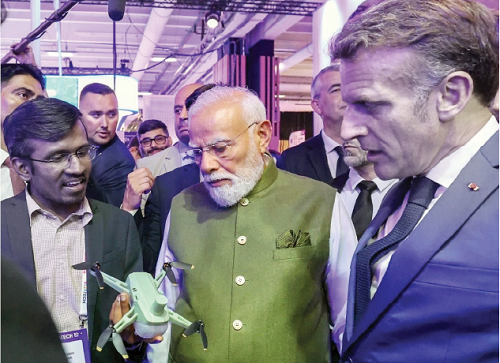
Accompanied by President of France E. Macron, PM Modi visited the exhibition space of VivaTech 2026 in France
Secularism is a sacred idea. But we are secular not because it is enshrined in the Preamble of our constitution. Indians, for ages believed in the concept of sarva dharma sama bhav (equal respect to all faiths). This is much more than being secular. If you are secular, you tolerate other faiths. But when you believe in the ancient Indian traditions of respecting all faiths. Ekam sat vipra bahuta vadanti (One truth, man speak of it differently) there we realize that all faiths, all rituals, all means of worship lead you to the same goal. That is why we say in Hinduism we have 330 million Gods. Everybody has the right to worship his own God. It will not lead to aggressions because of rivalry. This understanding is at the core of social harmony. Only when we are able to respect other faiths, we are in a position to appreciate, encourage, coexist and tolerate other faiths. If this belief is inculcated in our understanding, we will not disrespect, try to proselytize or condemn other faiths. India has survived centuries of external aggressions because of this basic nature of Indians.
At the same time, we have the faith, Lord Shri Krishna tells Arjuna in the Bhagwat Gita Swadharme nidhanam Shreya para dharme bhaya vaha” (it is great to die for once on faith it is sinful to adopt other faith) When all great civilizations perished as the great historian Arnold J Toynbee noted the Indian civilization survived through centuries and still living. That is why we call it Sanathana Dharma. It is eternal, it has the strength to surpass times.
India’s identity is defined by its diversity. People of many religions, languages and cultures live side by side. While diversity is our strength, it requires careful governance, laws, and initiatives to ensure communal harmony.
(Extracted from a forth coming book on Shri Narendra Modi – Iconic Harmonizer)
(The content of this article reflects the views of writer and contributor, not necessarily those of the publisher and editor. All disputes are subject to the exclusive jurisdiction of competent courts and forums in Delhi/New Delhi only)



















Leave Your Comment