


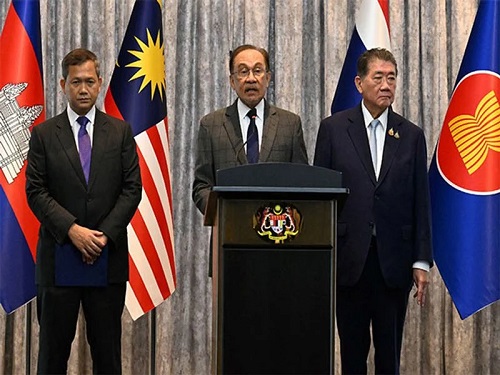
In a significant diplomatic breakthrough, Malaysian Prime Minister Anwar Ibrahim announced on Sunday that Thailand and Cambodia have reached an agreement for an “immediate and unconditional” ceasefire, effective from midnight of July 28. The announcement came at the conclusion of emergency peace talks chaired by Anwar in his capacity as the head of the ASEAN regional bloc.
The ceasefire aims to halt days of intense border clashes that have killed at least 33 people and displaced over 168,000 civilians. Speaking at a joint press conference, Anwar stated that Cambodian Prime Minister Hun Manet and Thai Acting Prime Minister Phumtham Wechayachai had “reached a common understanding to take steps to return to normalcy.”
Both leaders expressed satisfaction with the outcome and reaffirmed their commitment to peace by shaking hands at the conclusion of the brief yet significant press event.
The ceasefire follows mounting international pressure, particularly from former U.S. President Donald Trump, who reportedly engaged directly with both leaders. Trump posted on Truth Social that he had warned the Thai and Cambodian governments he would withhold further trade agreements unless the hostilities ceased.
His statement and diplomatic intervention reportedly served as a critical turning point. Within hours of Trump’s warning, both nations expressed a willingness to negotiate, setting the stage for ASEAN-led talks in Kuala Lumpur.
The conflict erupted on Thursday following a land mine explosion near the Thai-Cambodian border that wounded five Thai soldiers. The incident quickly spiraled into a violent confrontation, with both sides trading artillery fire and ground assaults.
In the immediate aftermath, both countries recalled their ambassadors and Thailand sealed off all border crossings with Cambodia. Despite diplomatic overtures, hostilities persisted through Sunday, particularly in contested areas along the border.
Cambodian Defence Ministry spokesperson Lt. Gen. Maly Socheata accused Thailand of intensifying the conflict with early morning shelling and a “large-scale incursion” involving tanks and troops into Cambodian territory. Thai officials, however, denied initiating the escalation, instead blaming Cambodian forces for the provocation.
Though the ceasefire offers a vital reprieve, experts warn that the underlying border dispute remains unresolved. The area in question has long been a point of contention between the two Southeast Asian nations, with periodic flare-ups over the past two decades.
ASEAN has pledged to facilitate further talks aimed at permanent conflict resolution. “This is a first step,” Anwar emphasized, “but we are committed to ensuring this ceasefire becomes the foundation for lasting peace and cooperation in the region.”
Global reactions to the ceasefire agreement have been overwhelmingly positive. The United Nations and several international watchdogs have called it a “welcome development” and urged both sides to honour their commitments to prevent further bloodshed.
Meanwhile, humanitarian organizations are mobilizing to assist the thousands displaced by the fighting, many of whom have sought refuge in makeshift camps near the border.
As midnight approaches and the ceasefire takes effect, eyes across Southeast Asia—and the world—remain fixed on Thailand and Cambodia, hoping that this diplomatic milestone will lead to lasting peace.

















Leave Your Comment