


A fresh political controversy has erupted in Tamil Nadu just days after actor-turned-politician Vijay assumed office as the state’s new Chief Minister. The dispute centres around the order in which the Tamil state anthem, Tamil Thaai Vaazhthu, was played during official government ceremonies — an issue that has quickly evolved into a larger debate over Tamil identity, federal politics, and the role of the Governor’s office.
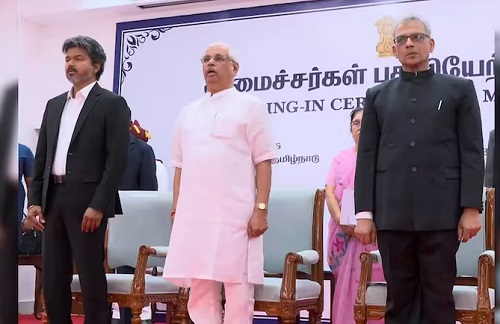
The controversy first surfaced during Vijay’s swearing-in ceremony last week. In a departure from long-established convention in Tamil Nadu, the national song Vande Mataram was played first, followed by the national anthem Jana Gana Mana, and only then the Tamil invocation song Tamil Thaai Vaazhthu. Traditionally, the Tamil anthem is played at the beginning of state government functions, reflecting the deep cultural and linguistic pride associated with Tamil identity.
The sequence immediately triggered criticism from opposition parties and even allies supporting Vijay’s newly formed government. Many viewed the change not merely as a procedural adjustment, but as an affront to Tamil cultural sentiment.
Facing mounting backlash, Vijay’s party, Tamilaga Vettri Kazhagam (TVK), quickly issued an explanation. Party leaders stated that the altered sequence was based on a recent circular issued by the Union government, which reportedly directed that the full version of Vande Mataram be played at formal and official events as part of celebrations marking the 150th anniversary of the national song.
Tamil Nadu Minister Aadhav Arjuna defended the government, saying the decision was made under pressure from the Governor’s office. According to him, the state administration had conveyed its objections but was informed that the Governor, acting under the Union government’s directive, had to follow the revised protocol. He also assured the public that the Tamil anthem would be played first in future government events.
However, the assurance lasted barely a week.
At Thursday’s swearing-in ceremony for 23 ministers in the Vijay-led coalition government, the Tamil anthem was once again played last, reigniting public outrage and political criticism. The opposition accused the government of surrendering Tamil Nadu’s long-standing traditions and failing to uphold its own promise.
TVK leaders again placed responsibility on the Governor’s office, claiming that the ceremony was organised by Raj Bhavan and that the state government had no role in deciding the sequence. Party leader Nanjil Sampath maintained that the Tamil anthem would continue to be played first during Assembly proceedings and state-run functions directly organised by the government.
The controversy provided fresh ammunition to the principal opposition party, the Dravida Munnetra Kazhagam (DMK). Party spokesperson Saravanan Annadurai questioned the credibility of the government’s earlier assurances and accused the TVK administration of failing to protect Tamil rights and traditions.
Coalition allies also expressed discomfort. Communist Party of India Secretary M Veerapandiyan described the incident as a violation of established convention and demanded clarity on who was responsible for the repeated lapse.
The issue became even more politically sensitive because two legislators from the Indian National Congress joined the Tamil Nadu cabinet for the first time in nearly six decades. Congress MP S Jothimani strongly criticised the sequence of songs, accusing the Bharatiya Janata Party and the Governor’s office of interfering in Tamil Nadu’s cultural practices.
She argued that Tamil people attach immense emotional value to Tamil Thaai Vaazhthu and that changing its position during official ceremonies sends the wrong message. According to her, the issue reflects a broader tension between regional identity and central directives.



















Leave Your Comment