


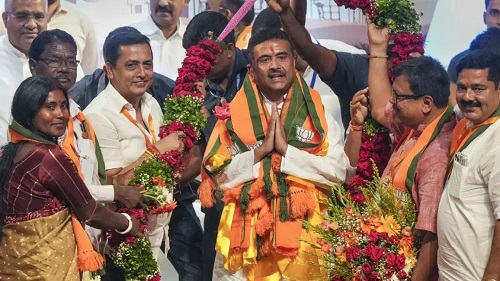
In a historic political transition in West Bengal, Suvendu Adhikari took oath as the Chief Minister, bringing an end to the 15-year rule of the All India Trinamool Congress in the state. The sweeping victory of the Bharatiya Janata Party in the 294-member Assembly has dramatically altered Bengal’s political landscape, with the BJP securing 207 seats while the TMC was reduced to 80.
The BJP legislature party unanimously elected Adhikari as its leader during a crucial meeting attended by Union Home Minister Amit Shah, confirming his elevation to the state’s top political office. The development marks one of the most significant power shifts in Bengal since the fall of the Left Front government in 2011.
Adhikari’s political journey has been closely linked with the defining moments of Bengal’s recent history. Born into a politically influential family in East Midnapore, he stepped into public life at a young age and began his career as a councillor in 1995. Over the years, he built a strong grassroots network, especially in rural Bengal, which later became the foundation of his political influence.
His emergence as a major political force came during the 2007 Nandigram anti-land acquisition movement. At the time, the protests against the Left Front government became a statewide symbol of resistance, and Adhikari played a central organisational role in mobilising people on the ground. The movement transformed Bengal politics and significantly weakened the Left’s decades-long dominance. It also strengthened the rise of the TMC under Mamata Banerjee.
As his popularity grew, Adhikari entered national politics and was elected to the Lok Sabha in 2009 and again in 2014. He later shifted focus to state politics, winning the Nandigram Assembly seat in 2016 and serving as a minister in Mamata Banerjee’s cabinet. During this period, he was considered one of the TMC’s most influential mass leaders.
However, political equations changed dramatically in December 2020 when Adhikari resigned from the TMC and joined the BJP ahead of the 2021 Assembly elections. His exit dealt a severe blow to the ruling party and gave the BJP a powerful organisational face in Bengal. Though the BJP failed to form the government in 2021, Adhikari’s political stature grew rapidly as he became the Leader of Opposition and emerged as the saffron party’s most aggressive voice against the TMC government.
His rivalry with Mamata Banerjee soon became the central narrative of Bengal politics. The high-voltage contest in Nandigram during the 2021 elections drew national attention, where Adhikari secured a dramatic victory over the TMC chief. Years later, his success in Bhabanipur further reinforced his image as the BJP’s strongest leader in the state.
Now, with the BJP securing a decisive mandate, Adhikari has completed a remarkable political transformation — from a grassroots activist and anti-Left movement leader to the Chief Minister of West Bengal. His rise reflects not only his personal political journey but also the larger ideological and electoral shifts that have reshaped Bengal’s politics over the past two decades.



















Leave Your Comment