


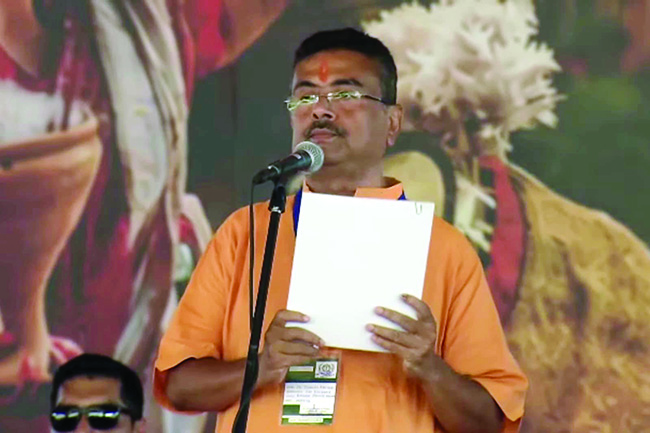
In a historic political transformation in West Bengal, Suvendu Adhikari has emerged as the new Chief Minister after the Bharatiya Janata Party (BJP) secured a sweeping mandate in the Assembly elections. His elevation marks the end of a long era of Trinamool Congress dominance and signals the rise of a leader who built his political career through decades of organizational work, adminis-trative experience, and grassroots connect.
Born in 1970 in Karkuli village of Purba Medinipur district, Adhikari comes from the well-known Ad-hikari family of Kanthi, a family deeply associated with Bengal’s freedom movement and public life. His ancestors, including Bipin Adhikari and Kenaram Adhikari, were active participants in India’s freedom struggle and reportedly faced imprisonment and persecution under British rule. This lega-cy of public service and political activism significantly shaped Suvendu Adhikari’s journey.
Adhikari completed his Master’s degree from Rabindra Bharati University before entering active politics. Over the last three decades, he has steadily risen through the ranks, building a reputation as a determined and accessible leader. Unlike many contemporary politicians, he remained unmar-ried and dedicated his life entirely to public service, a fact often highlighted by his supporters.
His political and legislative experience spans more than twenty years. Adhikari has served twice as a Member of Parliament in the Lok Sabha and three times as a Member of the Legislative Assem-bly. He also spent five years as the Leader of Opposition in the West Bengal Assembly, where he became one of the strongest voices against the then-ruling government. Earlier in his career, he served as a councillor and later Chairman of the Contai Municipality, gaining valuable experience in local governance.
Apart from legislative roles, Adhikari held several important administrative responsibilities. He served as Cabinet Minister handling key departments such as Transport and Irrigation, where he was associated with infrastructure development and public welfare initiatives. He also chaired the Hooghly River Bridge Commission and played a significant role in regional development projects.
One of the most notable phases of his career came during his tenure as Chairman of the Haldia De-velopment Authority. Under his leadership, Haldia witnessed major industrial and urban develop-ment, strengthening its position as one of eastern India’s important industrial hubs. His involve-ment in cooperative institutions, including agricultural rural banks and cooperative banks, further expanded his influence among rural communities and farmers.
Adhikari’s political rise gained national attention due to his organizational abilities and strong mass appeal in coastal Bengal. Over the years, he established himself as a leader capable of mobilizing support across districts and social groups. His transition to the BJP became a turning point in Bengal politics and helped the party significantly expand its reach in the state.
Now sworn in as the Chief Minister, Suvendu Adhikari faces the challenge of translating electoral promises into governance. Supporters view him as a leader capable of delivering administrative reforms, industrial growth, and political stability, while critics will closely watch how his government handles Bengal’s complex social and economic issues.
His journey from a grassroots political worker to the state’s highest office reflects not only personal ambition and persistence but also the changing political landscape of West Bengal.




















Leave Your Comment