


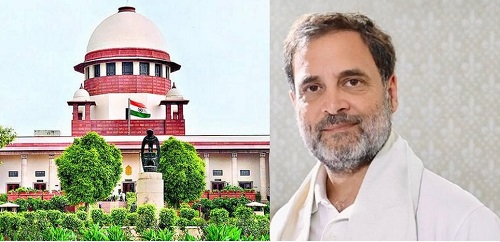
In a significant legal development, the Supreme Court of India has intervened in the defamation case against Rahul Gandhi, Leader of the Opposition in the Lok Sabha, concerning his alleged remarks against Union Home Minister Amit Shah. The apex court, on Monday, stayed the ongoing proceedings against Gandhi in a Jharkhand court, thereby halting further legal actions until the matter is deliberated upon by the higher judiciary.
The case dates back to a controversial statement made by Gandhi during a public address in Chaibasa ahead of the 2019 Lok Sabha elections, where he purportedly referred to Amit Shah as a "murderer." This remark prompted Navin Jha, a BJP worker, to file a defamation suit against Gandhi in 2019.
The legal saga saw a recent turn when the Jharkhand High Court, in February 2024, declined to quash the summons issued to Gandhi by a lower court. This decision prompted Gandhi to approach the Supreme Court, seeking relief from what his legal counsel, Senior Advocate Abhishek Manu Singhvi, argued as an improper filing by a third party not directly aggrieved by the alleged defamation.
Singhvi contended that under defamation laws, only the aggrieved party can legally file a complaint, questioning the legitimacy of Jha's role in initiating the case. The Supreme Court has issued notices to the Jharkhand state government and Navin Jha, calling for their responses to Gandhi's plea challenging the lower court's summons.
The legal complexities further unfolded when a Judicial Commissioner in Ranchi overturned an earlier magistrate court's dismissal of Jha's complaint, directing a reconsideration based on existing evidence. This led to renewed summons for Gandhi to appear in court under Section 500 of the Indian Penal Code, which deals with defamation charges.
The Supreme Court's decision to stay the proceedings signifies a crucial moment in the ongoing legal battle, providing Gandhi with temporary relief while the constitutional validity and procedural fairness of the defamation case are deliberated at the highest judicial level in the country.
Gandhi, a prominent figure in Indian politics and a key leader of the Indian National Congress, has consistently maintained his stance on issues of governance and political accountability. The outcome of this case could have far-reaching implications not only for him personally but also for the broader interpretation of defamation laws in India's legal framework.
As the legal process unfolds, stakeholders await further developments in this high-profile case, which has underscored the intersection of political discourse, freedom of speech, and the legal boundaries of defamation in India's democratic landscape.





















Leave Your Comment