


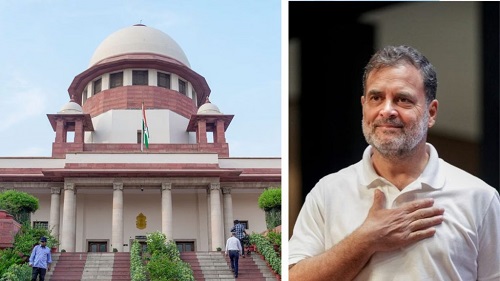
Congress leader and Leader of the Opposition in the Lok Sabha Rahul Gandhi has received significant relief from the Supreme Court in a case involving allegations of disproportionate assets. The apex court has overturned the Allahabad High Court's earlier directions asking the Central Bureau of Investigation (CBI) and the Enforcement Directorate (ED) to examine the allegations levelled against him. However, the Supreme Court has not closed the matter or ruled on the merits of the allegations. Instead, it has sent the case back to the Allahabad High Court for fresh consideration, asking it to examine all relevant legal and factual aspects, particularly whether the original complaint is legally maintainable.
The Supreme Court's latest intervention has provided an important legal reprieve to Rahul Gandhi in the disproportionate assets controversy. By setting aside the Allahabad High Court's earlier orders, the apex court has effectively reopened the question of how the proceedings against the Congress leader were initiated and whether the complaint itself satisfies the necessary legal requirements.
The matter originated from a complaint filed by S Vignesh Shishir, a Karnataka-based BJP worker, who alleged that Rahul Gandhi possessed assets disproportionate to his known sources of income. Acting on his petition, the Lucknow bench of the Allahabad High Court had, on May 12, 2026, directed the CBI and ED to examine the allegations in accordance with applicable legal provisions. The court had indicated that the investigating agencies could take appropriate action as permissible under the law.
Subsequently, the High Court sought information from the investigating agencies regarding the progress made on the complaint. During proceedings on July 20, it expressed dissatisfaction with the CBI's response and sought a more comprehensive account of the action taken. This development intensified the legal battle, prompting Rahul Gandhi to approach the Supreme Court.
Gandhi challenged the High Court's directions, questioning the legality of the proceedings and the complainant's locus standi, or legal right to initiate such proceedings. His challenge essentially raised the question of whether a court could issue directions to investigating agencies on the basis of a complaint without adequately examining its legal maintainability and the procedural requirements involved.
The Congress leader subsequently moved the Supreme Court, seeking relief against the Allahabad High Court's orders and the proceedings initiated on the basis of Shishir's complaint. His legal challenge also questioned the manner in which the complaint was being pursued and whether the petitioner had established sufficient grounds to seek judicial intervention.
On August 17, the Supreme Court had already granted interim protection to Gandhi by directing the Allahabad High Court to defer further proceedings. A three-judge bench headed by Chief Justice of India Surya Kant, comprising Justices Joymalya Bagchi and V Mohana, also restrained the CBI, ED and other investigating authorities from submitting investigation-related reports to the High Court until further orders.
The interim protection was subsequently continued while the apex court considered the matter. The latest decision takes the case into another phase by setting aside the earlier High Court orders and returning the matter for fresh judicial examination.
During Wednesday's hearing, the complainant, S Vignesh Shishir, appeared personally before the Supreme Court. In view of his personal appearance, the proceedings were conducted without the usual audio-video transmission, with the court's audio-video system switched off.
The Supreme Court has now asked the Allahabad High Court to reconsider the matter comprehensively. Significantly, the High Court will have to determine whether the complaint filed by Shishir is legally maintainable before proceeding further. This makes the question of the complainant's legal standing a central issue in the fresh hearing.
While the Supreme Court's decision represents a substantial relief for Rahul Gandhi, it would be premature to interpret it as a judicial declaration that the allegations are baseless. The apex court has set aside the earlier directions and ordered fresh consideration, but it has not delivered a final verdict on whether Gandhi possesses assets disproportionate to his known sources of income.
The distinction is important because the allegations remain allegations unless established through legally admissible evidence and an appropriate judicial process. Equally, the complainant's right to pursue the matter must be assessed under the applicable legal framework.
For the Allahabad High Court, the immediate task will be to examine the maintainability of the complaint and other relevant legal questions before deciding the appropriate course of action. Depending on its findings, the proceedings could either move forward in accordance with law or encounter further legal obstacles.
Politically, the development is significant because Rahul Gandhi occupies the position of Leader of the Opposition in the Lok Sabha, making any legal controversy involving him a matter of considerable national attention. For the Congress, the Supreme Court's intervention provides an opportunity to argue that legal proceedings must follow established procedures rather than be driven by allegations alone.
For the BJP complainant, however, the fresh hearing offers an opportunity to establish the legal validity of his petition.
Ultimately, the Supreme Court's decision reinforces an essential principle of the judicial process: allegations, however serious, must pass the test of legal scrutiny, and judicial intervention must rest on a sound legal foundation. The next chapter of the controversy will depend on how the Allahabad High Court evaluates the complaint and determines whether it deserves to proceed under the law.






















Leave Your Comment