


The Opposition’s legal challenge to the Election Commission of India (ECI) has encountered an unexpected procedural hurdle even before the Supreme Court could examine its substantive allegations. A petition led by Rahul Gandhi and 10 other INDIA bloc leaders, seeking an independent investigation into alleged electoral irregularities and a suspension of the ongoing Special Intensive Revision (SIR) of electoral rolls, could not be listed for hearing on Tuesday after the Supreme Court registry identified 14 defects in the filing. The objections, ranging from a ₹220 shortfall in court fees to missing authorisations and an illegible identity document, have delayed the Opposition’s attempt to bring its electoral concerns before the highest court.
The Supreme Court registry’s objections have temporarily complicated the Opposition’s efforts to obtain judicial intervention in the functioning of the Election Commission. Among the 14 defects identified were a shortfall of ₹220 in court fees, an illegible photocopy of Congress president Mallikarjun Kharge’s identity card and the absence of vakalatnamas—documents authorising legal representation—for nine of the 11 petitioners. The registry also questioned the inclusion of individual election commissioners as respondents in a petition described as being in the nature of public interest litigation.
The petitioners’ legal team requested that the matter be listed on Wednesday after the defects were rectified. Until then, the Supreme Court has not had an opportunity to examine the merits of the allegations contained in the plea.
The distinction is important. Registry objections concern compliance with procedural and filing requirements; they do not establish whether the allegations against the electoral authorities are justified. Nor does the delay amount to a rejection of the petition. Nevertheless, the episode illustrates how procedural preparedness can influence the timing of politically consequential litigation.
For the Congress and its INDIA bloc partners, the challenge is to ensure that the legal case is as carefully organised as the political campaign surrounding it. A petition seeking an independent and time-bound investigation into decisions allegedly taken unilaterally by Chief Election Commissioner Gyanesh Kumar must satisfy the court’s procedural requirements before its substantive claims can be considered.
The petition names the ECI, Kumar and the two other election commissioners, Sukhbir Singh Sandhu and Vivek Joshi, as respondents. The registry’s query regarding the inclusion of individual commissioners raises a question about the appropriate parties to a writ petition framed in the nature of public interest litigation. Such questions must be addressed through legal reasoning rather than political assertion.
The Opposition’s next step, therefore, is straightforward but consequential: rectify the filing defects, establish the legal basis of its claims and persuade the court that the requested investigation and interim relief are warranted.
At the heart of the dispute is the Special Intensive Revision of electoral rolls, an exercise that has become a major point of confrontation between the Opposition and the Election Commission. The petition seeks an independent, time-bound inquiry into decisions allegedly taken unilaterally by Kumar, including the decision in June 2025 to undertake the revision exercise. It also asks for the suspension of the ongoing SIR until the proposed inquiry is completed.
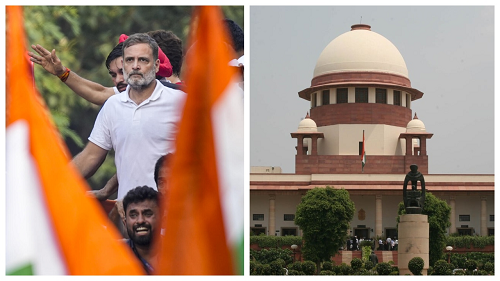
The petition followed a day of political mobilisation in which Rahul Gandhi, Mallikarjun Kharge and nine other Opposition leaders sought to present a united front against the electoral revision exercise and the alleged unilateral functioning of the poll panel.
The leaders had participated in a march billed as a “March for Democracy”, but police barricades stopped the procession on Bhagwan Dass Road, approximately 600 metres from the Supreme Court. Gandhi subsequently appeared at the court to file the petition, accompanied by Kharge and the other Opposition leaders.
The legal move also followed Chief Justice of India Surya Kant’s decision not to hold a meeting with Gandhi and Kharge, the Leaders of Opposition in the Lok Sabha and Rajya Sabha respectively. The Chief Justice indicated that their concerns could be raised through judicial proceedings and assured an expeditious hearing if they approached the court.
The filing represented an attempt to translate political mobilisation into a formal legal challenge. Yet the registry objections demonstrate that political unity does not automatically translate into procedural readiness.






















Leave Your Comment