


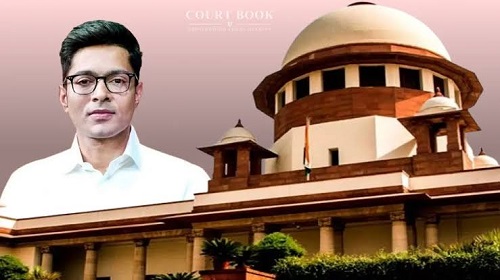
The Supreme Court on Monday permitted Trinamool Congress (TMC) MP Abhishek Banerjee to travel abroad for three weeks for eye surgery, while strongly questioning the West Bengal government's opposition to his request. The court observed that every individual has the right to travel abroad and choose the medical treatment of their choice.
A bench comprising Chief Justice of India Surya Kant and Justices Joymalya Bagchi and V. Mohana said it saw “no serious impediment” to Banerjee travelling overseas for medical treatment. The permission, however, was made subject to conditions intended to ensure that he remains available to the investigating agency whenever required.
“Every individual has a right to go abroad. Every individual has a right to choose the medical treatment of their choice,” the bench observed during the hearing.
The court also highlighted the privacy rights of an individual concerning medical information. It said a person cannot be expected to place their health records in the public domain merely because they are seeking permission to travel abroad for treatment.
“It is also a right to privacy to not bring your health records in public domain,” the bench remarked.
The West Bengal government opposed Banerjee's plea seeking permission to travel overseas. Additional Solicitor General S.V. Raju, appearing for the state, argued that there were at least 15 cases pending against the TMC leader and submitted that the possibility of him not returning to India was greater because of the criminal proceedings against him.
The Supreme Court, however, questioned the relevance and nature of the allegations in the particular case in which the restriction on Banerjee's foreign travel had been imposed. The bench noted that the matter concerned comments allegedly made during a public meeting and pointed out that there was no injunction against him in other cases.
“We are on to the nature of allegations. This is about a lecture given by him… there is no injunction against him in any other case,” the bench observed.
The court further noted that Banerjee had previously been allowed to travel abroad in cases involving what it described as more serious allegations. It questioned why permission should be denied in the present matter when the allegations forming the basis of the restriction related to remarks made at a public gathering.
“The State, we are certain, is weighed down with much serious investigations… He was allowed to travel before in cases with much more serious charges. What is the FIR in your case here? This is ultimately about some comments in a public meeting,” the bench said.
The Supreme Court's observations underscored the distinction between pending criminal proceedings and an individual's fundamental rights, particularly when the request involves medical treatment. While allowing Banerjee to travel, the court also sought to balance his right to seek treatment abroad with the requirements of an ongoing investigation.
The order provides temporary relief to the TMC leader, allowing him to undergo the proposed eye surgery overseas while remaining bound by conditions that require his cooperation with the investigating agency.



















Leave Your Comment