


Bhubaneswar: Manusmriti, one of the ancient Dharmasashtras of India, places women on a high pedestal in society. It says deities will dwell and prosperity will arrive there where women are worshipped. Women are equated with goddess of Lakshmi, meaning harbinger of wealth. History is replete with examples of how women went far in education, politics and almost every aspect concerning human life in the days of yore. In the Vedic period women were regarded as mother goddesses, in other words Shakti (energy). All these are a testament to the degree of eminence Indian society valued of women from time immemorial. The present sadly looks antithetical to the past.
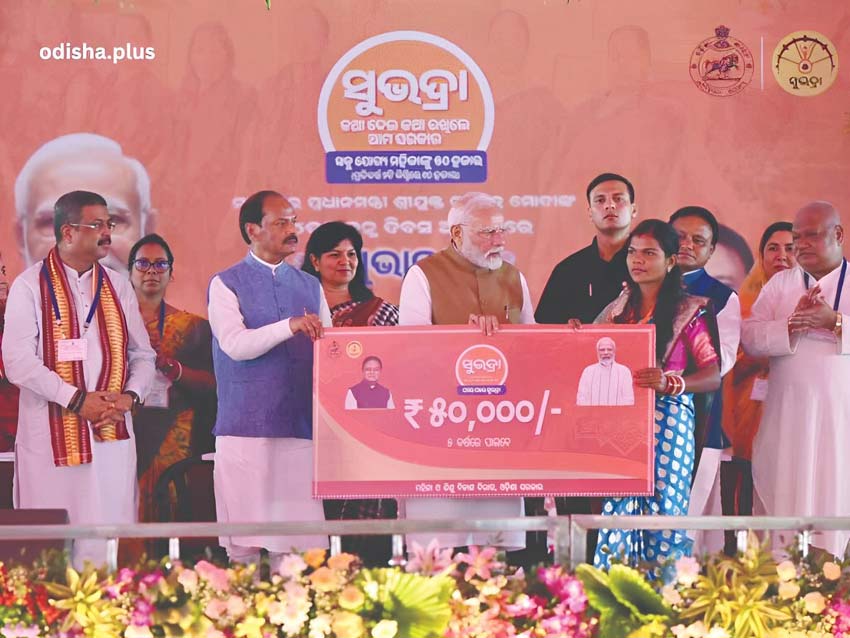
Prime Minister Narendra Modi since taking over the reins of the country in 2014 has initiated host of programmes for giving women their rightful place in the society. Be it Pradhan Mantri Jan Dhan Yojana in order to provide banking access to millions of women across the nation or the, Pradhan Mantri Ujjwala Yojana that freed women from the ‘drudgery of smoky kitchens’ or for that matter the MUDRA Yojana to activate the enterprising quality of women, the list is really long. In his third term and within 100 days of his government at the centre and also his own BJP government in Odisha (Lok Sabha and Assembly elections were held simultaneously), the PM has launched yet another plan of action recently in that direction in Odisha. The programme, considered to be the largest single women-centric scheme, is named Subhadra. More than one lakh women coming from different parts of Odisha were present when the Prime Minister launched the new women empowerment programme in Bhubaneswar on September 17, his birthday.
On that day more than 10 lakh beneficiaries whose applications were processed by that date received their first phase amount of Rs 5000 in their bank accounts instantly. The government has estimated to extend the Subhadra benefits to more than one crore women in the state. Two important days of the year- Raksha Bandhan symbolising protection of women and International women’s day symbolising celebration of womanhood – have been selected for disbursal of money.
Subhadra Yojana promises Rs 10,000 per annum in two equal instalments to be given for five years to each eligible woman in the state. The scheme is open for all excepting, among other restrictions, those having family income exceeding Rs 2.5 lakh. There is an age limit fixed between 21-60 (2024-25 to 2028-29) years to become a Subhadra beneficiary. The Mohan Charan Majhi government has allocated an ambitious amount of Rs 55,825 crore for the scheme to be spent in five years (2024-29). Subhadra Yojana is considered as the largest welfare scheme ever rolled out by the state.
Notwithstanding the pleasant side of the scheme, there are many questions asked by certain quarters including the opposition. Why Subhadra? How is it going to help the women? Some have even gone a step ahead demanding to bring girls above 18 and women beyond 60 under the ambit of Subhadra. There is also the demand to release the money to the beneficiaries in two years stating that Rs 10,000 per annum in two phases is too low to start any business.
It is a different matter that the cynics’ words have been lost in the crowd. This is evident from the kind of euphoria Subhadra has generated in the state. Two weeks after the programme was launched and while writing this piece one can see long queues of women outside designated centres like Jana Seva Kendras for preparing documents, collecting application forms and submitting them. Situation outside many banks particularly closer to villages is no better with women from early morning standing in line only to confirm whether or not their money has come to their accounts.
Doubts on the efficacy of Subhadra nevertheless refuse to die down in the minds of many. It was expected of the opposition parties to raise a hue and cry over Subhadra more for politics than economics. This is because if Subhadra according to them is a bad proposition and is a BJP ploy to reap political benefits, then Naveen Patnaik’s Biju Janata Dal (BJD) and the Congress have to equally share the blame. Naveen government during its tenure frequently resorted to floating schemes. Many of the schemes were announced on the eve of elections. They were viewed in public as poll-gimmicks, one of the reasons being they were not put to the kind of scrutiny required to find out their feasibility, implementation modalities etc. Even many BJD MLAs did not remember the schemes and their targets. These wasteful schemes included Biju Yuva Bahini, PEETHA (Peoples Empowerment - Enabling Transparency and Enhancing Accountability in Odisha Initiatives) to name a few. PEETHA was claimed to educate rural people about government schemes. Crores of rupees went down the drain. Congress though not in power in Odisha for more than a quarter century still cannot escape. Its track record in other states where the party is in power like Karnataka and Himachal is no better.
But there are others who are not connected to any political party but raise their voice seeking judicious use of public money. They are concerned when public resource is distributed free by elected governments. Before launching Subhadra the BJP government took to a path breaking idea of seeking public views regarding implementation of the programme. The government organised public consultation meetings in different districts inviting views on a wide range issues including selection of beneficiaries, modalities of disbursement of money etc. One of the suggestions to have emerged from the meetings was to convert the money into long term zero interest loans instead of grants. It was argued that free distribution of anything including rice presently given kills the working spirit of people. It was not surprising that in the face of freebie cultures and programmes similar to Subhadra existing in other states like Madhya Pradesh, Bengal, Punjab, Himachal Pradesh, Chhattisgarh the government ignored the suggestions. The government however has indicated that it would constitute monitoring mechanism at district and state level to find out the spending trend of Subhadra money.
There are as many to counter the cynics. They agree with Deputy Chief Minister Ms Pravati Parida that Subhadra would prove to be a ‘game changer’ and the scheme would inspire a large number of women to choose the path of economic self-reliance. Subhadra is cited as a rare transformative opportunity for poor women of Odisha to begin a life of dignity through own effort. Importantly, it is a non-returnable financial assistance being given without any string attached. Women are independent to spend the money as they wish.
“Until now all narratives lay the blame on government for the nagging poverty in Odisha. Subhadra aims to change the course: government to provide financial support and people have the choice to use as per their priorities,” said a senior official linked to Subhadra programme. The official maintained that Subhadra falls completely under different kind of welfare model. Almost all preceding schemes, many functioning now, are directly implemented by government where general public have little say. They are hence officer-controlled, who are prone to succumbing to pressure even by petty politicians operating at the lowest rung of the administration. The result is large-scale corruption of public money. As a case in point he cited siphoning of old age pension money by adding dead persons in the beneficiary list.
Doubts still persist. Will women use the money in economic activities as expected by the government? Or it will meet the same fate like that of several name sake welfare programmes launched by the previous Naveen government. Queries at the government and party level elicit unclear answers about Subhadra’s appropriate utilisation prospects as this too is to cost a fortune to the state exchequer. Counter to the pessimists there are optimists as well in good numbers.
Authorities debunk allegations that disbursal of Rs 50,000 in staggered manner would dim the prospects of business worth the name. Such charges of course do not stand on strong foundation. It is pointed out financial assistance without ensuring the potential of beneficiaries would not yield the desired result. The performance of Self Help Groups (SHGs) functioning under Mission Shakti programme brings home the point. Mission Shakti was introduced in the state in 2001 with the objective of empowering women socially, economically and politically through involving them into SHGs. As per Mission Shakti’s latest annual activity report upto March 2022, there are 6 lakh SHGs in the state with 70 lakh members. As per the report only 59404 SHGs are engaged in income generation activities. Their turnover is a meagre Rs 2372 crore. “The SHG experiment in Odisha is a colossal failure. The previous government claims to have spent hundreds of crores in interest subvention, community investment fund, revolving fund, Mission Shakti houses in panchayats, but the result is abysmally poor. This is because the government instead of creating an entrepreneurship mindset amongst women through motivation and training used them as potential vote banks. Hence, these result,” said Anil Biswal, spokesperson of BJP.
Officials insist Subhadra for that matter is a genuine guide. Phase wise distribution of money would instil a sense of ownership in the minds of women to save and properly utilise and not waste on fruitless plans. Added to this, the government has plans to constitute monitoring bodies at the district and state level to understand the spending pattern of women. It is admittedly not believable that a woman would require heavy investment to prepare papad, pickles, environment friendly paper bags, Badi (urad dal pasted and dried), spice powders, dolls, tailoring etc. Choices are many and these are market-ready products. In rural areas women can utilise Subhadra money in growing specially cash-crops. There is always heavy demand for vegetables and that they are pricy round the year.
Women can use the Subhadra money on meeting the education cost of their children. Odisha has the highest secondary level (class 9 and 10) drop outs recorded at 27.29 per cent. In most cases experts point out parents’ inability to bear education expenditures as a factor behind the drop outs. “Where there is a will, there is a way,” the official said quoting the centuries old common saying.
Like it or not, every official welfare scheme has both political and economic sides to it. While the economic side largely deals with sustainability of the programme including availability of funds, feasibility, net impact etc., the political aspect is to do with politicians. They try to know how much political mileage can be squeezed out of the programme. Subhadra is no exception.
The BJP had mentioned the programme in its 2024 election manifesto. It was stated that if voted to power the government would provide voucher worth Rs 50,000 to every eligible woman in two years. The Subhadra Yojana apparently was conceived as a counter to BJD ‘misusing’ the SHGs for vote purposes without letting women stand on their own feet. Though the entire BJP brass put in their might to outshine Naveen, there was certainly some degree of apprehension lurking in the party about the end result. That they finally won the support of women voters and broke BJD’s dominance is beside the point. The real test came after the party formed the government. Arranging more than Rs 11,000 crore annually to keep alive Subhadra is indeed a herculean task. The chief minister Mohan Charan Majhi has since requested the Central government to partially offset the flagship programme’s budget. The government is hopeful that the 2024 election having made possible to fix the ‘double engine’ the Centre would come to the rescue of the cash-starved state.
There is no cash delivery provision in the programme. The beneficiaries would have their entitlements deposited in their Aadhar-enabled and DBT-enabled bank accounts. What might have skipped the knowledge of many that nearly two third of nearly 6800 gram panchayats in Odisha do not have banks. Media regularly highlight how helpless women of all ages are either carried or they literally crawl kilometres to get money from banks. The situation gets murkier during rainy season when villages without walkable roads turn isolated islands.
It is however claimed that regardless of certain panchayats not having easy access to banks there would not be any problem in disbursal of Subhadra money. “That women from non-banked panchayats have opened accounts in banks located in other panchayats show their association with banking services,” said an official. The official’s contention points to government’s effort to avoid corruption in disbursal of Subhadra money till at least it reaches the beneficiaries’ accounts. There is also internet problem in remote villages and those located in hilly regions. The government however says that the digital ecosystem is ready to provide seamless banking services to Subhadra beneficiaries. There are one crore Jan Dhan accounts and over 93 percent people have Aadhaar cards. Media report cited a recent reply in Parliament as stating that as of April 2024 3853 villages in Odisha have no internet connections.
The government wants the Subhadra beneficiaries to utilise the money in income generating activities. But there is many a slip between the cup and the lip. The ground reality is for anybody to see to believe. That nearly two third GPs in the state do not have bank branches shows that banks are not confident of running services in places where people live in hand to mouth condition and transactions are likely to be too low to sustain the branches. In such a situation expecting women in distress to begin entrepreneurial activity would be like looking for a needle in haystack. But, more the criticism more has been the level of self-assurance evident in the new government’s setup and of course in the party. “No government scheme can yield cent percent result, nor do we expect of Subhadra. The degree of poverty in tribal areas is hard to hide. Yet we are sure to produce a far better result. For this the government has intensified the Subhadra awareness campaign across the state. There is also the plan to sensitise people with innovative ideas for improving their economic health,” the official said.
Finally is the touch of divinity in the name of the scheme which BJP people expect to help them gain politically. Subhadra jells with BJP’s core principle of glorification of Indian civilisation, ethos and culture. In the Odisha context the name seeking sameness with one of the triad – Lord Jagannath, Lord Balabhadra and Devi Subhadra – carries weight. Party people are of the view that Subhadra was chosen because it symbolises divine feminine energy. The name is part of Odisha’s rich cultural heritage that invokes women power, feeling of living with dignity, to become self-reliant and independent. Devi Subhadra’s presence with Lord of the Universe on the Ratnavedi at the 12th century grand temple in Puri shows that she is the supreme goddess (power) of the world. “Women are anchor of progress. Naming the scheme as Subhadra Yojana would boost the confidence of women to become an earning partner in family rather than depending every time on every matter on others. The scheme would certainly boost the confidence of women,” said a BJP leader.
(The content of this article reflects the views of writers and contributors, not necessarily those of the publisher and editor. All disputes are subject to the exclusive jurisdiction of competent courts and forums in Delhi/New Delhi only)

By Dr. Rajaram Satapathy




















Comments (2)
k
rajpur
u
rajpur