


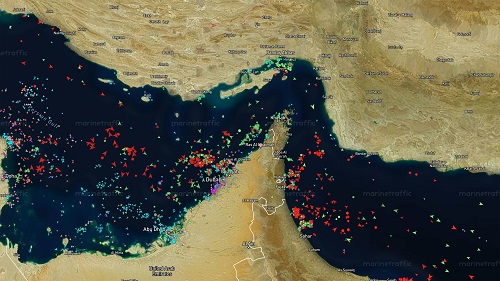
A fragile sense of relief in global energy markets has been tempered by mixed messaging from Iran, as officials and military authorities issued seemingly contradictory statements on the status of the strategically vital Strait of Hormuz. While Iran’s Foreign Minister Abbas Araghchi declared the passage “completely open” during the ongoing ceasefire period, the Islamic Revolutionary Guard Corps (IRGC) Navy simultaneously imposed strict conditions on vessels seeking to cross.
In a post on X, the IRGC Navy outlined what it described as a “new order,” mandating that all ships obtain prior permission before transiting the strait. According to the directive, civilian vessels must adhere to routes designated by Iranian authorities, while military ships remain barred entirely. The conditions, the IRGC stated, are consistent with the terms of the ceasefire agreement—though these specifics were absent from Araghchi’s earlier announcement.
Araghchi had framed the reopening in broader terms, stating that “all commercial vessels” could pass freely through the strait along routes coordinated by Iran’s Ports and Maritime Organisation. His message was intended to reassure global markets and signal stability following heightened tensions linked to the Lebanon ceasefire. However, the IRGC’s subsequent clarification has introduced uncertainty over what “open” truly means in practice.
The ambiguity has not gone unnoticed within Iran itself. State-affiliated media outlets were quick to critique the foreign minister’s statement. Tasnim News Agency labeled Araghchi’s remarks as “flawed and incomplete,” warning that they risked creating confusion over maritime policy. Meanwhile, Mehr News Agency emphasized the strategic importance of the strait, noting that it had been a decisive factor in recent conflicts and citing statements from Iran’s Supreme Leader suggesting it should remain closed under certain conditions.
International reactions have added another layer to the evolving narrative. Donald Trump welcomed the announcement, stating on social media that the strait was “fully open and ready for full passage.” Yet in a follow-up post, he underscored that the United States would maintain its naval presence in the region until broader negotiations with Iran are finalized. Trump also claimed that Iran had committed to never again using the strait as a geopolitical lever—an assertion not formally confirmed by Tehran.
Despite the conflicting signals, markets responded swiftly to the perceived easing of tensions. Global crude oil prices fell by approximately 10 percent following news of the reopening, reflecting optimism that disruptions to one of the world’s most critical النفط transit corridors may be avoided—at least for now.
The Strait of Hormuz, through which nearly a fifth of the world’s oil supply passes, remains a geopolitical flashpoint where even minor policy shifts can have outsized global consequences. Iran’s dual messaging—promising openness while enforcing control—highlights the delicate balance between diplomatic signaling and strategic leverage in a region where maritime access is both an economic lifeline and a powerful bargaining chip.




















Leave Your Comment