


Viksit Bharat or Vikhandit Bharat?
As India approaches another crucial electoral cycle in 2026, the upcoming assembly elections are far more than routine democratic exercises. They represent a defining moment in the country’s political trajectory—one that could either reinforce the vision of Viksit Bharat (Developed India) or deepen fractures that risk pushing the nation toward a more Vikhandit Bharat (Divided India). With multiple politically significant states heading to the polls, the stakes are not merely regional; they are profoundly national in character.
At the heart of this electoral battle lies a clash of narratives. On one side is the ruling establishment’s push for continuity, stability, and accelerated development under a centralized vision of governance. On the other is a fragmented opposition seeking to reassert federal autonomy, social justice frameworks, and regional political identities. The outcome of these elections will determine not just who governs individual states, but how India negotiates its path toward economic growth, social cohesion, and institutional stability in the coming decade.
The idea of Viksit Bharat has evolved into a powerful political slogan, but it is also a policy framework rooted in infrastructure expansion, digital transformation, manufacturing growth, and global positioning. Over the past decade, the central government has sought to align state policies with national priorities—be it through initiatives like production-linked incentives, digital governance platforms, or massive investments in highways, railways, and energy corridors. Assembly elections, therefore, become referendums on whether this model of synchronized development between Centre and states is accepted or resisted.
States voting in 2026 will play a pivotal role in this alignment. Many of them are economic engines, demographic heavyweights, or politically symbolic battlegrounds. Their choices will influence how smoothly national programs are implemented at the grassroots level. A state government aligned with the Centre often translates into faster policy execution, smoother fund flows, and coordinated governance. Conversely, political divergence can lead to friction, delays, and competing priorities.
However, reducing this electoral moment to a binary of alignment versus opposition would be simplistic. The deeper question is whether development itself is being defined uniformly across India. For many regional parties, Viksit Bharat as envisioned by the Centre risks overlooking local socio-economic realities. Issues like agrarian distress, caste dynamics, regional inequalities, and linguistic identity continue to shape political behavior at the state level. In this context, the opposition’s counter-narrative is not merely resistance—it is an attempt to redefine development through a more decentralized lens.
Strategically, the ruling party is expected to foreground governance metrics—roads built, houses delivered, welfare schemes digitized, and investments attracted. The campaign will likely emphasize a forward-looking vision, positioning India as a rising global power that cannot afford political instability. The messaging will revolve around continuity: that a fragmented political mandate could derail economic momentum and weaken India’s international standing.
On the other side, opposition parties are recalibrating their strategies to counter this narrative. Learning from past electoral setbacks, they are increasingly focusing on state-specific alliances, grassroots mobilization, and issue-based campaigns. Rather than confronting the national development agenda head-on, many are choosing to localize the debate—highlighting unemployment, price rise, social tensions, and governance deficits. The aim is to shift the electoral conversation from macro achievements to micro realities.
Coalition politics is also set to play a crucial role. In several states, the opposition’s success will depend on its ability to present a united front. Fragmentation has historically benefited the ruling party, allowing it to consolidate votes even in the absence of overwhelming majority support. The 2026 elections will test whether opposition alliances can move beyond opportunistic arrangements to offer credible governance alternatives.
Another critical dimension is voter psychology. India’s electorate has demonstrated a nuanced understanding of governance, often distinguishing between national and state-level issues. Voters may support one party in parliamentary elections while choosing another in assembly polls. This split-ticket voting reflects a mature democratic instinct, but it also complicates political calculations. Parties cannot rely solely on national narratives; they must engage deeply with local aspirations and grievances.
Youth voters will be particularly influential in this cycle. With a significant portion of the electorate under the age of 35, issues like employment, education, entrepreneurship, and digital opportunities will dominate. The promise of Viksit Bharat resonates strongly with this demographic, but it must be backed by tangible outcomes. Aspirational voters are less interested in ideological battles and more focused on economic mobility and quality of life.
At the same time, the risk of polarization cannot be ignored. Elections in India have increasingly seen the use of identity-based mobilization—whether along religious, caste, or regional lines. While such strategies may yield short-term electoral gains, they carry long-term consequences for social cohesion. A divided mandate driven by polarizing rhetoric could undermine the very foundation of Viksit Bharat, which requires unity, trust, and collective effort.
Media and digital platforms will also shape the electoral landscape. Campaigns are no longer confined to rallies and door-to-door canvassing; they are fought in the digital arena through targeted messaging, data analytics, and narrative control. The ability to influence public perception in real time has become a decisive factor. This raises important questions about misinformation, echo chambers, and the quality of democratic discourse.
Economically, the timing of these elections is significant. India is navigating a complex global environment marked by geopolitical tensions, supply chain disruptions, and technological shifts. Domestic political stability is crucial for sustaining investor confidence and policy continuity. A clear mandate in key states could reinforce India’s growth trajectory, while a fractured political landscape might introduce uncertainty.
The phrase Viksit Bharat or Vikhandit Bharat is not merely rhetorical; it encapsulates a genuine dilemma. Development is not just about GDP growth or infrastructure expansion—it is also about inclusivity, equity, and social harmony. A nation cannot be truly developed if large sections of its population feel excluded or marginalized. Similarly, political unity should not come at the cost of democratic diversity and federal balance.
Ultimately, the 2026 assembly elections will test India’s ability to balance these competing imperatives. Can the country pursue rapid development while preserving its pluralistic ethos? Can political competition remain constructive rather than divisive? Can governance be both centralized in vision and decentralized in execution?
The answers will emerge not just from electoral outcomes, but from the nature of the campaigns themselves. If political parties focus on substantive issues—jobs, education, healthcare, infrastructure—the elections could strengthen the foundations of Viksit Bharat. If, however, the discourse is dominated by divisive rhetoric and short-term populism, the risk of Vikhandit Bharat becomes real.
In many ways, these elections are a mirror reflecting the choices before the nation. They will reveal whether India’s democratic energy is being channeled toward collective progress or fragmented into competing identities. They will indicate whether the promise of development can unite diverse constituencies or whether political fault lines will deepen.
As the campaign intensifies and voters prepare to make their choices, one thing is clear: the 2026 assembly elections are not just about power—they are about direction. They will shape the contours of India’s journey in the years to come, determining whether the vision of a developed, confident, and cohesive nation moves closer to reality or remains contested in the arena of politics.
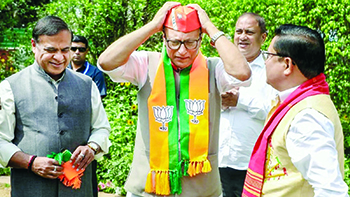
Assam’s political landscape today reflects a striking contrast between instability within the opposition and the structured dominance of the ruling establishment. As the state’s political narrative evolves, voters are increasingly confronted with two competing images—one of confusion and internal struggle, and another of cohesion and consistency. This divergence is shaping the momentum on the ground and could prove decisive in future electoral outcomes.
The condition of the Indian National Congress in Assam appears deeply unsettled. What was once a formidable political force in the state is now grappling with internal divisions, leadership uncertainty, and a lack of strategic clarity. The party’s organizational structure has weakened over time, with factions emerging and senior leaders often pulling in different directions. This absence of a unified command has translated into inconsistent messaging, leaving both party workers and voters unsure about its direction.
The situation is further aggravated by a visible exodus of leaders. As electoral prospects appear dim, several functionaries have either distanced themselves or exited altogether, reinforcing the perception of a sinking ship. Such developments tend to have a cascading effect—grassroots workers lose morale, and the party’s ability to mobilize support diminishes. In politics, perception often becomes reality, and the Congress is currently battling both.
Leadership remains another critical concern. The party’s continued reliance on familiar and often dynastic faces has drawn criticism, especially at a time when voters are seeking fresh leadership and performance-driven politics. Assam’s electorate, particularly its youth, is increasingly aspirational and less inclined to be swayed by legacy alone. The failure to nurture and promote new leadership has widened the disconnect between the party and the electorate.
Adding to these challenges is the fragility of opposition alliances. Efforts to forge a united front against the ruling party have been undermined by internal contradictions, seat-sharing disputes, and a lack of ideological cohesion. Without a common vision or narrative, these alliances appear opportunistic rather than organic, weakening their credibility in the eyes of voters.
In contrast, the Bharatiya Janata Party has managed to consolidate its position through discipline and strategic coherence. Under the leadership of Himanta Biswa Sarma, the party has projected a strong and decisive image. Its organizational machinery functions with a level of coordination that ensures message consistency and effective implementation on the ground.
The BJP’s advantage lies not just in the opposition’s weakness but also in its own ability to maintain unity and clarity. The party has largely avoided public factionalism and has successfully communicated its governance agenda to the electorate. By combining administrative delivery with strong political messaging, it has managed to build a narrative that resonates across different sections of society.
Ultimately, Assam’s political contest is being shaped by this contrast. Voters are likely to weigh instability against stability, confusion against clarity. While political fortunes can change, the current scenario clearly places the BJP ahead, with the Congress facing an uphill battle to regain credibility. The choice before the electorate is becoming increasingly defined—and decisive.
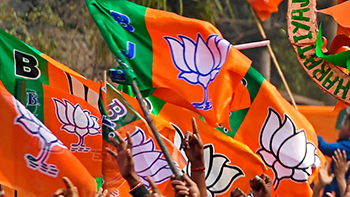
With the Election Commission of India announcing the schedule for Assembly elections across West Bengal, Tamil Nadu, Kerala, Assam and Puducherry, the political battlefield has been formally set. For the Bharatiya Janata Party, these elections are not merely state-level contests but a strategic test of its national expansion, consolidation, and adaptability across diverse political terrains.
At the heart of the BJP’s immediate priorities lies Assam, the only state among the five where it currently holds power. Retaining Assam is crucial not just for maintaining its foothold in the Northeast but also for reinforcing the narrative of governance continuity. Under the leadership of Himanta Biswa Sarma, the party has focused on administrative delivery, infrastructure expansion, and a calibrated blend of identity and development politics. Anti-incumbency, however, remains an inevitable factor, and the BJP’s challenge will be to counter it through performance-based campaigning while keeping its organizational machinery tightly coordinated. A victory here would reaffirm the party’s ability to sustain power in a region once considered politically distant from its core base.
If Assam is about consolidation, West Bengal represents ambition. The BJP has, over the past decade, transformed itself from a marginal player in the state to the principal challenger to the ruling All India Trinamool Congress led by Mamata Banerjee. While winning Bengal outright remains a formidable task, the party’s immediate goal is to either secure power or significantly improve its electoral standing. The state’s complex socio-political fabric, marked by strong regional identity and entrenched political loyalties, presents both opportunities and challenges. The BJP’s strategy is likely to hinge on polarisation narratives, governance critiques, and grassroots mobilization. Even a substantial increase in seat share would be projected as a strategic gain, reinforcing its status as a pan-Indian political force capable of challenging dominant regional parties on their home turf.
In Kerala and Tamil Nadu, the BJP’s objectives are more incremental but equally significant in the long term. Both states have historically been resistant to the party’s electoral appeal, dominated instead by strong regional and ideological formations. In Kerala, the bipolar contest between the Communist Party of India (Marxist)-led Left Democratic Front and the Indian National Congress-led United Democratic Front leaves limited space for a third force. Yet, the BJP has been steadily working to expand its vote share, focusing on pockets of influence and leveraging issues of governance and social dynamics. Breaking even a small barrier in terms of seats would carry symbolic weight, signaling the party’s growing acceptance in a traditionally resistant state.
Tamil Nadu presents a different challenge. The state’s politics has long been dominated by Dravidian parties such as the Dravida Munnetra Kazhagam and the All India Anna Dravida Munnetra Kazhagam. Here, the BJP’s approach has been to build alliances while gradually strengthening its independent base. The party has invested in leadership development, cadre expansion, and issue-based campaigns aimed at urban voters and younger demographics. While immediate electoral breakthroughs may be limited, a steady increase in vote share and visibility is central to its southern strategy.
The inclusion of Puducherry in this electoral cycle adds another layer to the BJP’s calculus. Though smaller in scale, the Union Territory offers an opportunity to consolidate alliances and demonstrate governance capabilities in a compact political setting. Success here, even if through coalition arrangements, contributes to the broader narrative of expansion.
What ties these varied state strategies together is the BJP’s emphasis on organizational discipline and message coherence. Unlike many regional rivals, the party operates with a centralized strategic framework while allowing state-specific adaptations. This dual approach enables it to maintain consistency in its national narrative while addressing local aspirations and concerns.
However, the road ahead is not without challenges. Each state presents a unique political ecosystem, and the BJP’s ability to navigate these differences will determine its success. Anti-incumbency in Assam, entrenched regional leadership in Bengal, ideological resistance in Kerala, and cultural-political distinctiveness in Tamil Nadu all require nuanced strategies rather than a one-size-fits-all approach.
Ultimately, these Assembly elections are as much about immediate electoral outcomes as they are about shaping the BJP’s long-term national trajectory. Retaining Assam would signal stability, gains in Bengal would indicate expansion, and incremental progress in Kerala and Tamil Nadu would reflect persistence. As the campaign unfolds, the party’s performance across these diverse arenas will offer a telling insight into its evolving political strategy—and its ambition to deepen its footprint across every corner of India.

NILABH KRISHNA
(The content of this article reflects the views of writer and contributor, not necessarily those of the publisher and editor. All disputes are subject to the exclusive jurisdiction of competent courts and forums in Delhi/New Delhi only)


















Leave Your Comment