


The inauguration of the Iconic Tower at Sri Sri University in Cuttack has brought together India’s ancient educational philosophy and its contemporary aspirations. Vice-President C. P. Radhakrishnan described the landmark structure as more than an architectural achievement, calling it a reflection of India’s civilisational inheritance, the transformative power of education and the vision of a developed Bharat. Emphasising the need to combine knowledge with character, compassion and innovation, he urged students to place the nation above everything else and contribute to the making of Viksit Bharat by 2047.
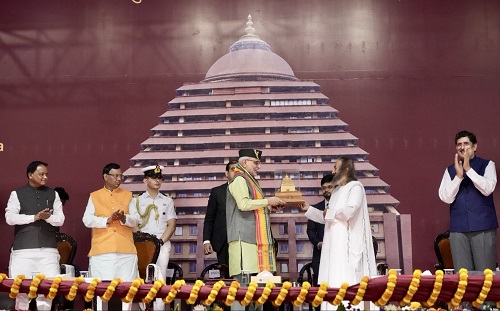
The Vice-President inaugurated the Iconic Tower at Sri Sri University in Cuttack, Odisha, on Monday in the presence of Odisha Governor Braj Mohan Ram, Chief Minister Mohan Charan Majhi and Gurudev Sri Sri Ravishankar, Founder and Lifetime President of the university. Addressing the gathering, Radhakrishnan said the inauguration represented the coming together of an inspiring educational philosophy, India's glorious cultural inheritance and a commitment to shaping the country's future. He observed that the tower symbolised a vision in which education was not restricted to academic qualifications but served as an instrument for developing enlightened, responsible and compassionate citizens.
Describing Sri Sri University as an embodiment of Gurudev Sri Sri Ravishankar's vision, the Vice-President highlighted its distinctive approach of bringing Eastern wisdom and Western knowledge together. Established in 2012, the university was founded on the belief that meaningful education must nurture character, consciousness and compassion alongside intellectual abilities. He said that institutions of higher learning had a responsibility to prepare young people not merely for professional achievements but also for meaningful participation in society and responsible global citizenship. Appreciating the university's description of itself as the 'Happiest Campus in the World', he remarked that happiness was a universal human aspiration deeply embedded in India's cultural and traditional values.
Drawing attention to Odisha's extraordinary architectural legacy, Radhakrishnan said the state's temples represented much more than magnificent physical structures. They reflected the artistic excellence, scientific understanding, spiritual consciousness and cultural continuity of Indian civilisation. Referring to the Lord Jagannath Temple in Puri, the ancient temples of Bhubaneswar and the architectural grandeur of Konark, he said the Kalinga tradition demonstrated the remarkable creative capabilities of India's ancestors. According to him, the Iconic Tower draws inspiration from this inheritance, with its rising structure representing humanity's journey from the foundations of knowledge towards the higher realms of wisdom and enlightenment.
Connecting the university's vision with India's national ambitions, the Vice-President referred to Prime Minister Narendra Modi's vision of Viksit Bharat @2047. He said the aspiration of transforming India into a developed nation by the centenary of its Independence required capable institutions, innovative thinking and a generation equipped with knowledge and strong values. Educational institutions, he emphasised, would play a decisive role in translating this national ambition into reality.
Highlighting the expansion of India's higher education infrastructure over the past twelve years, Radhakrishnan cited the increase in the number of universities from 760 in 2014-15 to more than 1,400 at present. The number of Indian Institutes of Technology has grown from 16 to 23, while Indian Institutes of Management have increased from 13 to 22. Similarly, the number of All India Institutes of Medical Sciences has risen from seven to 20. Student enrolment in higher education institutions has also expanded considerably, increasing from 3.42 crore in 2014-15 to more than 4.50 crore. These developments, he observed, reflected the expanding opportunities available to India's younger generation.
The Vice-President also drew attention to the educational challenges facing Odisha, particularly in view of its sizeable tribal population. He urged government and private universities across the state to introduce School Connect programmes for tribal children. Such initiatives, he said, could help prevent students from discontinuing their education and motivate them to pursue higher studies. Ensuring that children from disadvantaged and remote communities receive opportunities for quality education was essential for making development genuinely inclusive.
Emphasising the relationship between cultural identity and national strength, Radhakrishnan said India's traditions and civilisational values would remain important in determining its future direction. He underlined that a nation aspiring to protect its independence, dignity and interests must possess the strength and capabilities to stand firmly on its own. A strong India, he said, would be better positioned to safeguard its sovereignty and ensure that no external power could dictate terms to it.
Delivering a message to the students, the Vice-President said that an individual's real stature was determined not by material achievements or positions but by the depth of knowledge, strength of character and breadth of compassion. He called upon the university community to embrace the principle of 'Nation First – Rashtra Pratham' in their thoughts and actions. He also urged young people to stay away from drugs, stressing the importance of discipline and responsible choices in building a productive future.
Calling upon the university fraternity to uphold the ideals represented by the Iconic Tower, Radhakrishnan said knowledge should provide the foundation, wisdom the guiding light, innovation the instrument, compassion the strength and service the ultimate purpose. He expressed confidence that the structure would inspire generations of students and remain a lasting symbol of Odisha's cultural spirit, educational aspirations and India's journey towards becoming a prosperous, confident and developed nation.
During his visit, the Vice-President also explored the state-of-the-art planetarium housed in the newly inaugurated tower. The facility, dedicated to scientific curiosity, discovery and innovation, adds another dimension to the university's educational infrastructure. Its presence reflects the importance of encouraging students to explore the frontiers of science while remaining connected to the country's intellectual and cultural traditions.




















Leave Your Comment