


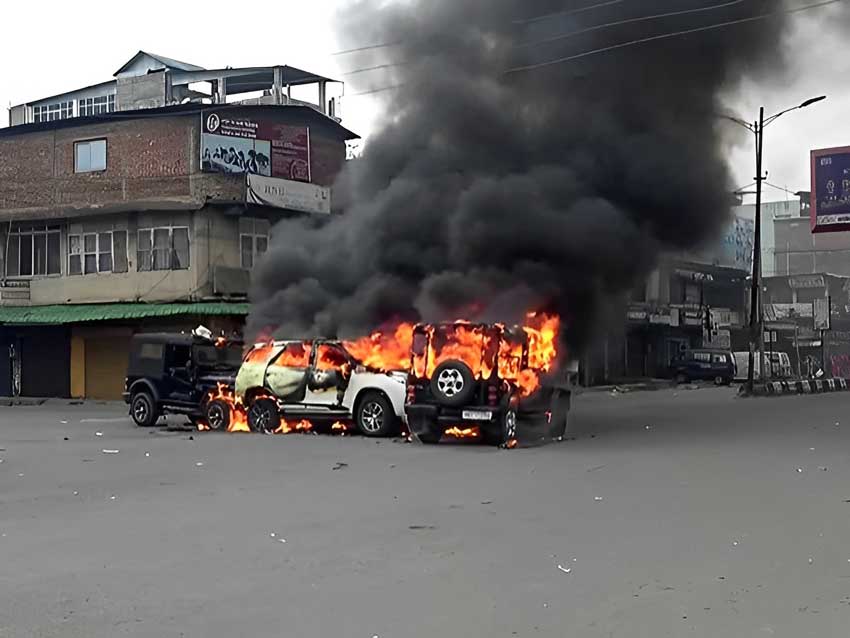
Insurgency again occupied North Eastern state of Manipur since first week of last May. Now it seems the two ethnic groups are not ready to live with each other in the Himalayan province. The minority ten per cent Kukis have been occupying fifty per cent of the land area, in addition to dominating bureaucracy. Meitei the majority fifty six per cent occupying ten per cent of the land, however, they occupy political power. Today these indigenous people have been trying hard to wipe each other out of Manipur as if they have forgotten all about the homeland. Meanwhile the apex court appointed three member judicial committee. It will be headed by Justice Gita Mittal. Justice Asha Menon and Shalini Joshi are other members of the all women panel.
The bone of contention rests in the verdict of the Manipur High Court on April 20. Justice M.V. Muralidharan has directed government to consider Meitei community to be included in the Scheduled Tribe (ST) list. Right after that this insurgency started, exactly within next two weeks. Here long series of violence can be traced back to nineties that started with the advent of the globalisation. In fact 400 people were killed in Kuki-Naga clashes of 1993. Again more than 350 tribes were slaughtered in one of the last series of ethnic violences of the 20th century.
Long before the introduction of the Christianity among these tribes, the proponents of Bhakti movement like Chaitnya Mahaprabhu and his disciples reached Manipur to teach them Hindu way of life. Meiteis are the same tribes scattered across the North East Region. During colonial regime Christianity reached there to convert Kuki Zo tribes. Meitei Pangal are yet another indigenous people that came into contact with Islam. Before this introduction of politics of religion they used to be the Himalayan tribes with their own set of values. Today the Meitei, Kuki and Naga are as white as a Christian or a Hindu or any such sect, and it can be questioned, too. But there is no question on the ethnicity of these two warring fractions. No one has answered what’s wrong in it, if the High Court has directed to consider ST status for the Meiteis.
Before the naked parade of victims of this insurgency, at least twelve Manipuri women stripped naked in front of Kangla Fort in Imphal valley on July 15, 2004. Irom Sharmila, often referred as Iron Lady for her long Satyagraha against AFSPA (Armed Forces Special Powers Act), is another name from same region. In fact these protests series were against the government of India. Demands for independent state is nowhere now, and they have been seeking help from the Indian Army. What the insurgents want today is a separate administrative territory for the Zo tribes.
Before the end of July, yet another series of violence is reported. This time from Haryana. Hindu Muslim riots of Nuh in Mewat region soon reached Gurugram in the NCR (National Capital Region). Gandhi is now being remembered to visit the Ghasera village in Nuh to persuade Meo ethnic group of Mewat to stay in India, when they were leaving for Pakistan during the Partition. He has referred to the Meo as back bone of India. A decade before that Gandhi referred to an average Hindu as the coward and an average Muslim as a bully. The same is still true, however, the bunch of right wing activists are being heard repeating, Jai Shri Ram.
The ethnic and communal violence always helped the political class to polarise the voters. At least 40,000 Kuki Zo tribes so far migrated from Manipur to certain other parts of North East. The state has arranged for the safe return of the Meiteis to Manipur. The working class migrant Muslims are returning to the safe destinations from Gurugram in Haryana. Definitely it’s going to consolidate vote banks of political parties in different constituencies. Proponents of the Hindus and the Muslims will be greatly benefited, at the same time, the vulnerable people like the old and weak, women and children are destined to suffer the most. What’s expected, other than this, in the prevailing model of the democracy!
Ethnicity and Communalism are top terms in public discourse creating a division among masses. The idea of unity in diversity has nothing to do with the realities of this electoral democracy. Polarisation is the key process that can manage the vote banks effectively. Now it seems to be time tested. The political theatre is set to repeat at least the century old tune to win the next elections, however, the top 100 public figures signed the two lines pledge to settle the communal tensions.
Almost six years after Lucknow Pact and its consociationalism between Congress led by Bal Gangadhar Tilak and Muslim League represented by Ali brothers and Jinnah, appeal for communal harmony was one of the monumental efforts still relevant. In a special session of Congress that prolonged through 15 to 19 September 1923 when they had gathered in Delhi. Maulana Azad reads it in his presidential address: In view of the recent deplorable disturbances we, the undersigned Mussalmans, Hindus and Sikhs, hereby declare, that if any individual or group of individuals, belonging to any community commits any act of violence against or attacks the person, property or honour of women or places of worship of his neighbours or fellow townsmen or helps those who indulge in such misdeeds, is, from the religious point of view, guilty of a great sin and that it is the duty of the coreligionists of such offenders to stand up to resist these miscreants and to protect those who are so attacked. We further appeal to the followers of every religion that they should act, each towards the other, with mutual toleration and regard for religious ideas of their neighbours and townsmen.
Approach of this appeal seems to revisit the Indian cultures. In this context the sacrifice of Ganesh Shanker Vidyarthi is one of the examples from that history. Sadly most other signatories forgotten what they signed after returning to the respective places. They tried to focus on how to win elections held before end of that year. Precisely this is what Netaji Subhas Chandra Bose has observed in The Indian Struggle. Ghost of Netaji that once appeared on the Red Fort after the World War II in 1945 reflected a similar spirit of that historical appeal during the trial of INA soldiers like Sehgal, Dhillon and Shahnawaz. The study of these few chapters of the history can help us to realise the top folly of last century.
Gandhi advised the Congress not to contest elections, and first time it was adhered to in same elections. C.R. Das and Moti Lal Nehru were known to start the Swaraj Party on 1 January 1923 that contested and won general elections. Netaji used to be one of its prominent leaders before starting the Forward Block.
Today a similar kind of gimmicks are at play to win the battle next year. The displacement of Christian Kukis and Hindu Meiteis in the Himalayas and working class Muslim migrants of NCR (Gurugram) reflected politics of divide and rule. Political parties are partners in this sin, vice and crime. They need to make a fresh beginning to address this question. Truth and reconciliation can be the appropriate terms leading the public discourse instead of communalism and ethnic violence. Social Harmony Pact is something equally required in Manipur, Mewat and other parts of India today.
By Kaushal Kishore
(The content of this article reflects the views of writers and contributors, not necessarily those of the publisher and editor. All disputes are subject to the exclusive jurisdiction of competent courts and forums in Delhi/New Delhi only)




















Leave Your Comment